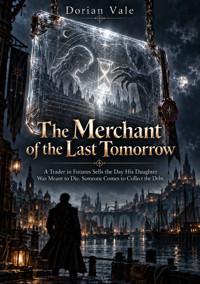
The Merchant of the Last Tomorrow - A Trader in Futures Sells the Day His Daughter Was Meant to Die. Someone Comes to Collect the Debt. ebook
Dorian Vale
Uzyskaj dostęp do tej i ponad 240000 książek od 14,99 zł miesięcznie
- Wydawca: ALL-IN Rafał Płonkowski
- Kategoria: Fantastyka•Fantasy
- Język: angielski
Nine years ago, Taren Voss made the kind of bargain no father should ever have to consider.
His ten-year-old daughter, Lina, was dying. The healers had failed. A priest had already heard the final narrowing of her future. Then a trader named Orven Sahr offered Taren one impossible alternative: sell the day on which Lina was supposed to die.
Taren agreed.
Lina survived.
For nine years, he convinced himself that whatever price he had paid was worth it.
Then a woman in a gray coat appears at his door carrying a plate of silver glass. On one side is the date of Lina’s death. On the other is a single word:
DEBT.
In Avenor, the future can be bought, sold, pledged, insured, inherited, and used as collateral. Behind ordinary trade exists a hidden economy of tomorrow - contracts written in blood, memories offered as security, rights transferred before their owners even understand what they have lost.
Taren knows that world better than most. He has spent his life valuing risk and finding weaknesses in agreements. But the contract he signed for Lina is unlike anything he has ever seen.
As its forgotten clauses begin to activate, the debt expands far beyond one family. Old registries open. Lost investigators return. People begin paying for obligations they barely remember signing. And beneath Avenor lies a system built from thousands of purchased futures, designed to protect the city at a cost no one was ever meant to see.
To save Lina, Taren must discover what he truly sold nine years ago, who actually owns the claim, and whether a contract can demand more than its original parties ever agreed to give.
But Lina is no longer the dying child whose future her father could decide for her.
She is nineteen now.
And this time, she intends to have a say in what happens to her tomorrow.
The Merchant of the Last Tomorrow is an adult fantasy novel about magical contracts, debt, responsibility, parental fear, institutional power, and the dangerous belief that everything valuable must therefore have a price. Set in a city where probability can become property, it combines mystery, family conflict, political tension, and a rule-bound system of future trading in which every loophole has consequences.
If a day can be sold, who owns everything that comes after it?
And what happens when someone finally comes to collect?
This publication was prepared using tools that support the creative process, including artificial intelligence solutions. The final concept, structure and editing are the responsibility of the author.
Ebooka przeczytasz w aplikacjach Legimi na:
Liczba stron: 253
Rok wydania: 2026
Odsłuch ebooka (TTS) dostepny w abonamencie „ebooki+audiobooki bez limitu” w aplikacjach Legimi na:
Podobne


















Dorian Vale
The Merchant of the Last Tomorrow
A Trader in Futures Sells the Day His Daughter Was Meant to Die. Someone Comes to Collect the Debt.
ALL-IN Rafał Płonkowski
2026
ISBN 9788384833674
Table of contents
Title page
INTRO
Chapter 1 - The Price of an Ordinary Day
Chapter 2 - The Woman Without a Yesterday
Chapter 3 - The First Change
Chapter 4 - The Bond
Chapter 5 - The City as Collateral
Chapter 6 - The Fund of the Last Tomorrow
Chapter 7 - The City's Debt
Chapter 8 - What Cannot Be Valued
Chapter 9 - The Anchor Beneath the Floor
Chapter 10 - The Last Tomorrow
Chapter 11 - The Right to Object
Chapter 12 - The Day That Never Was
Chapter 13 - The Price of Objection
Chapter 14 - Party to the Contract
Chapter 15 - Four Rights
Chapter 16 - What Remains After the Fire
Chapter 17 - The Faceless Opponent
Chapter 18 - The Place of the First Sale
Chapter 19 - Source Settlement
Chapter 20 - Tomorrow Without an Owner
Landmarks
Cover
Title page
Table of contents
Start of content
INTRO
Taren Voss knew his daughter would die tomorrow because three people had valued her death at exactly eighty-seven crowns.
The first was a healer from the southern district, who examined the bluish marks beneath her fingernails, listened to her uneven breathing, and said the fever had already gone too deep.
The second was a priest from the Temple of the Last Hour. He did not try to heal her. He merely placed two fingers against ten-year-old Lina’s forehead and, for a moment, listened for something Taren could not hear.
- She’ll still be with you until dawn - the priest said. - After that, she won’t.
The third man was a merchant.
And he was the only one who offered a price.
His name was Orven Sahr, and he ran a futures exchange in the cellar of an unnumbered house, down an alley that did not appear on city maps. Taren had known the place for years. He himself had led clients through its doors - people richer than he was, poorer than he was, and far more desperate.
He had never imagined that one day he would sit on the other side of the table.
Orven placed a thin plate of silvery glass in front of him. Its surface remained dull until the merchant touched it with his thumb.
Then a date appeared.
Tomorrow.
No month. No year. No hour.
In the trade of futures, details sometimes cost more than the future itself.
- Is that her day? - Taren asked.
Orven did not answer immediately. He had a habit of letting silence work for him. Clients usually began talking too much, and anyone who spoke too much at a bargaining table always lost.
Taren knew that rule.
That evening, it did not matter.
- I’m asking whether that is the day she dies.
- Yes.
A log cracked in the fireplace behind Orven.
Taren stared at the plate.
- If I sell it?
- It will no longer belong to her.
- That isn’t an answer.
- It’s the only answer I can give you.
Taren clenched his hands beneath the table. That very morning he had been capable of bargaining over a shipment of pepper for three hours, until the caravan owner cursed the day he had learned to speak. Taren could recognize false gold by the weight of a coin balanced on his fingernail. He had seen contracts sealed with blood, memories, names, and years of life.
But the future was a different kind of commodity.
You could not inspect it.
You could only see the price.
- Who’s buying?
Orven looked up.
- You shouldn’t ask that.
- I did.
- And I’m answering you as a man who still wants to do business with you. Don’t ask.
Taren leaned back in his chair. A single lamp hung from the ceiling. The flame beneath its glass flickered unevenly even though there was no draft in the cellar.
- Eighty-seven crowns - he said. - For one day of my daughter’s life?
- No.
Orven pushed the plate closer.
- For her tomorrow.
The distinction should have interested him. In any other contract, that was exactly the kind of word that would have made him stop.
Her tomorrow.
Not her life.
Not her death.
Not her rescue.
But several streets away, upstairs in their home, Lina was breathing so quietly that every few minutes Taren leaned over her bed just to make sure her chest was still rising.
- What happens in the morning?
- If the transaction is accepted, nothing that was meant to happen to her tomorrow will belong to her anymore.
- Will she live?
Orven said nothing.
Taren struck the table with his open palm.
- Will she live?
- Probably.
That word cost more than eighty-seven crowns.
Taren felt something cold tighten around his stomach.
- Probably?
- We trade in futures, Taren. Not gods. We do not create days. We do not cure disease. We do not reverse death. We transfer the right to what has not happened yet.
- So the buyer gets her death?
This time Orven looked directly into his eyes.
- The buyer gets her tomorrow.
Taren should have stood up.
He should have gone home and spent the final hours beside his daughter’s bed. He should have held her hand when dawn came and made sure the last thing she saw was not a ceiling stained by smoke from the street braziers.
Instead, he asked:
- Where do I sign?
For a moment, Orven looked older than he really was.
He pulled a dark leather-bound ledger from beneath the table.
- You don’t sign.
- Every contract requires a signature.
- Not this one.
The merchant opened the ledger to a blank page. He laid the silvery plate on top of it, then placed a small brass knife beside it.
- It requires one drop of blood from the person who has the right to sell the child’s future.
Taren looked at the blade.
- I’m her father.
- That’s why you’re sitting here.
He cut his thumb.
The blood fell onto the plate and did not spread across its surface. It sank into the glass as though falling into very deep water.
The date vanished.
For a moment, Taren saw only his own reflection.
Then three words appeared.
SALE ACCEPTED.
Orven slammed the ledger shut.
The lamp above the table went out.
Taren heard his own breathing and the distant clatter of wheels on the street overhead.
- Is that all? - he asked.
- No.
Orven moved away from the table.
For the first time since Taren had known him, there was fear in his voice.
- You need to remember one thing.
- What?
The merchant looked at the dark plate.
- A future doesn’t disappear just because someone sells it.
Taren waited.
- It changes owners - Orven finished.
By morning, Lina’s fever had broken.
She opened her eyes shortly after sunrise and asked for water. Before noon, she ate half a piece of bread. By evening, she was able to sit up in bed on her own.
Three days later, the healer called her recovery a miracle.
Taren did not correct him.
He told no one about the exchange, the silvery plate, or the day that had ceased to belong to his daughter.
For the next nine years, he convinced himself the price had been paid.
Until one winter evening, someone knocked on his door three times.
When Taren opened it, a woman in a gray coat stood on the threshold. She carried neither weapon nor luggage. In one hand, she held only a piece of silvery glass.
A date from nine years earlier was written across its surface.
The day Lina Voss was supposed to die.
- Taren Voss? - she asked.
He did not answer.
The woman turned the plate over.
On the other side was a single word.
DEBT.
- I’ve come for the tomorrow you sold - she said.
Chapter 1 - The Price of an Ordinary Day
For nine years, Taren Voss had built his life around the belief that the worst thing he had ever done was also the best.
The belief rested on solid foundations.
Lina was alive.
That morning she sat at the table in his office, nineteen years old, with an ink stain along the side of her hand and the expression of someone who had just discovered a mistake worth more than most people in the lower city earned in a month. She pushed the ledger toward her father, tapped one of the columns with her finger, and said:
- If you pay Jerm what he wrote here, he’ll fleece you for seventeen crowns.
Taren did not even look up from the shipping letter.
- Eleven.
- Seventeen.
- Eleven, if you know how to read his handwriting.
- I know how to read numbers. Usually that’s enough.
- Jerm writes his sevens like ones.
Lina bent over the ledger, narrowed her eyes, then sighed.
- I hate people who invent their own rules for numbers.
- That’s why trade is more interesting than priesthood.
- Priests invent their own rules for numbers too. They call them offerings.
Taren smiled before he could stop himself.
Their mornings had looked like this for the past two years, ever since Lina had begun helping him regularly at the office. It was not an exchange like the one Taren had once carried his own desperation into. No tomorrows, deaths, or events yet to come were sold behind the front window. The painted sign on the glass was ordinary enough:
VOSS - NOTES, INSURANCE, GOODS IN TRANSIT.
At least officially.
Unofficially, Taren could put a price on more difficult things.
The risk of losing a ship.
The probability that a northern caravan would arrive before the mountain pass closed.
The chance that a young prince really would marry the governor’s daughter before the grain market had time to raise its prices.
He needed no magic for any of it. Rumors, patience, contacts, and the understanding that people betrayed the future more honestly with their money than with their words were enough.
Real trading in futures was something else entirely.
He did not discuss it even with Lina.
Especially not with Lina.
- Did someone come by last night? - she asked suddenly.
Taren’s hand froze above the document.
- Why do you ask?
- The lock by the door is scratched.
He looked toward the entrance.
The mark was small, barely more than a pale line beside the brass plate. He had noticed it himself at dawn. The woman in the gray coat had not entered the house the previous evening. After speaking about the debt, she had handed him the plate and walked away without haste, as though she had set a payment date rather than delivered a message from the past.
Taren had not slept for a single minute afterward.
- A deliveryman - he lied.
Lina looked at him.
From her mother she had inherited the ability to remain silent in a way that made a person begin correcting his own lie before he had even finished telling it.
- Deliverymen usually use the knocker - she said.
- This one had poor manners.
- And came after dark?
- Lina.
- Fine.
She returned to the ledger.
Taren disliked how easily she had given up.
He opened the drawer beneath the counter and felt the cold of the silvery glass beneath his fingertips.
The plate looked exactly as it had nine years ago.
It was not scratched.
It had not gone cloudy.
Its weight had not changed.
On one side was the date of the day he had sold. On the other, the word DEBT.
Before dawn, he had tried everything. He had warmed the glass over a flame, submerged it in brine, dusted it with powdered chalk of the kind notaries used to detect altered seals. Nothing happened. The word did not react.
The worst part was that he recognized the workmanship.
Not the specific maker.
The technique.
Future plates were not made from ordinary glass. Their cores were fashioned from sand dug up in places where, according to old stories, reality ran thin, as though the world remembered several versions of itself at once. For years, Taren had considered such stories little more than tales repeated to clients in order to justify extravagant prices.
Then he had seen the date of his own child’s death.
After that, he had stopped laughing at stories.
- I’m going to the Guild - he said.
Lina looked up.
- We were supposed to inspect the warehouse at Third Quay together.
- Reschedule it.
- Yesterday you said if we didn’t inspect it today, Halven would push through a damaged shipment as full-quality goods.
- Then go alone.
For a moment, something between surprise and satisfaction crossed her face.
Taren regretted the words almost immediately.
For months, Lina had been demanding assignments of her own. She no longer wanted to copy accounts or sit beside him during negotiations. She wanted to negotiate.
- Alone? - she made sure.
- You have eyes. You have the books. You know what to look for.
- And if Halven tries to cheat me?
- He will.
- That’s not very helpful.
- If you spot the lie immediately, don’t tell him. Let him talk. People caught too quickly start defending themselves. People who think they’re winning show you every weak point they have.
Lina closed the ledger partway.
- So I should let him lie.
- You should let him invest in the lie.
A smile appeared on her face.
- Now you sound like my father.
- Was that meant to be insulting?
- A little.
Taren took five crowns from the cash box for expenses and handed her the warehouse key.
Lina’s fingers closed around the metal.
Suddenly he saw a different hand.
Small. Burning with fever. Lying limp on the bedding nine years earlier.
He pulled his own hand back at once.
- Everything all right? - she asked.
- Yes.
- You look like you want the key back.
He did.
He wanted to lock her inside the house, barricade the doors, and keep every possible tomorrow outside.
Instead he said:
- If Halven offers you wine, don’t drink it.
- Because he’ll poison me?
- Because his wine is worse than poison.
Lina laughed and slipped the key away.
Only after she had left did Taren realize he had watched her until the very last moment, as if simply taking his eyes off her might trigger some mechanism in the old contract.
The Merchants’ Guild stood in the upper part of the city, where houses no longer fought over every foot of space and the streets were wide enough for two carriages to pass without bargaining for right of way. Taren walked. He needed movement more than comfort.
Avenor woke around him.
At Copper Market, vendors stretched heavy awnings over their stalls. Carts from the port carried barrels of fish and oil. At one intersection, a city collector marked boxes with chalk to show that their owners had paid the proper fee. Everything had a price, a deadline, an owner, and a consequence.
Taren had always liked that predictability.
Today it seemed naive.
The Guild occupied the old customs palace. In the main hall, thin brass lines ran through the marble floor, forming a map of the major trade routes. A vast board on the wall displayed the prices of grain, metals, and transport insurance, adjusted twice a day.
Taren did not stop to look.
He went down to the lowest level.
There was no marble there.
The Archive of Extraordinary Contracts smelled of dust, oil, and sour ink. Most merchants never came down this far. Officially, the archive held agreements concerning inheritance of shares, redemption of obligations after death, and disputes over ownership of goods that could not easily be weighed.
Unofficially, the Guild had been cataloguing transactions involving time for generations.
Iven Marr sat behind the desk, a short man whose hair was so white it looked dusted with flour.
- Voss - he said before Taren could speak. - If you’ve come to ask for Sahr’s ledger again, the answer hasn’t changed.
Taren stopped.
- I came once.
- Six years ago.
- You remember every visitor?
- I remember people who ask about things sensible men know not to ask about.
Taren sat across from him.
- Is Orven Sahr alive?
Marr tilted his head.
- Interesting.
- What?
- Six years ago, you asked about his records. Today you ask whether he’s alive.
- Are you going to answer?
- I don’t know.
- The Guild always knows when one of its members dies.
- Sahr stopped being a member before he disappeared.
That was new.
- Disappeared?
Marr set down his pen.
- Five years ago. His exchange was closed. His documents were confiscated, and then half of them vanished before they could be inventoried. There was an investigation. It led nowhere.
- Who investigated?
- Why does that matter to you?
Taren took out the plate.
He did not put it on the desk. He merely showed Marr one edge beneath his coat.
The effect was immediate.
For a second, Marr stopped breathing.
- Put that away.
- You know what it is?
- Put it away.
Taren concealed the plate again.
The archivist looked around the room. Two scribes worked among the distant shelves, but neither was paying any attention to them.
- Where did you get it?
- Someone brought it to me yesterday.
- Who?
- A woman.
- Name?
- She didn’t give one.
Marr lowered his voice.
- Did she say anything?
- She said she had come to collect a debt.
The archivist closed his eyes.
- What did you sell?
Taren said nothing.
Marr looked at him irritably.
- If you’ve shown me a buyer’s notice, then you’re either a fool or desperate. Either way, spare me the theater.
- A tomorrow.
- Whose?
- My daughter’s.
Something clattered in the room. One of the scribes had knocked over a metal container of seals.
Marr went pale.
- When?
- Nine years ago.
- How old was she?
- Ten.
- You sold a minor’s future.
- She was dying.
- I’m not asking why. I’m asking whether you understood what you sold.
- Sahr told me that if I gave away the day of her death, that day would no longer belong to her.
- That’s true.
- She survived.
- Apparently.
Taren leaned forward.
- Yesterday someone brought that day back to me.
- No. - Marr shook his head. - They did not bring the day back.
- The date is on the plate.
- The date identifies the subject of the contract. The word on the reverse identifies the claim.
- What’s the difference?
Marr stood.
- Come with me.
He led Taren between the shelves to a heavy door set into the rear wall. He unlocked three separate locks, lit a lamp, and ushered him into a small room filled with metal cabinets.
From one of them, he took a book.
It was not bound in leather. It had thin copper covers and dark pages.
- Trading in futures is not about removing events - Marr said. - Every licensed factor of time knows that.
- Orven said almost the same thing.
- Then he was honest at least once. Think of the future as a right to a consequence. If you sell a day, you sell every possibility attached to that particular stretch of a life. A buyer can keep it, exchange it, sometimes use it as collateral for another agreement.
- How can anyone use someone else’s day?
- Usually they can’t. That’s why the market doesn’t trade in random Tuesdays.
- But someone bought her death.
- They bought the day on which she was supposed to die. That isn’t the same thing.
Taren felt the first true wave of fear since the woman’s visit.
- Then what do they want?
Marr opened the book. The pages were filled with tiny writing.
- If the original future can no longer be executed upon the person to whom it belonged, the buyer may claim equivalent value.
- Eighty-seven crowns?
The archivist looked at him sadly.
- Not the price.
He turned a page.
- The value.
- What is one day worth?
- It depends on what that day contains.
Taren stared at him.
Marr touched a paragraph with one finger.
- If the day contained death, then its value was death.
For a moment, Taren heard only the faint crackle of the lamp.
- Whose?
- The contract decides that.
- I never saw the contract.
- Of course you didn’t. You were the seller of the asset. Not the purchasing party.
- I’m her father.
- You were her legal disposer. That was enough to sell. It did not entitle you to know the buyer.
Taren clenched his jaw.
- I want to see Sahr’s register.
- I told you it vanished.
- You said half the documents vanished.
- And the other half were sealed by order of the Guild Council.
- Open them.
Marr almost laughed.
- No.
Taren placed five gold crowns on the desk.
The archivist glanced at them.
- Are you insulting me with the amount or with the offer itself?
Taren added another five.
Marr pushed the coins back.
- Listen to me. If you received a notice, the buyer knows where you are. If you start officially searching for documents, they’ll also learn what you don’t know.
- They already know I know almost nothing.
- Don’t assume that.
Taren stood.
- So I should go home and wait?
- You should establish the execution deadline.
- The woman didn’t give me one.
Marr looked at him sharply.
- That’s impossible.
- Why?
- A notice without a deadline has no legal force.
Taren took out the plate again.
He placed it on the copper-bound book.
The word DEBT still stood in the center.
Marr moved the lamp closer.
- Turn it over.
- The date is on the other side.
- That’s not what I mean. Lay it flat.
Taren obeyed.
The archivist rubbed the surface with a piece of black felt.
A thin line appeared beneath the word.
Then letters.
BY SUNSET OF THE THIRD SUN.
Taren counted without thinking.
The woman had come yesterday.
- Two days left - he said.
- Less. The first term began the moment the notice was delivered.
Taren put the plate away.
Marr closed the book.
- Leave the city with your daughter.
Taren looked at him.
- You just said the buyer knows where I am.
- They do.
- Then what changes if we leave?
- Perhaps nothing.
- That isn’t advice.
- It’s all I can say.
- No.
Taren walked toward the door, then turned instead of leaving.
- Who investigated after Sahr disappeared?
Marr did not answer.
- Iven.
- A Guild inspector. Her name was Mara Edevane.
- Where can I find her?
- You can’t.
- Is she dead?
- Alive. Worse.
Taren frowned.
- What does that mean?
Marr extinguished the lamp.
- Three years ago, she sold her own surname.
Chapter 2 - The Woman Without a Yesterday
Taren returned to the office an hour later and knew immediately that something had happened.
Lina was already there.
She stood behind the counter, but she was not going through the books. The warehouse key lay in front of her beside a small wooden box. Her arms were folded across her chest.
- Halven tried to cheat me - she said.
Taren closed the door.
- By how much?
- Twenty-three crowns.
- More expensive than I expected.
- You were right. I let him lie.
- And?
- He lied for a very long time.
- He tends to.
- Then I showed him the cracks in six crates and the mold beneath the canvas on two more.
- What did he say?
- That it was salt.
- In the wood?
- I wondered about that too.
Taren took off his coat, trying not to look at her for too long.
He had already made a decision on the walk back from the Guild.
He would not leave the city.
Not because Marr had been right. Running away was simply a transaction made without knowing the price. Taren had no idea whether the claim deadline operated independently of location, or whether leaving Avenor might itself be treated as an attempt to breach the agreement.
First, he had to learn exactly what had been sold.
Then he would find a way to buy it back.
Every commodity had a price.
It had to.
- I negotiated thirty-one crowns off - Lina said.
Taren blinked.
- Thirty-one?
- And he’ll pay the transport costs for the defective lot to be returned.
- How?
- I told him that if he refused, I’d take a sample to the port inspector.
Taren nodded.
- Good.
Lina stared at him.
- Just good?
- Very good.
- And now you’re going to tell me what’s going on?
- Nothing.
- You’re a bad liar.
- I make my living from liars.
- Which is exactly why you should be better at it.
Taren went to the shelf and began rearranging documents that did not need rearranging.
- I have one more matter to deal with today.
- Without me again.
- It’s private.
- Your private matters have been affecting the business since this morning.
- Lina.
- I’m not a child.
The words struck exactly where they should not have.
Taren turned.
Nine years earlier, he had possessed the right to sell her future precisely because she had been a child.
- I know - he said more quietly.
Lina frowned. She had clearly expected an argument.
- Then stop treating me as if I were ten.
Taren felt his heart beat harder.
Did she know something?
Impossible.
He had never told her.
After the illness, Lina remembered very little. Several days of fever had blurred into dark images in her memory: wet cloths, the healer, her father’s voice. She did not remember the priest. She did not remember Orven. She could not remember the contract because Taren had made it without her.
- You’re right - he said.
Lina raised her eyebrows.
- Suspicious.
- What?
- You agreed with me after the first sentence.
- Don’t get used to it.
He braced both hands against the counter.
- Close early today. Don’t accept any new contracts this afternoon.
- Why?
- Because I’m asking you to.
- That isn’t an answer.
- Today it has to be enough.
She watched him for another moment, then nodded.
Taren hated that agreement more than an argument.
Mara Edevane lived in the Ash District.
Getting the address cost Taren more than bribing Marr would have and considerably less than asking the wrong person might have cost him. He found a former Guild clerk who now ran a paper warehouse on Saddlers’ Street. The man did not remember Mara Edevane. He did, however, remember the inspector who had lost her surname three years earlier.
That was how selling things people should never sell worked.
The world did not forget that someone had existed.
It merely forgot how to name them.
The Ash District lay at Avenor’s western edge, beyond the old ceramic kilns. Wind almost always carried dust from the manufactories there, leaving a thin gray layer over roofs and windowsills. The house Taren was looking for was narrow, three stories tall, and had a red door with no knocker.
He knocked.
Nothing.
He knocked again.
- If you’re selling religion, I already have three - a woman’s voice called from behind the door.
- I’m looking for Mara Edevane.
Silence.
A lock clicked.
The door opened the width of a hand.
The woman on the other side looked about fifty. She had short gray hair and a scar running from her left ear to the base of her neck. She looked at Taren, then at the street behind him.
- I don’t know anyone by that name.
- I’m told you used to carry it.
The door started to close.
Taren put his boot between the threshold and the door.
- Orven Sahr.
The door stopped.
- Move your foot.
- Hear me out first.
- Move your foot or I’ll break it. I don’t need to remember my surname to remember anatomy.
Taren withdrew his foot.
The door remained partly open.
- Sahr disappeared five years ago - he said. - You investigated.
- Who told you?
- Someone who still remembers you well enough.
Something that might have been pain crossed the woman’s face.
- That’s rare.
- I need information about a contract.
- I don’t handle contracts anymore.
- All the more reason I can pay you.
She laughed once.
- Spoken like a Guild man.
- I’m not with the Guild.
- Worse. A merchant.
Her gaze moved over his sleeves, boots, belt buckle.
- Third-circle license. Private business. Port and credit. Not wealthy, but wealthy enough to think poverty can’t reach you.
Taren looked down at his clothes.
- How did you...
- People always ask about magic when someone observes them carefully. Come in.
She let him inside.
The room was almost empty. A table, two chairs, a stove, a shelf holding a dozen or so books. No portraits, no ownership marks, no letters addressed to the woman of the house. Even the bill pinned beside the door displayed only the house number.
The woman gestured toward a chair.
- What should I call you? - Taren asked.
- Most people call me Mara.
- So you kept your first name.
- First names are weaker commodities than surnames. They bind a person to themselves. A surname binds them to other people. That makes it more valuable.
Taren sat.
- You sold yours?
- No.
- I was told...
- I lost it.
Mara poured water into two clay cups.
- There’s a difference between a sale and an enforcement.
Taren felt cold.
- A debt?
Her hand stopped over the cup.
- Finally, an interesting question.
He took out the silvery plate and put it on the table.
Mara did not touch it.
For several seconds she stared at the date.
Then at him.
- Whose?
- My daughter’s.
- What did the day contain?
- She was supposed to die.