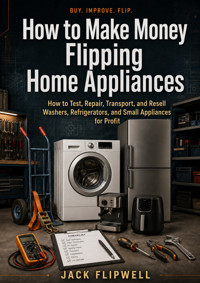
How to Make Money Flipping Home Appliances - How to Test, Repair, Transport, and Resell Washers, Refrigerators, and Small Appliances for Profit ebook
JACK FLIPWELL
Uzyskaj dostęp do tej i ponad 240000 książek od 14,99 zł miesięcznie
- Wydawca: ALL-IN Rafał Płonkowski
- Kategoria: Biznes, rozwój, prawo•Biznes, rozwój
- Język: angielski
Used home appliances can be one of the most practical categories for resale. Washers, refrigerators, dryers, dishwashers, vacuums, coffee machines, and small household appliances regularly enter the secondhand market not because they have become useless, but because owners move, renovate, upgrade, replace equipment, or simply want large inconvenient items removed quickly.
Where someone else sees a transportation problem, a dirty machine, a weak listing, or incomplete information, a prepared flipper may see an opportunity.
How to Make Money Flipping Home Appliances is a practical guide to the complete process, from finding a listing to closing the sale and calculating the real result afterward.
This book does not promise easy money. It does not assume every broken washer is a profitable repair project. Instead, it shows how to reduce uncertainty, reject weak deals, and buy only when the condition, costs, logistics, and resale market support the transaction.
You will learn how to choose appliance categories that fit your budget, vehicle, storage space, testing setup, and technical ability. You will learn how to analyze listings, contact sellers, identify exact models, check missing accessories, and calculate a maximum purchase price before leaving home.
A major section of the book focuses on testing. Washers, refrigerators, dishwashers, dryers, washer-dryers, vacuums, coffee machines, and other small appliances are treated separately because their risks are different. You will learn which functions to verify, which warning signs deserve caution, and why a machine that powers on is not automatically a working appliance.
The book also draws a clear line between low-risk tasks that a prepared reseller may reasonably handle and work that should be left to appropriately qualified specialists. Special attention is given to mains electricity, microwave high-voltage systems, gas appliances, sealed refrigeration circuits, and heat pump dryers.
The goal is not to turn you into a professional appliance technician.
The goal is to teach you how to make better business decisions.
You will also learn how to clean and prepare appliances without damaging finishes, seals, electronics, or food-contact surfaces. Separate guidance covers washers, refrigerators, dishwashers, coffee machines, vacuums, dryers, and other categories where hygiene can directly affect resale value.
Large appliances require logistics as much as technical knowledge. This book explains how to plan collection, measure appliances and doorways, organize lifting help, secure loads, manage transport hardware, store inventory safely, and calculate delivery before the purchase rather than after it.
You will also learn how to control repair budgets, source parts, evaluate original and aftermarket components, price used appliances, create listings based on evidence, negotiate without giving away the margin, and document the appliance before delivery.
The final chapters show how to turn isolated flips into a repeatable operating system. You will learn how to track profit, time, inventory age, post-sale problems, capital tied up in stock, sourcing performance, and category profitability.
You do not need a huge warehouse.
You do not need to repair everything yourself.
You need disciplined buying, controlled risk, safe procedures, and a clear understanding of where value is created.
Buy when the numbers make sense.
Improve only what genuinely adds value.
Sell evidence, not promises.
BUY. IMPROVE. FLIP.
Find the Deal. Add the Value. Keep the Margin.
A practical guide to making money in the secondhand home-appliance market. Learn how to source, test, repair, clean, transport, price, and resell washers, refrigerators, dishwashers, dryers, vacuums, coffee machines, and other appliances while controlling risk and protecting your margin.
A cheap washer is not always a bargain.
A broken refrigerator is not always a good project.
And the difference between buying price and selling price is not profit.
This book shows you how to approach home-appliance flipping as a controlled business process.
You will learn how to:
• identify appliances with real resale demand,
• test washers, refrigerators, dishwashers, and dryers,
• evaluate vacuums, coffee machines, and small appliances,
• recognize high-risk faults,
• calculate your maximum purchase price,
• control parts and repair costs,
• clean and prepare appliances properly,
• organize safe transport,
• price and photograph used equipment,
• negotiate without giving away your margin,
• build a repeatable sourcing and resale system.
You do not need to repair everything.
You need to know what is worth buying.
BUY. IMPROVE. FLIP.
This publication was prepared with the assistance of tools that support the creative process, including artificial intelligence-based solutions. The final concept, structure, and editing belong to the author.
Ebooka przeczytasz w aplikacjach Legimi na:
Liczba stron: 239
Rok wydania: 2026
Odsłuch ebooka (TTS) dostepny w abonamencie „ebooki+audiobooki bez limitu” w aplikacjach Legimi na:
Podobne














INTRO
Home appliances are one of those resale categories where market value often falls much faster than usefulness. A washer may be listed cheaply because the owner has already bought a new one and simply needs the old machine gone. A refrigerator may be sold below market before a move because transportation is more inconvenient than the money. A vacuum, coffee machine, food processor, or microwave may be described as "broken" even though the actual problem is dirt, a clogged filter, a worn accessory, incorrect setup, or another relatively simple issue.
That gap creates an opportunity for someone who can buy more intelligently than the average secondhand buyer. Flipping appliances, however, is not about buying every cheap machine, making a random repair, and listing it at a higher price. One poor decision can destroy the margin quickly. A washer may need an expensive part that was not obvious during inspection. It may complete a short test but reveal a mechanical problem during a full spin cycle. A refrigerator may become cool without maintaining a stable temperature. A coffee machine may power on normally while hiding severe neglect inside the water or milk system.
Then there is transportation. Large appliances are heavy, awkward, easy to damage, and expensive to move badly. They require storage space, safe testing conditions, and a realistic plan for delivery. Even small appliances can become unprofitable when a missing charger, cracked jug, worn battery, unavailable filter, or broken attachment is discovered after purchase.
For that reason, this book does not treat home appliances as one giant category. A washer should not be evaluated like a refrigerator. A dishwasher has different risks from a dryer. A cordless vacuum has different economics from a coffee machine. Each group has its own failure points, testing procedures, common wear patterns, transport requirements, and repair boundaries.
What remains consistent is the business process. Find the appliance. Identify exactly what it is. Determine its real condition. Calculate the full cost. Add value only where it makes economic sense. Then sell it with accurate information and controlled risk.
Why home appliances can work well for flipping
One major advantage of home appliances is that buyers do not always care about owning the newest model. In many situations they mainly need something that works, fits the available space, and costs less than a new replacement.
A student furnishing an apartment may need an affordable washer. A landlord preparing a rental property may want reliable basic appliances rather than premium new equipment. Someone whose refrigerator suddenly fails may care more about immediate availability than the latest technology. A buyer moving into an unfurnished home may need several appliances at once.
This creates a practical secondhand market. Large appliances also create a natural barrier to competition. Not everyone has a vehicle that can transport a washer or refrigerator. Not everyone has a dolly, straps, blankets, storage space, or another person available to help move heavy equipment. Many sellers are willing to accept a lower price in exchange for a fast, uncomplicated collection.
Logistics can therefore become part of your advantage. That does not mean larger appliances always produce better margins. Five small devices that can be tested, cleaned, photographed, stored on shelves, and shipped may be a better use of time and space than one large refrigerator that occupies valuable storage for several weeks. You should not judge an appliance only by its resale price. You should judge the entire operation.
Your margin begins at the purchase
A common beginner mistake looks harmless. You find a washer listed for $200. Similar machines are advertised for $450. It appears that you can make $250. But an asking price is not necessarily a selling price, and the difference between purchase price and resale price is not profit.
You may also pay for: fuel,; vehicle rental,; parking,; a helper,; parts,; cleaning materials,; hoses,; packaging,; platform fees,; delivery,; storage,; disposal of an unsuccessful project. Your time matters as well.
If an appliance requires several hours of cleaning, diagnosis, driving, messaging, and delivery for a small return, it may be a worse project than a lower priced item that needs twenty minutes of preparation.
It simply prevents you from mistaking optimism for a business model. The realistic selling price should come from the current market. Compare the exact model whenever possible. If that is not possible, compare products with similar capacity, technology, age, condition, accessories, and local delivery conditions. Where a marketplace allows you to see completed transactions, those can be more useful than active listings.
The best opportunities often look ordinary
Not every profitable flip looks dramatic. Sometimes the best purchase is an ordinary washer being sold quickly after a kitchen renovation. Sometimes it is a refrigerator that looks terrible in photos but works properly and only needs cleaning. A small appliance may be cheap because the owner no longer has the original box, manual, or patience to clean it.
The flipper earns money by reducing uncertainty. The seller may not know the exact model. You can identify it. The seller may not know how to test all the functions.
You can test them. The seller may take three dark photographs in a cluttered room. You can clean the machine, document its condition, photograph it properly, and provide the information a buyer actually needs.
Adding value does not always mean repairing something. Sometimes the value is cleanliness. Sometimes it is completeness. Sometimes it is a verified test. Sometimes it is delivery. Sometimes it is a replacement filter or missing shelf. Sometimes the value is simply an honest description that tells the buyer exactly what has and has not been tested.
Test before you repair
One of the most important principles in this book is simple: Diagnose first. Replace parts second. Buying used appliances without testing means buying incomplete information. There may be situations where you deliberately accept that risk because the price is low enough, but that should be a calculated decision.
The more expensive and complicated the machine, the more important the testing process becomes. A washer should not be judged by whether the control panel lights up. Useful testing may include water intake, drum movement, draining, spinning, leaks, unusual noise, door locking, heating, and program behavior.
A refrigerator should not be judged by whether the interior light works or whether the compressor starts. The real question is whether it reaches and maintains appropriate operating temperatures. A vacuum should not be judged only by whether its motor makes noise. You also need to consider suction, airflow, filters, hose condition, power cable, battery, brush head, and accessories.
Every test should have a purpose. You are not trying to prove that the appliance "basically works." You are trying to answer three questions: Is the appliance safe to continue testing?; Can its condition be described with reasonable confidence?; If there is a problem, does correcting it make economic sense? If the first answer is uncertain, stop. Do not continue experimenting with an appliance when you cannot assess the safety of the next step.
Repair only what you should repair
Home appliances can create false confidence. A video may show someone replacing a component in five minutes. That does not mean the task is suitable for everyone. Appliances can involve mains electricity, capacitors, heating elements, moving parts, sharp sheet metal, pressurized systems, high voltage sections, gas systems, refrigerants, and other hazards.
Some work should only be performed by people with appropriate training and qualifications. Refrigerators and heat pump dryers deserve particular caution because sealed refrigeration systems may be subject to technical and legal requirements. Gas appliances require another level of specialist knowledge. Microwave ovens contain high voltage components that can remain dangerous even after the appliance has been disconnected from power.
Current requirements may vary by country and can change over time. Always verify applicable rules in official sources when necessary. For a flipper, the safest and often most profitable approach is to focus on low risk value creation.
That can include: cleaning user serviceable areas,; replacing filters,; replacing missing accessories,; installing manufacturer specified user replaceable parts,; improving presentation,; replacing simple mechanical items when you understand the work,; paying a qualified technician when the numbers justify it.
If you cannot confidently determine whether a repair is safe, do not experiment on a product you plan to sell to another person. The cost of professional service is simply another business expense. If professional repair destroys the margin, the real problem may be that the appliance was purchased at the wrong price.
A fault is not automatically an opportunity
Listings such as "washer not spinning," "refrigerator not cooling," or "coffee machine needs repair" can look attractive because the price is low. This is also where beginners can lose money quickly.
A seller's description is not a diagnosis. "Doesn't spin" can have several causes. "Doesn't cool" can have several causes. "Won't turn on" may be caused by a simple external issue or a failure that makes repair uneconomic.
Your job is not to assume the cheapest explanation. Your job is to price uncertainty. If the fault is unknown, use a conservative scenario. The purchase price should leave enough room for an unexpected repair or even a failed project. Sometimes the best decision is to walk away. The ability to say "I am not buying this" is one of the most profitable skills in flipping.
Large appliances are a logistics business too
A washer can weigh tens of kilograms. A refrigerator can be tall, wide, unstable, and difficult to grip. Finding a good deal means very little if you cannot collect the appliance safely.
Before buying large appliances, confirm more than the address. You may need to know: floor level,; elevator access,; stair width,; doorway width,; parking access,; distance to the vehicle,; number of people needed,; whether the appliance is disconnected,; whether water remains inside,; whether transport bolts or other securing parts are available.
A moving appliance can damage itself during transport if it is not prepared properly. A refrigerator requires additional attention because transport position and the time before restart may depend on the model and manufacturer instructions.
Do not use one universal rule for every refrigerator. Check the documentation. Transport blankets, straps, a proper dolly, a suitable vehicle, and another person are not luxuries when they are genuinely required. They are margin protection.
Cleanliness is part of the product
In used appliances, the difference between "used" and "well maintained" is highly visible. A moldy washer seal, dirty detergent drawer, greasy microwave, dusty refrigerator, clogged vacuum filter, or coffee stained espresso machine can destroy perceived value immediately.
That does not mean every appliance should be attacked with the strongest chemical you can find. Different materials require different methods. You need to distinguish between: painted metal,; stainless steel,; glass,; rubber,; electronics,; food contact surfaces,; plastic,; coated surfaces,; filters.
Cleaning products should be suitable for their intended use and compatible with the appliance. You also need to know when cleaning is not enough. If an appliance has severe mold, pest contamination, extensive water damage, persistent biological contamination, or a strong odor that cannot be properly removed, the project may not be appropriate for resale. The goal is not to hide the appliance's history. The goal is to return it to a clean, honest, verifiable condition.
Sell evidence, not promises
"Works perfectly" is a weak description. The buyer wants to know what you actually tested. If you ran a complete washer cycle, say so. If you checked draining and spinning, say so.
If a refrigerator was monitored long enough to confirm stable operation, describe the test accurately. If a specific part was replaced, state what was replaced. If you have documentation from a professional service, preserve it where appropriate.
Photographs should document condition, not merely advertise the machine. Show: the front,; sides,; interior,; control panel,; identification label,; accessories,; visible defects. A defect disclosed before purchase usually creates less conflict than the same defect discovered by the buyer after the transaction.
Do not promise what you cannot guarantee. A used appliance may work correctly during your test without giving you any basis to guarantee that it will never fail in the future. Describe what you know. Do not manufacture certainty.
Your legal obligations depend on how you sell
A person occasionally selling a privately owned appliance may be in a different legal position from someone regularly purchasing products for resale. If your flipping becomes organized and profit driven, you may need to consider rules relating to:
business registration,; taxation,; consumer rights,; sales documentation,; waste electrical equipment,; data protection,; product safety. The exact rules depend on where and how you operate. Do not rely on old forum posts, random comments, or copied disclaimers. Check current official sources and obtain professional advice where appropriate. This book focuses on business process, not on replacing legal, tax, electrical, refrigeration, or safety professionals.
Not every margin is a good margin
Imagine two appliances. The first can be purchased very cheaply, but it has an unknown fault, difficult transport, several possible parts, hours of work, and a narrow buyer pool. The second costs more but is already functional, only needs cleaning, and can be sold quickly.
A beginner may prefer the first because the theoretical spread between buying and selling prices appears larger. An experienced flipper is more likely to consider: probability of success,; time,; capital tied up,; storage,; repair uncertainty,; speed of resale.
Cash tied up in an unsold refrigerator cannot be used to buy the next appliance. That is why you should study both margin and turnover. A smaller repeatable result realized frequently may create a stronger business than an occasional large margin that takes weeks to complete.
Start with a category you can control
You do not need to buy a washer, refrigerator, dishwasher, coffee machine, and three vacuums on your first day. A better approach is to master one product type. If you have limited space and only a passenger car, start with small appliances.
If you have proper transport, a safe testing area, and enough room, washers may be practical. If you enjoy technical research and can manage hygiene carefully, coffee machines may become a specialization.
Specialization reduces the number of unknowns. After evaluating similar appliances repeatedly, you begin noticing missing parts more quickly. You know which photographs matter. You know what questions to ask. You recognize unusual sounds. You understand normal resale ranges. You stop evaluating every listing from zero. That speed becomes a competitive advantage.
Build a system instead of chasing random deals
The best flipping process is repeatable. If every purchase is completely different, you cannot improve the process efficiently. You need a sequence that can be applied again and again. A strong appliance flip typically moves through these stages:
Identify the product types with real demand; Find a potentially undervalued listing; Identify the exact model; Collect information before traveling; Inspect and test the appliance; Calculate or confirm the maximum purchase price; Collect and transport it safely; Perform justified cleaning and repairs; Test it again; Document condition; Price it for the current market; Create the listing; Sell and deliver or ship it; Record the true result. The more routine this process becomes, the less room there is for emotional decision making.
Keep records from the first appliance
You do not need complicated accounting software to begin learning from your own transactions. You do need data. For every appliance, record at least: model,; source,; purchase date,; purchase price,; transport,; parts,; materials,; service cost,; time spent,; listing price,; final selling price,; days to sell.
Do not remove failed projects from the records. Those are often the most valuable ones. After enough transactions, you may discover that one category sells quickly but produces small margins. Another may look profitable but require too much driving. A third may be excellent when purchased working but poor when purchased with faults. Without data, you tend to remember the impressive wins and forget the mediocre transactions that consumed most of your time.
Your advantage should be specific
Trying to compete only on price is difficult. Someone can almost always list another appliance more cheaply. A stronger advantage is process quality. You can become the seller who: tests thoroughly,; cleans properly,; photographs honestly,; lists exact model information,; offers reliable local delivery,; keeps accessories together,; discloses defects clearly,; responds professionally.
Two similar washers do not feel equally risky to a buyer. One listing may show only two blurry photographs and say "works." The other may show the model label, drum, door seal, hoses, control panel, cosmetic wear, and a clear description of the test performed. The second seller has reduced uncertainty. Reducing buyer uncertainty creates value.
This is not a repair technician's manual
This book is not intended to turn you into a professional appliance technician. It does not replace: technical documentation,; trade qualifications,; electrical training,; refrigeration certification,; gas certification,; professional diagnosis. The goal is to help you make better commercial decisions around used appliances.
You will learn to recognize situations where a simple issue may represent an opportunity. You will also learn to recognize the point where you should stop. A good flipper does not need to repair everything. A good flipper needs to know: what can be done safely,; what should be outsourced,; what the work will cost,; whether enough margin remains afterward.
What you will build through this book
The chapters ahead will move from product selection and sourcing through inspection, testing, cleaning, parts, logistics, pricing, selling, customer communication, and scaling. Washers, refrigerators, dishwashers, dryers, washer-dryers, vacuums, coffee machines, and other small appliances will be treated separately where their risk profiles differ.
You will learn how to calculate a maximum purchase price before you arrive at the seller's address. Instead of standing beside an appliance thinking, "This probably still works financially," you will know what your ceiling is.
You will learn why transportation needs to be part of the purchasing decision. You will learn when cleaning adds value and when it wastes time. You will learn how to distinguish cosmetic defects from technical uncertainty.
You will learn how to create listings based on evidence rather than exaggerated claims. You will also learn how to measure the result after the sale. Not the imagined result. The real one.
Your first goal is not maximum profit
If you are new to this category, your first objective should be to complete the process with controlled risk. Your first appliance does not need to produce an impressive margin.
It is more valuable to experience the entire cycle: finding the listing,; asking the right questions,; inspecting the appliance,; transporting it,; testing it,; cleaning it,; photographing it,; dealing with buyers,; delivering it,; recording the result.
You may discover that collection takes longer than expected. You may discover that cleaning is your bottleneck. You may learn that local delivery creates most of your competitive advantage. You may discover that a certain appliance type is too difficult to store. Every transaction should improve the system.
The principle that will appear throughout this book
You do not make money when you buy an appliance cheaply. You do not make money when you repair it. You do not make money when you publish the listing.
Profit appears only after the appliance is sold and every relevant cost has been counted. That is why every decision in this book will be judged using the same question:
Does this action increase the probability of completing the transaction with an acceptable result and controlled risk? Buying is the beginning of the process. Repair is a tool. Cleaning is an investment only when it adds enough value.
Transport is a cost that must be calculated before the purchase. The listing is part of the product. Buyer trust is part of the value. And margin is the reward for running the entire process better than someone who simply buys cheap appliances and hopes they sell. That is the system behind Book 20 of BUY. IMPROVE. FLIP. Find the Deal. Add the Value. Keep the Margin.
Chapter 1 - How to Choose Home Appliances That Are Actually Worth Buying
The biggest mistake a beginner flipper can make is focusing only on price. A cheap appliance is not automatically a bargain, and a more expensive one is not automatically a bad purchase. What matters is the relationship between purchase price, expected preparation cost, realistic resale value, turnover speed, and risk. If any of those factors is difficult to estimate, your safety margin should increase.
Home appliances are an uneven category. A freestanding washer may be easy to sell locally but awkward to move. A coffee machine may take little space and offer a strong margin, but its internal water system can be harder to assess. A vacuum may be simple to test, yet its resale value can drop sharply if the main brush, charger, pipe, battery, or filters are missing or worn. Your first job is not to find the cheapest appliance. Your first job is to decide which types of appliances you can safely buy, test, store, transport, and sell.
Start with your own limitations
Your category should match your real operating conditions. Someone living in a small apartment with a passenger car has a very different setup from someone with a garage, van, appliance dolly, storage racks, and help available for lifting.
Before buying anything, answer a few basic questions: How much storage space can I allocate?; Do I have a safe place to test appliances?; Can I connect a washer to water and drainage?; Can I leave a refrigerator running long enough to test it?; Can I transport the appliance without damaging it?; Do I need another person for lifting?; How far am I willing to travel for a purchase?; Do I want to sell locally, ship products, or use both methods?
These answers immediately narrow your market. If you do not have the infrastructure for large appliances, that does not mean you need to avoid the entire category. You can focus on vacuums, coffee machines, blenders, food processors, air fryers, microwaves, or other products that are easier to store and move.
Large appliances versus small appliances
Large appliances have obvious advantages. They solve important household needs, and there is often consistent local demand. Transportation also creates a barrier to competition because many buyers and sellers do not have the right vehicle or equipment.
This can create meaningful price differences. The downside is that every mistake is more expensive. A badly evaluated washer occupies space. A refrigerator may require two people to move and still remain unsold for weeks. If the appliance turns out to be uneconomic to repair, disposing of it properly may also cost time and money.
Small appliances are usually easier logistically. You can store several products in the space taken by one washer. Many can be shipped. Photography is easier, and testing can often be done on a workbench.
However, small appliances often depend heavily on accessories. A food processor without its bowl, a cordless vacuum without its main powered head, or a blender without the correct jar may look like a bargain, but replacing the missing pieces can cost more than expected.
Demand matters more than your interest in the product
You can know a product category extremely well and still lose money if the market does not want it. Flipping works when there are enough buyers willing to pay a price that leaves room for margin.
Do not judge demand only by the number of active listings. Many active listings may mean: a popular market,; heavy competition,; slow turnover,; prices that are too high. More useful information comes from observing how long similar items remain listed, how often sellers reduce prices, and whether comparable products disappear quickly.
If a platform shows completed sales, use them. If not, create your own simple market tracking. Record: model,; asking price,; condition,; date listed. Check again later. You will not know whether every disappeared listing resulted in a sale, but patterns become visible over time.
What a beginner-friendly appliance looks like
Good beginner products usually meet several conditions at once. They are: easy to identify,; easy to compare with similar listings,; supported by available consumables or accessories,; reasonably testable,; based on understandable functions,; visible in the secondhand market,; affordable enough that one mistake does not destroy your budget,; compatible with your transport setup.
There is no single perfect category. The goal is to reduce unknowns. If every transaction requires you to learn a completely new appliance type, testing process, failure pattern, parts market, and resale range, you will make slower and weaker decisions.
Model matters more than brand
Beginners often think in terms of brands. They hear that one manufacturer is reliable and begin treating almost every product from that company as a good target. That is too broad.
Within one brand, models may differ significantly in: construction,; repair difficulty,; parts availability,; common faults,; resale demand,; software support,; accessories. One model may sell quickly while another visually similar model sits for weeks.
Learn to identify exact models. The rating plate or product label is one of the most useful pieces of information during inspection. It can help you: identify the appliance accurately,; find the manual,; verify dimensions,; confirm specifications,; find compatible parts.
Some products also have variant codes or serial number ranges that matter for compatibility. Do not publish unnecessary identifiers if they create privacy or misuse concerns, but keep enough information in your own records to distinguish each unit.
Appliance age
Older equipment is not automatically a bad purchase. In some cases, simpler construction and available parts can be advantages. On the other hand, age may increase: mechanical wear,; energy consumption,; cosmetic deterioration,; parts scarcity,; buyer hesitation.
Do not estimate age only from appearance. Use model information, labels, documentation, and reliable references. For appliances where energy use matters, buyers may compare running costs. Energy labels and rating systems may change over time, so avoid comparing old and new labels without understanding the differences. Use official sources when presenting current energy information.
Cosmetic condition versus technical condition
From a flipper's perspective, a scratch can be much better than a strange noise. Cosmetic defects are often easier to price. A dent on the side of a washer, a scratch on a refrigerator door, or discoloration on plastic may reduce the price but leave function unaffected.
If the buyer sees the defect clearly before purchase, it can remain a perfectly saleable product. Technical issues are more uncertain. A noise during spinning may be minor or expensive.
A refrigerator that "sometimes does not cool properly" may require long testing and specialist diagnosis. Beginners should prefer defects they can understand. A dirty but working appliance is often a stronger project than a beautiful appliance with an unknown fault.
Completeness
Missing components can completely change the economics. For large appliances, check items such as: hoses,; shelves,; drawers,; baskets,; caps,; mounting pieces,; accessories. For small appliances, check: chargers,; docking stations,; filters,; attachments,; bowls,; blades,; lids,; containers,; safety pieces. Some missing parts are cheap. Others are surprisingly expensive or almost impossible to find. Always check actual availability before purchase. Do not assume you will "find one later."
Products beginners should avoid
At the beginning, avoid appliances with serious uncertainty or safety concerns. Examples include: major water damage,; burned wiring,; severely damaged power cords,; heavy corrosion around electrical areas,; strong burning smells,; makeshift electrical repairs,; missing safety covers,; evidence of improper modification.
Be particularly careful with devices that have been opened or altered by unknown people. Improvised wiring, missing insulation, substituted fasteners, and bypassed safety components can create more risk than the low price justifies.
If you cannot assess whether previous work is safe, do not assume you can simply "fix the cable." The same caution applies to heavily contaminated food and water contact appliances. Not every dirty appliance is worth cleaning. Sometimes the labor and hygiene risk are larger than the resale potential.
Red flags in listings
Certain phrases should increase caution. "Cannot test it." This may be completely honest, but it transfers uncertainty to you. "Worked the last time I used it." That is not a current test.
"Probably an easy fix." That is not a diagnosis. "I do not know anything about it." This may be genuine, but it does not reduce your risk. "For someone who knows how to repair it." That means the fault is unresolved. One phrase does not automatically make a listing bad. The point is to stop converting uncertainty into optimistic assumptions.