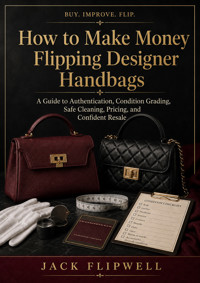
How to Make Money Flipping Designer Handbags - A Guide to Authentication, Condition Grading, Safe Cleaning, Pricing, and Confident Resale ebook
JACK FLIPWELL
Uzyskaj dostęp do tej i ponad 240000 książek od 14,99 zł miesięcznie
- Wydawca: ALL-IN Rafał Płonkowski
- Kategoria: Biznes, rozwój, prawo•Biznes, rozwój
- Język: angielski
Designer handbags can cost hundreds, thousands, or significantly more. On the resale market, the difference between a strong opportunity and an expensive mistake can come down to a few details: the wrong model identification, a missed defect, poor authentication, or an unrealistic resale estimate.
How to Make Money Flipping Designer Handbags is a practical guide for anyone who wants to learn how to find undervalued luxury handbags, evaluate condition, reduce counterfeit risk, prepare products safely for resale, price them realistically, and build a repeatable flipping system.
This is not a book about buying luxury for the sake of owning it.
It is a book about making better trading decisions.
You will learn how to identify the brand, exact model, size, material, color, variant, and approximate production period. You will see why authentication should be treated as a structured process based on multiple consistent details rather than one supposed "secret test." You will learn which warning signs should increase caution and when paying for professional authentication is a rational cost of risk control.
The book walks through condition grading in detail. Corners, handles, straps, stitching, edges, linings, zippers, hardware, odors, moisture damage, color transfer, previous repairs, and restoration are all examined from the perspective of value and resale liquidity.
A dedicated section explains safe cleaning and preparation. Not every leather or textile reacts the same way, and one incorrect product can reduce the value of an expensive handbag in seconds. You will learn when basic preparation is enough, when specialist work makes sense, and why some defects should simply be disclosed rather than repaired.
Pricing is one of the most important parts of the system. You will learn how to compare realistic resale transactions, distinguish asking price from market value, and create fast-sale, realistic, and ambitious scenarios. You will also learn how to calculate a maximum purchase price after accounting for selling fees, shipping, authentication, preparation, risk, and your required profit.
The book also covers purchase negotiation, safer payment methods, local collection, remote buying, reservations, international transactions, documentation, and common scam patterns. It explains how to evaluate both the seller and the transaction rather than focusing only on the handbag.
You will learn how to manage inventory so your business does not turn into a collection of random luxury items. The book shows how to track capital tied up in stock, measure turnover, identify aging inventory, and decide when to hold, reduce the price, or accept a weaker result in order to release cash.
A large section is dedicated to resale execution. You will learn how to photograph a designer handbag professionally while showing the real condition, write listings that answer buyer questions before they are asked, and select the right sales channel based on net proceeds, liquidity, trust, and workload.
Separate chapters cover buyer negotiation, packing, shipping, returns, disputes, and protection against product substitution. You will see why pre-shipping documentation can be as important as the original sales photographs and how to respond when a buyer questions authenticity or condition.
The book also explains how to move from individual transactions toward a repeatable business. You will learn how to track profit per item, return on capital, time to sale, sourcing-channel profitability, brand performance, sales-channel economics, repeat customers, and inventory concentration.
The final chapters combine everything into one complete workflow from the first listing you find to the final performance review after the sale. You will have a procedure for answering the essential questions before every purchase:
Do I know exactly what I am buying?
Can I justify the authenticity assessment?
Have I graded the condition properly?
What are the realistic net proceeds?
What is the maximum I can safely pay?
What happens if the bag sells for less than expected?
Can one mistake threaten too much of my capital?
This book is for readers who want to treat designer handbag flipping as a business based on knowledge, process, data, and risk control rather than famous logos, optimistic pricing, and guesswork.
Find the Deal. Add the Value. Keep the Margin.
A practical guide to flipping designer handbags. Learn how to identify models, assess authenticity and condition, clean safely, analyze secondary-market prices, calculate full transaction costs, negotiate purchases, create professional listings, and sell high-value handbags with greater confidence.
This publication was prepared with the assistance of tools that support the creative process, including artificial intelligence-based solutions. The final concept, structure, and editing belong to the author.
Ebooka przeczytasz w aplikacjach Legimi na:
Liczba stron: 351
Rok wydania: 2026
Odsłuch ebooka (TTS) dostepny w abonamencie „ebooki+audiobooki bez limitu” w aplikacjach Legimi na:
Podobne














INTRO
The designer handbag market may look, at first glance, like a world of fashion, status, luxury purchases, and personal taste. For a reseller, however, it is primarily a market of information. The same bag may be listed by one seller close to its realistic resale value and by another at a significant discount simply because the photos are poor, the description is vague, the piece needs basic cleaning, or the owner wants a fast sale. Money is not made because you found a "beautiful handbag." It is made because you can assess authenticity, condition, demand, risk, and resale potential more accurately than the person on the other side of the transaction.
Flipping designer handbags is more demanding than reselling many ordinary used goods. With electronics, furniture, or tools, a large part of the value may come directly from functionality and physical condition. In luxury accessories, value is also heavily influenced by the brand, exact model, size, material, color, age, hardware, completeness, history, and the buyer's confidence in the seller. A detail that a beginner barely notices may affect the resale price, the time required to sell, or whether the bag should be purchased at all.
The central principle of this book is simple: profit is created when you buy and realized when you sell. If you overpay, cleaning, better photography, and a polished listing may not be enough to save the margin. If you buy well, leave a realistic safety buffer, and prepare the product properly, you gain much more control over the economics of the transaction. Before asking how much money you can make, you need to learn when not to buy.
This business is not about guessing what is authentic
Counterfeits are one of the biggest risks in this category. Some are crude and easy to identify. Others are produced carefully enough that confidence, intuition, or a quick check of a few popular details is not sufficient. There is no universal rule such as "check the stitching and the serial number" that reliably authenticates every brand, every model, and every production period. Marking systems, construction methods, materials, packaging, and documentation change over time.
Authentication should therefore be treated as a process rather than a single test. You examine whether multiple layers of evidence agree with one another: construction, proportions, materials, hardware, stitching, stamping, typography, interior layout, zippers, production identifiers, aging patterns, and consistency with the documented characteristics of the specific model and period. One correct detail does not prove authenticity. One minor difference does not always prove a fake either, because legitimate products can vary between production runs and generations.
When meaningful uncertainty remains, the responsible solution is to use a competent authentication service or a specialist with experience in the relevant brand and category. This is especially important for high-value pieces, heavily counterfeited models, and purchases where a mistake would represent a significant loss. The cost of professional authentication should then be treated as a risk-control expense, much like paying for an expert inspection before purchasing an expensive vehicle.
Do not sell a product as authentic unless you have reasonable grounds to do so. Phrases such as "probably authentic," "looks real to me," or "selling as found" should not be used to shift counterfeit risk onto the buyer. Responsible luxury resale depends on transparency. If authenticity cannot be established to the standard necessary for a safe transaction, walking away may be the best business decision.
The brand is not enough
Beginners often focus too heavily on the logo. They see a famous name and assume they have found something valuable. In reality, two bags from the same brand can have completely different liquidity, demand, and resale values.
The exact model matters. Size matters. Material matters. Color matters. Condition matters. Current buyer interest matters. So does the number of competing listings and how easily the product can be compared with recent sales.
You may find an impressive-looking bag from a prestigious house that sits unsold for months. Another, less dramatic model may have a much broader customer base and regular transaction activity. A flipper should therefore look beyond prestige and focus on liquidity.
Liquidity means the ability to sell a product within a reasonable period at a price that still leaves an acceptable margin. A bag that appears to be worth 5,000 but takes many months to sell may be a worse use of capital than a bag worth 2,000 that turns quickly and predictably. Capital tied up in slow inventory has a cost even if the item eventually sells at a profit.
Condition needs more detail than "good"
Small signs of wear can matter significantly in luxury handbags. Buyers often pay attention to issues that might be considered purely cosmetic in lower-value goods. Corner wear, color transfer, dry leather, stained lining, scratched hardware, cracked edge coating, odor, structural deformation, worn handles, or traces of poor restoration can all affect desirability and price.
That is why phrases such as "very good condition" are not enough unless they are supported by photographs and a detailed description. In this book, condition grading is treated as a structured inspection. You will evaluate the body, corners, handles, straps, lining, metal hardware, closures, stitching, and previous repairs separately. This makes your listings more honest and your buying decisions more accurate.
The most dangerous problems are often the ones that photographs do not reveal. Odor, sticky coatings, deteriorating interiors, moisture damage, or structural weakness may only become obvious during physical inspection. When buying remotely, you therefore need to learn how to ask precise questions and request specific photographs instead of relying on the seller's overall description.
Cleaning should never become an experiment
One of the simplest ways to add value is to improve presentation. A bag covered in surface dust, with loose debris inside and poor shape from storage, may look dramatically worse in a listing than it does after safe preparation. This is where a reseller can create value without fundamentally changing the product.
That does not mean every bag should be aggressively cleaned. Some leathers, fabrics, coatings, dyes, and finishes are highly sensitive. The wrong product can alter the color, leave a permanent stain, remove a protective layer, flatten the texture, or damage the finish. An attempt to improve a bag can reduce its value instead.
A useful principle is simple: perform only the tasks whose risks you understand and that you can carry out safely. Removing loose dust, carefully vacuuming an interior, and gently restoring the natural shape of a bag are very different from recoloring leather, rebuilding edge coating, carrying out structural stitching, or chemically removing difficult stains. When specialist restoration is needed, use someone with appropriate experience.
This book does not teach you how to hide damage. Improving presentation is only valuable when the buyer still receives complete and accurate information about the condition. If corners have been refinished, a strap repaired, or part of the surface recolored, that work may be material information for the next owner.
Asking price is not market value
One of the most common beginner mistakes is looking only at active listings. If five sellers are asking a high price for similar bags, it is tempting to conclude that your bag is worth the same amount. The problem is that all five may still be unsold because those prices are too high.
Where reliable data is available, completed sales are usually more useful than active asking prices. You still need to compare more than the final number. Condition, size, material, accessories, platform, and the time required to sell can all matter. A heavily worn example should not be compared directly with one in near-pristine condition simply because the model name matches.
In practice, market value is a range rather than one magic number. The same bag can achieve different results depending on the sales channel, the quality of presentation, seller reputation, availability of the exact variant, and platform costs. You should therefore work with realistic resale scenarios instead of the most optimistic price you can find online.
Margin is not the difference between the purchase price and sale price
Suppose you buy a handbag for 1,000 units of currency and later sell it for 1,400. That does not automatically mean you made 400. There may be costs for inbound shipping, authentication, cleaning, packaging materials, platform fees, payment processing, insured shipping, returns, and other transaction-specific expenses.
Only then do you have a meaningful view of what the transaction actually produced before considering any other obligations related to your personal or business situation. Tax rules, seller responsibilities, and platform requirements vary by jurisdiction and may change over time. Always check current official rules that apply where you operate.
You should calculate the deal backward before buying. Start with a realistic resale value, subtract expected selling costs, subtract the required safety margin and target profit, and only then determine the maximum purchase price. This approach protects you from emotional buying.
The best deal is not always the cheapest bag
A very low price can signal opportunity. It can also signal a counterfeit, serious damage, missing information, or an attempt to pass a problem on to the next buyer. A disciplined reseller does not only ask, "Why is this so cheap?" A better question is, "What would need to be wrong for this price to make sense?" That reversal of perspective is particularly useful in luxury resale.
Sometimes the better buy is a slightly more expensive bag from a seller who provides excellent photos, a credible history, and enough access to inspect the product properly. A much cheaper listing with blurred photographs and limited information may create far greater risk. Purchase price is only one part of the equation. The other is the probability that the assumptions behind your calculation are actually correct.
Information creates the advantage
You do not need to know every brand and every handbag model. Trying to learn the entire market at once usually leads to shallow knowledge. A more effective approach is to specialize gradually.
You might begin with a few brands, several product lines, or a particular price range. Over time you will learn common materials, variants, wear patterns, resale ranges, construction details, and the places where attractive deals appear most often. Every well-documented transaction can improve your information advantage.
Maintain your own database of observations. Record models, asking prices, completed sale prices where available, condition, time on market, notable features, preparation costs, and actual transaction results. After dozens of carefully documented observations, your buying decisions can become much stronger than decisions based on memory or intuition.
Buying requires a procedure
The most dangerous moment in flipping often comes when you see something that appears to be a rare bargain and feel pressure to act before someone else does. That is exactly when procedure matters most.
Before buying, you should be able to answer several questions. Can you identify the exact model? Do you have enough information to assess authenticity? Can you see all the important areas? Has condition been evaluated properly? Is there real demand for this variant? What is a conservative resale figure? What will preparation and selling cost? What happens if you need to sell faster and lower than expected?
Weak answers do not necessarily mean the product is bad. They mean your knowledge about the transaction is insufficient. In a resale business, walking away from an uncertain purchase is also a form of profit because it protects capital from becoming trapped in a weak asset.
The sale begins before you take the photos
Good selling is not just about publishing a listing. It begins with proper preparation and the collection of evidence that helps the buyer make a decision. Photographs should show both strengths and flaws. Capture the front, back, sides, bottom, corners, handles, straps, interior, closures, hardware, markings, and any features relevant to identification. If there is a scratch, stain, discoloration, or worn corner, show it clearly enough for the buyer to understand the scale of the issue.
The description should answer likely buyer questions before they are asked. Provide the exact model or the most precise identification available, material, color, measurements, included accessories, condition by area, and any known repair or restoration history. Use facts whenever possible instead of vague labels.
In the premium segment, trust is part of the product's value. A buyer may be willing to pay more to a seller who presents the item carefully, answers questions precisely, and demonstrates that they understand what they are selling. This is a competitive advantage that is difficult to replicate simply by lowering the price.
The sales channel matters
The same handbag can behave differently across different platforms. Some marketplaces attract more luxury-focused buyers. Others are more local. Some provide authentication procedures, while others place more responsibility on the buyer and seller. Fees, return policies, payment systems, seller protections, shipping requirements, and restrictions on branded goods may all vary.
There is no single best channel for every item. A high-value bag may justify selling through a marketplace with stronger authentication or a more specialized buyer base even if the fees are higher. A lower-value, highly liquid model may produce a better result elsewhere. Platform rules change, so check current requirements in official sources before listing. This is particularly important for authentication, branded goods policies, payments, returns, fees, shipping, and prohibited products.
Risk does not end when you find a buyer
High-value goods require serious transaction security. The risk is not limited to buying a counterfeit. Sellers can also face fraudulent payment attempts, disputes over condition, delivery problems, dishonest claims, and problematic returns.
Document the product before shipping. Keep clear photographs of its condition, markings, included accessories, and packaging. Choose a shipping method appropriate to the value and the platform's requirements. Check current terms concerning carrier liability, insurance, proof of delivery, and documentation.
Use equal care with in-person transactions. Meet in an appropriate location, avoid carrying unnecessary amounts of cash, and do not allow the other party's urgency to replace your normal inspection process. Personal safety is more important than one deal.
Not every handbag should be saved
Flipping is often associated with finding neglected items and restoring their appeal. In luxury handbags, this can work, but only within the right limits. Some pieces have problems that are uneconomical to repair. Others can technically be restored, but the cost of specialist work absorbs the expected margin. Some may look better after restoration but appeal to a smaller group of buyers because part of the market prefers original materials with honest wear over heavily refinished surfaces.
Before buying a problematic bag, calculate more than the repair quote. Consider the risk of additional work, the time required, and the realistic increase in resale value. If you spend 200 on a repair that only adds 100 to the price, you have done extra work to reduce your profit.
Fast turnover or maximum price
Not every selling strategy should target the highest possible price. In practice, you are often choosing between maximum margin on one piece and faster capital turnover. Imagine two scenarios. In the first, you hold a bag for a long period waiting for a buyer willing to pay the top of the market. In the second, you accept a somewhat lower price, sell faster, and release the capital for another purchase. Which approach is better depends on your model, your available capital, the number of new opportunities, and your selling costs.
For that reason, this book looks not only at profit margin but also at time. A bag that earns slightly less but sells consistently may be a better business asset than one with high theoretical profit that sits for months.
Build a system, not a collection of random bargains
The biggest improvement comes when you stop buying individual items based on impulse and start operating through a repeatable system. That system should include sourcing, initial screening, product identification, authentication, condition inspection, comparable sales analysis, maximum purchase price calculation, safe preparation, documentation, listing creation, negotiation, packing, shipping, and financial tracking. The more decisions you convert into procedures, the less dependent you become on emotion.
Over time, create brand-specific and model-specific checklists for products you handle regularly. They are not meant to replace judgment. They are there to prevent you from forgetting basic controls when you are working quickly.
Reputation is part of your capital
In premium resale, seller reputation can have direct economic value. Strong reviews, consistent descriptions, clear photos, fast communication, and fair handling of problems reduce uncertainty for buyers. Do not try to create short-term margin by hiding defects. One transaction may produce a little more money, but a dispute, return, poor review, or account restriction can cost far more. In luxury resale, the customer is buying both the handbag and the credibility of the seller's presentation.
A strong reputation can also make future products easier to sell. Returning customers need less time to decide. This is one of the reasons flipping can evolve from occasional deals into a repeatable business.
What this book will teach you
The chapters that follow build one complete process from purchase to resale. We begin with the structure of the designer handbag market and how to choose a segment in which to develop real expertise. From there, we move into sourcing, precise identification, authentication, and systematic condition grading.
You will learn how to distinguish materials, recognize common wear patterns, and separate cosmetic problems from defects that affect function, structure, and value. We will examine which preparation tasks a reseller can reasonably perform and which should be left to qualified specialists. You will also build a pricing system based on comparable transactions and complete cost analysis.
The book then moves into purchase negotiation, inventory management, professional photography, listing creation, channel selection, buyer negotiation, payment security, packing, shipping, and post-sale dispute handling. Finally, all of these elements are combined into a system for controlling capital, measuring performance, and gradually scaling without losing buying discipline.
The objective is not to make you buy every handbag that appears cheap. It is to help you reject most weak opportunities and recognize the smaller number of deals where price, quality, risk, and resale potential work in your favor.
The most valuable skill is knowing when to say no
Every flipping market rewards patience. The luxury handbag market rewards it especially strongly because one serious mistake can erase the profit from several successful transactions. You will see listings that look like once-in-a-lifetime opportunities. Some will be excellent. Others will turn out to be counterfeit, structurally damaged, difficult to sell, or far less valuable than the seller's story suggests.
You do not need to buy a deal simply because you found it. You do not need to win every negotiation. You do not need a warehouse full of inventory. Strong resellers often protect their capital through the products they refuse to buy.
A good deal should survive calm analysis. You should understand what you are buying, why the price is attractive, how you are assessing risk, who is likely to buy the product later, and what you will do if the market does not follow the most optimistic scenario.
That is the foundation of the JACK FLIPWELL method: BUY. IMPROVE. FLIP. Buy only when the numbers and the evidence justify the decision. Add value where you can do so safely, honestly, and economically. Sell in a way that builds not only profit on one transaction, but a system that makes the next transaction better.
Chapter 1 - How the Designer Handbag Market Works and Where the Margin Really Comes From
Flipping designer handbags is not about randomly finding famous brands and reselling them for more. The market is far too fragmented for that to become a reliable system. The value of a specific piece comes from a combination of brand, model, size, material, color, age, condition, availability, completeness, and current demand. If you want repeatable results, you need to learn how to break that value into components and understand which ones actually influence resale price.
The most important change in mindset is to stop asking, "Is this bag cheap?" and start asking, "Is this bag cheap relative to a realistic resale value after all costs and risks are included?" An item can be inexpensive and still be a terrible purchase. It can also be expensive and still represent a strong opportunity if its realistic resale value is sufficiently higher.
The primary and secondary markets are different worlds
The retail price of a new handbag is a useful reference point, but it does not automatically determine the value of a used example. Some models retain a large part of their value, others depreciate quickly, and some can periodically perform very strongly on the secondary market because of limited availability, a desirable configuration, or renewed interest in a particular line.
You therefore cannot assume that a handbag that was expensive when new remains attractive inventory several years later. The resale market has its own demand structure. Buyers compare available used pieces against one another, not only against boutique prices. If many similar examples are available, pricing pressure can be strong even when the original retail price was high.
The opposite can also happen. Certain variants may appear infrequently on the secondary market. A buyer may then be willing to pay more for a specific color, size, material, or discontinued version. That does not mean you should speculate based on one unusually high listing. Scarcer products require more careful analysis because fewer reliable comparable sales may exist.
Brand creates attention, but the model creates the transaction
A prestigious brand helps attract buyers, but the exact model often determines whether the piece is easy to sell. Beginners frequently overvalue the logo and fail to study the product line in enough detail. One brand can contain iconic models with strong resale demand alongside dozens of pieces that receive far less attention.
You need to understand the difference between recognition and liquidity. Recognition means that many people know the brand or recognize the style. Liquidity means there is a sufficiently large group of buyers willing to purchase that specific model at a reasonable price.
Liquidity is what matters most to a flipper. A handbag that appears to be worth 5,000 but requires many months to find a buyer may be a worse use of capital than a bag worth 2,000 that sells regularly in a much shorter period. The faster your capital returns, the more transactions you can potentially complete without increasing your total budget.
Size matters more than many beginners expect
The same handbag model may exist in several sizes that behave very differently on the secondary market. A small version may be highly fashionable and easy to resell while a larger one sits longer. With another model, the opposite may be true because buyers primarily want a practical everyday bag.
Never assume that one size gives you a reliable price reference for another. Whenever possible, compare the exact size. If no close comparable sales exist, you can widen the search, but you should also increase your uncertainty buffer.
A relatively small dimensional difference can also affect shipping cost, packaging requirements, and practical use. This matters particularly with very small bags and large travel or work models. Size is therefore both a value factor and an operational factor.
Material can change the entire deal
Smooth leather, pebbled leather, suede, coated canvas, textile, nylon, and more unusual materials all wear differently and require different condition analysis. Two examples of the same model made from different materials can have very different values, durability, and risk profiles.
Delicate materials may look impressive but show scratches, dents, color transfer, or wear much more quickly. More durable materials may be easier to resell because buyers are comfortable using them regularly. That does not automatically make the more durable option more valuable. Market demand can still favor a less practical material because of appearance, rarity, or desirability.
Some materials can also create additional legal or shipping considerations. Certain exotic leathers, for example, may require documentation or be subject to import and export restrictions depending on the jurisdiction. Rules can vary between countries and over time. If you plan to trade in such products, verify current requirements from official sources rather than assuming a used bag can automatically be shipped anywhere.
Color affects demand, but not always in an obvious way
Neutral colors often attract a broad customer base because they are easy to wear. More unusual colors may have a smaller audience but can sometimes be highly desirable to collectors or buyers looking for a specific discontinued version. There is no universal rule that black, beige, or another neutral shade will always command the highest price.
Color also affects condition risk. Light-colored bags can be more vulnerable to stains, denim transfer, and visible edge wear. Dark surfaces may hide some marks while making scratches or lost sheen more visible.
In practice, color affects three things at the same time: price, sale speed, and condition sensitivity. It should be treated as a major pricing variable rather than a minor aesthetic detail.
Completeness can increase trust, but not always proportionally increase price
Depending on the brand and model, the set may include a box, dust bag, strap, lock, key, charms, cards, documents, or other accessories. These items do not all carry the same economic value.
You should distinguish functional components from presentation accessories. A missing detachable strap on a bag designed to be worn on the shoulder may materially reduce usefulness and desirability. A missing box often matters less, although completeness can still increase buyer confidence in the premium segment.
Do not treat a box, dust bag, receipt, or card as proof of authenticity. Those items can be transferred from another product or counterfeited themselves. Completeness may support the product's history, but it does not replace proper authentication.
Age does not affect value in a straight line
An old handbag is not automatically valuable, and a newer bag is not automatically better inventory. Age can influence value in several different ways. Some older versions are desirable because of their styling, materials, construction, or discontinued configuration. Others lose demand because the design appears dated or because many similar examples are available.
Older bags also require more careful material inspection. Even when the exterior looks good, coatings, adhesives, linings, and structural components may deteriorate over time. The older the piece, the less you should rely on appearance alone.
The important question is whether the specific model has a market today. In flipping, you are not buying history for its own sake. You are buying a future opportunity to resell the item.
Retail price is not your resale target
One of the most common mistakes is calculating a "discount" from the original boutique price. If a bag once sold for 10,000 and you can buy it today for 3,000, it may feel like an extraordinary bargain. That information is almost useless if similar used examples currently sell for around 3,200.
Your reference point must be the secondary market. Retail price can help explain the product's original positioning, but it cannot replace current resale data. Build your valuation from the bottom up. Start with actual comparable listings and completed sales when available. Do not begin with the boutique price and then try to force your numbers to fit it.
Where a flipper's advantage comes from
The strongest deals rarely come from a magical source of permanently underpriced handbags. They come from better information, faster analysis, and stronger discipline. The seller may not know the exact model. They may identify the size incorrectly. Their photos may make the color look poor. The interior may contain only removable loose debris. They may need a quick sale. Any of these situations can create an opportunity, but only if you can evaluate the product accurately.
Your edge should not come from deceiving an uninformed seller. It comes from doing analytical work the seller has not done. You identify the model, study the market, assess the risk, prepare the product, and connect it with the right buyer.
Five common sources of margin
In practice, resale margin usually comes from one or more of five differences. The first is an information difference. You understand the product better than the seller and can estimate its value more accurately.
The second is a presentation difference. You buy a poorly photographed or visually neglected bag, then safely prepare it, document it, and present it at a much higher standard. The third is a market difference. You buy in a channel where demand is lower or the seller values speed, then resell where the correct buyer base is stronger.
The fourth is a time difference. The original seller needs liquidity immediately, while you are able to wait for a more suitable buyer. The fifth is an operational difference. You manage the full process better, from authentication and pricing to photography, negotiation, shipping, and customer service. The safest deals often combine several of these advantages. If the entire transaction only works when you achieve an unusually high selling price, your margin is fragile.
Demand matters more than your personal taste
It is easy to buy handbags you personally find attractive, especially if you enjoy fashion. The problem starts when your preferences replace evidence. You may love a specific color or an unusual design, but if comparable examples repeatedly remain unsold, your taste does not change the market. You may also dislike a classic bag that has a large customer base and strong liquidity.
A flipper must separate aesthetic judgment from economic judgment. The question is not, "Would I carry this?" The question is, "Do I understand who is likely to buy it, at what price, and how long I may need to wait?"
Liquidity can be observed
You will not always have perfect data about time to sale, but you can look for useful signals. Check how many comparable listings are active, how often new examples appear, how many variants are currently available, and whether you can find evidence of completed sales.
A market full of nearly identical bags with repeated price reductions can suggest oversupply. A market with relatively few good examples but regular evidence of completed transactions may be more attractive. Do not draw conclusions from one day of observation. Track models over time and record changes. Even a simple database can make pricing anomalies much easier to recognize.
Capital has a cost
Every handbag you purchase locks up part of your money. Even if the item eventually sells at a profit, a long holding period can limit the growth of the business.
Suppose you have 10,000 available. You could use most of it to purchase one expensive bag or spread the capital across several lower-value pieces. The first option may provide a large profit on one transaction but concentrates risk. The second spreads the risk across several products but creates more operational work. There is no universally correct model. What matters is knowing how much of your capital is concentrated in one piece, brand, category, or price segment.
Concentration risk
If most of your budget is tied up in one handbag, a mistake in authentication, condition, or valuation can materially damage your overall results. This is particularly important for beginners who are still learning the market.
Early on, every transaction should also be viewed as a learning exercise. The smaller the potential loss, the more mistakes you can analyze without seriously damaging your capital. This does not mean buying cheap products carelessly. It means controlling your exposure. If one transaction is so large that a failed resale would seriously limit your ability to continue operating, either raise the required level of certainty or walk away.
The biggest mistake is buying without an exit plan
Before you pay for a handbag, you should already have a reasonable idea of where you will list it, what a conservative sale price might be, and what you will do if the bag does not sell within your expected timeframe.
A useful approach is to build three scenarios. The first is your target price in a normal sale. The second is a faster-sale price if you need to release capital. The third is a defensive exit level where you are willing to close a weak transaction and accept a low profit or loss. This tells you how much safety exists before you buy. If the deal produces an attractive result only in the most optimistic scenario, it is probably too risky.
Do not confuse theoretical value with achievable price
A handbag may theoretically be worth a high amount, but actually achieving that number can require time, seller reputation, the right platform, and the right buyer. A beginner with no sales history may not achieve the same result as an established specialist offering an identical piece.
Your pricing assumptions should therefore reflect not only the product but also your position as a seller. If you are starting out, use more conservative estimates. It is better to be pleasantly surprised by the final price than to discover after buying that the market does not accept your assumptions. Over time, reputation, customer relationships, and experience may improve the economics of your sales. Do not price your current purchases as though those advantages already exist.
What a good first specialization looks like
Instead of trying to follow the entire designer handbag market, choose a smaller area. It might be several popular models, one brand, a particular price range, or a group of products that appear regularly in the sources you use.
A good specialization has three characteristics. First, there are enough listings for you to learn from. Second, there are enough sales for the market to be analyzed. Third, the level of risk is appropriate for your knowledge and capital.
Avoid beginning with items where one authenticity mistake could absorb a large percentage of your budget. You can build knowledge by observing without purchasing. Studying hundreds of listings can be more valuable than rushing into one expensive transaction too early.
A simple market observation card
For every model you follow regularly, record: brand and exact model,; size,; material,; color,; approximate period or generation when relevant,; condition,; completeness,; asking price,; observed completed sale price where available,; platform,; observation date,; major defects,; notes on liquidity.
After some time, patterns become visible that are easy to miss when casually browsing listings. You begin to recognize which variants appear often, which disappear quickly, and at what price level buyers seem to respond.
Your goal is not perfect knowledge
You cannot eliminate all risk. You also cannot know every version of every handbag. The goal is to build a process that gradually reduces the number and size of expensive mistakes.
At first, your advantage may simply come from analyzing products more carefully than the average buyer. Later, you add specialization, your own database, better authentication knowledge, stronger condition grading, and faster calculations. That is how knowledge begins to translate directly into money. The next step is sourcing. Understanding value is not enough if you cannot consistently find products that leave room for a realistic margin.
Chapter 2 - Where to Find Deals and How to Build a Repeatable Handbag Sourcing System
A good transaction starts with the source. If you only browse the same obvious listings as thousands of other buyers, your pricing advantage will be limited. That does not mean major marketplaces are useless. It means sourcing should be treated as a multi-channel system rather than a single website that is expected to provide a constant stream of bargains.
The best source is not necessarily the one with the lowest prices. Information quality, inspection access, payment safety, return options, negotiation potential, and the amount of time required to find good inventory all matter. A cheap channel filled with suspicious listings may be more expensive in practice than a channel with higher prices but significantly lower risk.
Large marketplaces
Major listing platforms have one enormous advantage: volume. New products appear constantly, and some sellers have not researched the value of what they own. That creates opportunities in poorly described, badly photographed, or quickly priced handbags.
The disadvantage is competition. Strong deals can disappear quickly, particularly when the model is easy to identify. Your edge comes from efficient screening and fast analysis rather than simply being present on the platform.
Large marketplaces also attract fraudsters. Never assume that a famous marketplace guarantees authenticity simply because the item was allowed to be listed. Check current buyer protection, authentication, and payment rules, but treat those systems as additional protection rather than a substitute for your own due diligence.
Bad titles can create good opportunities
Many strong deals never appear in the most obvious search results. A seller may misspell the brand, use a casual nickname, omit the model name, or list the item simply as a "leather handbag."
Search using multiple naming variations. If you know a model well, look for abbreviations, common misspellings, characteristic design features, and broader category terms. The stronger your visual knowledge becomes, the more often you will be able to identify valuable items from photographs even when the title is poor. This is one of the cleanest forms of information advantage. You do not need special access or personal connections. You need better search habits and product knowledge.
Price filters can be misleading
Sorting by lowest price is an obvious way to find potential bargains, but it also takes you directly into the highest concentration of counterfeits, damaged goods, and incomplete listings. A better approach combines price with additional filters. Narrow by category, brand, condition, location, or listing date, then look for anomalies rather than simply the cheapest item available.
A bag priced 10 percent below the normal market may be a much better purchase than one priced 60 percent below market if the cheaper piece carries major authenticity or condition risk.
Newly listed items deserve attention
Good products often do not remain available for long. Speed matters, especially with popular models. If the platform allows sorting by newest listings or saved searches, use those tools. This does not mean buying anything that appears cheap. You need a fast screening process that allows you to reject most listings quickly. Only the products that survive the first filter deserve deeper work. Professional speed comes from preparation. You act quickly because you already know what to check.
Saved searches and alerts
If you repeatedly hunt for the same models, manually typing the same searches several times a day is inefficient. Use saved searches and notifications where available. A good search should not be so broad that it floods you with irrelevant results. It should also not be so narrow that it misses poorly described products. For important models, several separate alerts may be better than one.
One alert could use the full model name. Another might combine the brand with a distinctive material or feature. A third might include common spelling mistakes. After several weeks, you will know which alerts produce actual opportunities and which mostly create noise.
Local listings and in-person inspection
Local markets provide one major advantage: you may be able to inspect the handbag physically before paying. That can reveal things photographs cannot show well, including odor, stiffness, surface texture, structure, zipper function, and hidden interior problems.
In-person buying still requires common sense. Meet in a public place appropriate to the value of the transaction. Avoid carrying unnecessary amounts of cash when a safer payment method is available. Do not let the seller rush you through the inspection. If someone refuses to allow a reasonable inspection of an expensive handbag, that is useful information. You can simply walk away.
Specialist consignment stores and pre-owned luxury retailers
Specialist stores can be both buying and selling channels. Prices are often higher than in private listings because the business has costs related to staff, verification, storage, and retail presentation. Good opportunities can still appear.
The advantage may come from a difference in demand between markets. A model that moves slowly in one store may perform much better on another platform. You still need to calculate the full economics and verify that the price gap is real.
Do not assume that a specialist shop eliminates authentication risk entirely. A reputable business can reduce risk substantially, but with valuable pieces you should still understand what you are buying and what terms apply to the transaction.
Second-hand and charity shops
These channels attract attention because of stories about luxury items discovered for very little money. Such finds do happen, but they should not form the foundation of your business model. Most visits will not produce a high-value handbag.
The advantage is potentially low acquisition cost. The disadvantage is inconsistent supply and high identification risk. If the store does not specialize in luxury goods, do not assume the item has been authenticated properly.
This source can work well for someone who enjoys physical sourcing and can recognize useful visual clues quickly. It becomes less attractive if you spend many hours searching for one rare success while ignoring higher-quality sources.
Estate sales and private collections
Owners sometimes sell several handbags at once when moving, reorganizing a wardrobe, or reducing a collection. A group of items can create more negotiating room than one piece sold individually.
These situations require discipline. Do not buy the entire lot just because the average unit price appears attractive. Each bag still needs separate authentication, condition analysis, and resale assessment. One excellent piece should not justify taking several weak products. Bundles can easily hide slow-moving inventory.
Auctions
Physical and online auctions can provide access to handbags from collections, estates, liquidations, consignments, and other sources. Opening bids may look attractive, but the total purchase cost matters more than the hammer price.