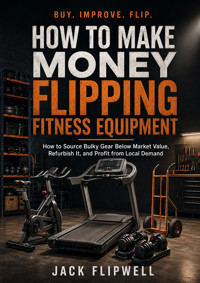
How to Make Money Flipping Fitness Equipment - How to Source Bulky Gear Below Market Value, Refurbish It, and Profit from Local Demand ebook
JACK FLIPWELL
Uzyskaj dostęp do tej i ponad 240000 książek od 14,99 zł miesięcznie
- Wydawca: ALL-IN Rafał Płonkowski
- Kategoria: Biznes, rozwój, prawo•Biznes, rozwój
- Język: angielski
Bulky used fitness equipment creates a unique resale opportunity because the same characteristics that make it inconvenient for the owner can create margin for an organized buyer. Treadmills take up space. Weight plates are heavy. Power racks need disassembly. Exercise bikes require transport. Entire home gyms can become a major problem during a move, renovation, or downsizing.
That inconvenience is exactly where a prepared reseller can create value.
How to Make Money Flipping Fitness Equipment is a practical guide to sourcing, evaluating, transporting, refurbishing, and reselling used fitness equipment for profit. It is not built around guaranteed returns, unrealistic income claims, or the assumption that every cheap machine is a bargain. Instead, it focuses on building a repeatable decision-making process that helps you buy more selectively and avoid expensive mistakes.
You will learn how to research local demand without confusing asking prices with actual resale value. The book shows how to estimate realistic selling prices, understand inventory liquidity, and calculate a maximum purchase price before you negotiate with the seller.
You will also learn why the purchase price alone tells you very little about the true economics of a deal. Transport, paid help, replacement parts, cleaning, platform fees, delivery, storage, and labor all affect the final result. A treadmill bought for a fraction of its original retail price can still be a terrible investment if it needs expensive repairs, occupies half your garage, and takes months to sell.
The book covers the major fitness equipment categories separately, including dumbbells, barbells, weight plates, kettlebells, benches, stands, power racks, treadmills, exercise bikes, ellipticals, rowing machines, multi-gyms, and larger commercial machines. Each category is examined through the same practical lens: demand, condition, technical risk, completeness, transport difficulty, storage requirement, and exit strategy.
A major section is devoted to pre-purchase inspection. You will learn what a reseller can reasonably check independently and where the line should be drawn before specialist expertise is required. The book clearly separates basic cleaning, visual inspection, and straightforward assembly from electrical repairs, structural welding, safety-system modifications, and other work that should only be performed by properly qualified people.
Transport receives equally serious attention. Bulky fitness equipment can destroy a good deal if you discover too late that the machine does not fit through the doorway, cannot be carried down the stairs, exceeds the vehicle's payload, or requires several people to move safely. The book walks through measurements, collection planning, disassembly documentation, labeling hardware, protecting electronics, securing loads, and preparing the product for both storage and final delivery.
You will also learn how to manage storage as a limited business resource. One large machine can occupy the space of several faster-moving products. The book explains how to build simple intake, preparation, ready-to-sell, parts, and dispatch zones, how to track inventory age, and how to identify stock that is becoming dead capital.
Refurbishment is treated as a business decision rather than a hobby project. Cleaning, replacing the correct minor part, organizing accessories, improving presentation, and documenting the equipment can add substantial value without risky technical intervention. You will learn how to decide which improvements are worth doing and when additional work is unlikely to produce enough return.
The book also explains bundling and part-out strategies. A bench, rack, barbell, and matching plates may create a stronger home-gym package than the individual components. A large mixed lot may be more profitable when divided into smaller groups. A broken machine may sometimes have recoverable parts value, but only when there is a real market for those parts and the storage and labor costs make sense.
Once the equipment is ready, the focus moves to selling. You will learn how to photograph bulky products clearly, show defects honestly, write listings that reduce buyer uncertainty, set asking, target, minimum, and fast-exit prices, and handle negotiation without making emotional decisions.
Local delivery can become a major competitive advantage. Many buyers want fitness equipment but lack the vehicle, lifting help, or experience required to move it. The book explains how to price transport, separate delivery from carrying and assembly, avoid hidden labor costs, and use professional partners where appropriate.
This publication was prepared with the assistance of tools that support the creative process, including artificial intelligence-based solutions. The final concept, structure, and editing belong to the author.
Ebooka przeczytasz w aplikacjach Legimi na:
Liczba stron: 299
Rok wydania: 2026
Odsłuch ebooka (TTS) dostepny w abonamencie „ebooki+audiobooki bez limitu” w aplikacjach Legimi na:
Podobne














INTRO
Big Equipment, Local Buyers, and a Very Specific Opportunity
Fitness equipment is an interesting category for a reseller for one simple reason: plenty of people want to own it, but far fewer want to deal with moving it, cleaning it, taking it apart, testing it, storing it, and assembling it again. That inconvenience can create opportunity. A treadmill, elliptical, weight bench, rack, exercise bike, or set of plates can still have substantial practical value while sitting unwanted in somebody's garage simply because the owner wants the space back.
Many used products can be placed in a box and shipped across the country. Bulky fitness equipment is different. Local logistics are often part of the product itself. A buyer is not comparing price alone. They are also comparing distance, condition, transportation, completeness, ease of pickup, credibility of the seller, and whether the equipment appears ready to use.
That gives an organized reseller more ways to compete than simply paying less and asking more. You can create value through logistics. You can create value through better information. You can create value through cleaning and presentation.
You can create value by assembling compatible items into a useful package. You can create value by solving a problem that the previous owner no longer wants to solve. That does not mean every cheap treadmill is a deal.
Fitness equipment can be one of the easiest categories in which to freeze cash inside something enormous, heavy, difficult to sell, and expensive to move. It is also easy to miss a fault whose repair costs more than the entire expected margin. For that reason, this business does not begin with finding the lowest asking price. It begins with selection.
You Are Not Selling Metal. You Are Selling a Solution
Someone buying a weight bench is not really looking for a welded steel frame with padding attached to it. They want a safe, practical place to train. Someone buying dumbbells does not simply want chunks of iron.
They want a useful set of weights. Someone shopping for a treadmill wants a machine they can place in the right room, turn on, and use without immediately discovering missing parts, strange noises, or hidden problems.
That distinction is the foundation of added value. Suppose you buy a dusty piece of equipment that has been sitting in a basement. You inspect it carefully, clean it safely, identify the exact model, verify the parts that can reasonably be checked, organize the accessories, take clear photos, disclose the wear, write an accurate listing, and make pickup simple.
You are no longer offering the market the same product in the same form. You are offering a product prepared for its next owner. That is why straightforward improvements can matter more than ambitious repairs.
Removing years of dust can matter. Finding the correct manual can matter. Pairing matching dumbbells can matter. Sorting plates by size can matter. Replacing a missing non-critical cap with the correct part can matter.
Reassembling a rack correctly according to the manufacturer's instructions can matter. The objective is not to disguise wear. Wear should be described. A defect should be disclosed. A missing component should be identified.
If equipment requires electrical troubleshooting, structural repair, welding, specialist measurements, or work involving safety-critical systems, do not improvise. Those tasks should be handled by someone with the appropriate competence, tools, and qualifications. Good flipping does not turn defects into secrets. It turns neglected inventory into a clearly presented product.
Why Owners Sell Valuable Equipment Cheaply
Fitness equipment has an unusual life cycle. It is often purchased with strong motivation. It may be used regularly for a while. Then less frequently. Then occasionally. Eventually, it may become a large object occupying valuable space.
At that point, its value to the owner can fall much faster than its actual resale value. A treadmill that once represented a serious commitment to home fitness may later represent half a garage the owner wants back.
A bench and weight set may become a problem during a move. An elliptical may no longer fit after downsizing. A home gym may become unnecessary when someone returns to a commercial gym.
A studio may replace several machines and care more about clearing the floor quickly than extracting the maximum possible amount from every unit. In these situations, the seller may be optimizing for something other than price.
They may want the room empty. They may need everything gone before a move. They may not want to dismantle a machine. They may not have a suitable vehicle. They may not want to answer twenty messages.
They may prefer one buyer who collects several items at once. For the reseller, this creates the possibility of exchanging convenience for margin. But never confuse urgency with automatic value.
A low price can reflect genuine seller motivation. It can also be the correct price for broken, incomplete, obsolete, unpopular, or extremely difficult equipment. Sometimes even free equipment is too expensive.
If a free machine requires several people, a rental vehicle, hours of disassembly, a large storage area, specialist repair, and months of waiting for a buyer, zero purchase price does not mean zero cost. The asking price is only the beginning of the calculation.
The Biggest Beginner Mistake: Comparing Only Buy Price and Sale Price
Imagine you find a machine listed for a fraction of what similar equipment appears to sell for. It looks excellent. You buy it. You move it. You clean it. You list it at a substantial markup.
Only then do the additional costs begin to appear. You needed another person to collect it. It did not fit in the vehicle without disassembly. A proprietary part was missing.
Cleaning took several hours. It occupies a large section of your storage area. The local market turns out to be much weaker than expected. Weeks later you lower the price just to recover the space.
On paper, the difference between purchase price and sale price might still look attractive. In reality, transport, labor, missing parts, storage, and risk have absorbed a large portion of the deal.
Throughout this book we will therefore evaluate a transaction more broadly. A purchase should account for: realistic resale value,; transportation,; paid labor,; consumables,; missing parts,; specialist servicing when needed,; selling fees,; payment fees where applicable,; storage,; delivery,; likely negotiation,; expected selling time.
Space Is Capital Too
With small items, dozens of units can fit on a shelf. Fitness equipment behaves differently. One treadmill can occupy the space of many smaller products. A rack, bench, bar, and several hundred kilograms of plates can convert a garage into a warehouse surprisingly quickly.
Storage therefore needs to be treated as a limited resource. If you can realistically store five large machines, the question is not simply: "Can I make money on this?" A better question is:
"Is this the best use of one of my five available spaces?" That changes buying behavior. A machine that might produce a large profit but remain unsold for several months can be less valuable than a simpler piece of equipment that produces a smaller profit but turns quickly. In bulky inventory, turnover matters. The goal is not to own a lot of equipment. The goal is to move equipment through a system.
Fitness Equipment Is Not One Market
Beginners often group all training equipment together. In reality, dumbbells behave differently from treadmills. Benches have different risks from exercise bikes. Commercial machines have different logistics from kettlebells. This book will separate several major groups:
free weights,; bars and plates,; benches,; racks and cages,; treadmills,; exercise bikes,; ellipticals,; rowing and other cardio equipment,; multi-gyms,; larger commercial machines,; accessories,; complete home-gym packages. Each has different advantages.
Free weights are mechanically simple and usually easy to inspect, but they are heavy relative to their value. Benches and racks may look simple, but structural condition and safety components matter.
Cardio equipment can offer more value per transaction, but it contains more possible points of failure. Large resistance machines may have substantial value but can be extremely difficult to move and may appeal to a narrow audience.
Accessories are easy to store, but an individual transaction can be too small to justify a dedicated pickup trip. There is no single universal buying strategy. You need to understand the economics of the specific product.
Local Demand Matters More Than Internet Theory
For many small products, national transaction data can give a useful pricing reference. Bulky fitness equipment is often more local. A used treadmill in one region may not have the same practical value in another.
Why? Because transportation is part of the transaction. If a buyer has to rent a vehicle, recruit another person, spend several hours traveling, and carry a machine down difficult stairs, a low asking price becomes less attractive.
Local availability can therefore affect what buyers are willing to pay. When valuing bulky fitness equipment, you need to investigate more than a single internet listing. Look at: how many comparable units are available nearby,; how long similar listings remain active,; whether sellers keep reducing prices,; what accessories are included,; whether competing sellers offer delivery,; whether the equipment can be dismantled,; how easy pickup appears,; how many potential buyers can realistically collect it.
You must also distinguish asking price from transaction value. The fact that somebody listed a machine for a particular amount does not mean anybody has paid that amount. Throughout the book we will therefore work with realistic resale value rather than the highest optimistic listing you can find.
Do Not Buy a Brand. Buy Demand.
Brand can matter. Recognizable manufacturers can improve buyer confidence. Documentation may be easier to find. Replacement parts may be more available. Some models may have established resale markets. But brand alone does not make a good flip.
Age, condition, model, construction, available parts, dimensions, electronics, completeness, and local demand may matter just as much. A popular mid-range product can sell faster than an excellent specialist machine made for a narrow type of training.
A reseller should not fall in love with specifications. Watch buyer behavior. If a certain type of bench appears locally and regularly disappears quickly, that is useful information. If another type of machine is repeatedly relisted for months, that is useful information too. Your objective is not to build a collection of the finest training equipment. Your objective is to turn inventory back into cash.
Learn to Buy on Paper Before Buying in Real Life
One of the most valuable reseller skills is the ability to make decisions quickly. The problem is that speed without a process easily becomes impulsive buying. This book will build a simple screening system that you can use before leaving home.
First identify the product. Then estimate realistic local value. Check the important risks. Estimate transportation and preparation. Set a maximum purchase price. Only then negotiate. The order matters. If you first become emotionally attached to the deal, then convince yourself that the equipment will definitely sell, and only afterwards calculate the numbers, the calculation is no longer functioning as a decision tool. It has become a justification. Professional buying works in the opposite direction. The numbers determine whether the trip is worth making.
Maximum Purchase Price
One of the central concepts in this book is the maximum purchase price. This is not the price you hope to pay. It is the highest amount at which the transaction still meets your requirements for profit, cost, and risk.
Suppose your research indicates a realistic resale value. From that amount you subtract all expected costs. Then you subtract the minimum result you require to compensate for your time, capital, work, and risk.
That maximum can vary dramatically between categories. A simple set of iron plates may have relatively little technical uncertainty. An older treadmill with unknown electronics requires a much larger risk allowance.
The point is that you do not begin negotiation by asking the seller: "What is your lowest price?" First ask yourself: "What is the highest price I can rationally pay?"
Transportation Can Become a Competitive Advantage
Bulky equipment discourages many buyers precisely because it is bulky. That can work in your favor. Every inconvenience that reduces competition can become an advantage for a better-prepared operator. If you can measure equipment before pickup, bring the correct vehicle, protect surfaces, secure loads properly, plan disassembly, and arrange enough people for safe lifting, you can complete transactions that others avoid.
That does not mean taking unnecessary risks. Do not overload vehicles. Do not attempt to manually lift equipment beyond safe capability. Do not improvise with unstable ramps or insufficient straps.
Use suitable equipment and qualified help where needed. Before buying a large machine, you should know the answers to questions such as: Will it fit through the doors?; Can it be safely dismantled?; Will it fit in the vehicle?; What is the heaviest individual component?; Are there stairs?; Is there an elevator?; Is it in a basement?; How far is it from the parking area?; How many people are realistically needed? Failing to answer these questions can destroy a good deal before the equipment even reaches your storage space.
Cleaning and Refurbishment Have Limits
Cosmetic condition has a strong effect on used fitness equipment. Dust, sweat residue, surface grime, oxidized metal, dirty plastics, and disorganized accessories can make working equipment look neglected. Cleaning therefore creates real value.
But cleaning must be separated from repair. Wiping surfaces, vacuuming accessible areas, cleaning handles, organizing cables, replacing a correct cosmetic cap, or assembling a product according to the manufacturer's instructions is very different from opening electrical control modules, modifying structural parts, repairing safety mechanisms, or improvising with load-bearing components.
If you do not have the knowledge required for a repair, do not experiment on equipment that someone will later use under physical load. Be especially cautious with: frames,; welds,; weight supports,; safety catches,; cables,; pulleys,; electrical wiring,; powered drive systems,; moving parts. Cosmetic improvement can increase value. A bad repair can create danger.
Safety Is Part of the Product
Fitness equipment differs from many other used goods because failure can happen while the user is carrying a load, running, pulling against resistance, or moving dynamically. Safety therefore cannot be an afterthought.
A cracked load-bearing component should be treated seriously. A damaged safety mechanism should not be presented as ready for normal use. A burned plug, exposed wiring, unpredictable electronics, or evidence of overheating can require professional diagnosis.
A damaged cable operating under tension may need proper replacement before the machine is used normally. This book will not teach improvised repairs to safety-critical systems. It will teach you to recognize warning signs early enough to avoid turning them into your problem.
Photos Are Part of the Refurbishment
You can do excellent work on a piece of equipment and then lose much of its commercial value through poor presentation. Photos are especially important in local sales because a buyer of bulky equipment is making a larger commitment.
They may need to organize a vehicle. They may need another person. They may have to spend several hours collecting the product. Before doing that, they want confidence. Good photos should answer questions, not simply look attractive.
Show: the complete product,; the main working areas,; the model information where relevant,; included accessories,; adjustment mechanisms,; normal wear,; disclosed defects. If the machine has an electronic display or powered functions, document what was actually tested without implying that you performed a deeper technical inspection than you did. A good listing reduces uncertainty. Reducing uncertainty can improve both price and conversion.
A Complete Set Can Be Worth More Than Its Parts
One of the most useful ways to add value is through bundling. A single bar may have a market. A bar with compatible plates and collars may have a better market.
A bench can become more attractive with suitable stands. A pair of matching dumbbells is often more useful than two unrelated weights. This does not mean everything should always be sold together.
Sometimes the opposite creates better economics. A full home-gym package acquired during a move may contain items wanted by completely different buyers. One buyer wants the bench. Another wants the plates.
Another wants the bar. Someone else wants the rack. That leads to two opposite strategies: bundle - increasing usefulness by combining compatible products, and part-out - increasing recovery value by selling components separately. The right choice depends on local demand, compatibility, time, selling fees, storage, and how quickly you want your capital back.
Different Buyers Want Different Things
People buying used fitness equipment are not one audience. One buyer is building a first home gym and wants a complete affordable setup. Another knows exactly which barbell or bench they need.
Someone wants equipment for a garage. Another has limited apartment space. One buyer cares mostly about price. Another is willing to pay more for delivery. Another values professional servicing. Another only needs replacement parts.
The better you understand the buyer, the better you can present the product. A listing for a bench should not simply say: "Workout bench for sale." It can explain: whether it is flat or adjustable,; the available positions,; dimensions,; condition,; what is included,; whether it can be dismantled,; how pickup works. The objective is not to inflate the product with marketing language. It is to provide the information the right buyer needs.
Seasonality Exists, but It Cannot Rescue a Bad Purchase
Interest in fitness equipment can change throughout the year. Weather, local habits, consumer motivation, gym membership patterns, household moves, and seasonal routines can all affect demand. Do not build your business on a universal calendar claiming that a certain month automatically guarantees higher prices.
Markets change. Platforms change. Consumer preferences change. Local competition changes. Use real signals. Watch: number of comparable listings,; speed at which they disappear,; frequency of price cuts,; your own inquiry volume,; actual selling time. Seasonality can improve a good transaction. It cannot turn a fundamentally poor purchase into a good one.
Turnover Is Often More Important Than Maximum Price
Beginners frequently try to obtain the highest possible price for every unit. A machine that could have been sold today for a reasonable result remains in storage for another month because the seller is waiting for an ideal buyer.
During that month: capital stays frozen,; space stays occupied,; the equipment must be stored,; the next opportunity may be harder to accept. For that reason, we will evaluate not only profit per deal, but how quickly capital returns.
Two smaller, fast transactions can sometimes create a better business than one larger deal that ties up money for a long time. That does not mean discounting everything immediately. It means recognizing that time has value.
Your First Product Is the System
This book is not designed as a catalog of specific fitness models. Models change. Prices change. New machines appear. Older ones lose parts support. Platforms change their rules. A process is more durable.
The objective is to build a method that can be applied to different equipment. First we will understand the used fitness market and identify where margin comes from. Then we will decide which categories make sense based on demand, risk, value, size, and turnover.
We will build sourcing methods for local marketplaces, moves, clear-outs, liquidation situations, and direct relationships. We will learn how to distinguish asking price from realistic resale value. Then we will construct the maximum purchase price.
After that we will move into seller communication and negotiation. Inspection will receive its own chapter because a few disciplined minutes before paying can prevent many hours of expensive problems later.
The middle of the book examines major product groups separately. We will look at free weights. Benches and racks. Treadmills. Exercise bikes and ellipticals. Large multi-gyms and commercial equipment. Then we will move into transport, disassembly, storage, cleaning, refurbishment boundaries, bundling, part-out, photography, listings, pricing, negotiation, pickup, and delivery.
The final section focuses on measurement and scale. You will learn how to track: real result after costs,; selling time,; capital turnover,; labor time,; storage efficiency,; sourcing quality,; common mistakes. Finally, we will turn the process into a repeatable local flipping system.
The 20-Chapter Plan
The English edition follows the same structure as the Polish edition. The Used Fitness Equipment Market - where margins come from and which market problems can be converted into value; What Is Worth Flipping - evaluating categories by demand, value, technical risk, size, and turnover; Where to Source Equipment Below Market Value - local marketplaces, moves, clear-outs, liquidations, and direct sources; How to Measure Local Demand and Real Prices - comparing listings without confusing asking price with actual resale value; Deal Math and Maximum Purchase Price - total cost, safety margin, turnover, and use of storage space; Seller Communication and Negotiation - questions to ask before leaving home, warning signs, and negotiating without losing good deals; Inspecting Equipment Before You Buy - completeness, wear, structure, basic functions, and knowing when to walk away; Dumbbells, Barbells, Plates, and Kettlebells - evaluation, compatibility, cleaning, pairing, bundling, and resale; Benches, Stands, Racks, and Strength Equipment - stability, safety components, compatibility, completeness, and structural condition; Treadmills - machine evaluation, typical risks, practical testing, and the limits of DIY repair; Ellipticals, Exercise Bikes, and Other Cardio - mechanics, electronics, noise, wear, and local buyer appeal; Multi-Gyms and Large Commercial Equipment - when higher value justifies difficult logistics and when the right decision is to pass; Transport, Disassembly, and Safe Handling - planning collection, protecting components, tools, vehicles, and logistics; Storage and Space Management - organizing inventory, managing turnover, and measuring the value of limited storage; Cleaning, Cosmetic Work, and Refurbishment - improving presentation without hiding defects or performing unsafe repairs; Bundling, Part-Out, and Adding Value - when to create complete packages, when to separate products, and how compatibility affects resale; Photos, Listings, and Pricing - presenting equipment, describing condition, setting prices, and reducing buyer uncertainty; Local Selling, Negotiation, and Delivery - qualifying buyers, pickup, payments, transport, and closing transactions; The Numbers That Show Whether You Are Actually Making Money - margin, labor time, turnover, capital, storage, and performance analysis; From Individual Deals to a Flipping System - sourcing, procedures, specialization, scaling, and building a repeatable local business.
How to Use This Book
You will get more value from this book if you use each chapter as part of an operating process rather than as theory. Before buying, analyze. Before collecting, ask the right questions.
Before paying, inspect. Before refurbishing, define the scope. Before listing, research the market again. Before accepting an offer, calculate the result. The best flipping business is usually less dramatic than social media makes it look.
It is not built on constantly discovering unbelievable bargains. It is built on repeating sensible decisions often enough that the good deals outweigh the mistakes. You do not need to be right every time.
You need to control the cost of being wrong. If you cannot confidently evaluate the condition of an expensive machine, walk away or involve the right specialist. If transportation is uncertain, calculate conservatively.
If you do not understand the construction, do not improvise. If there is not enough distance between purchase price and realistic resale value, do not buy. The ability to reject a deal is one of the most valuable skills in reselling.
Your Advantage Is Created Before the Sale
Many beginners assume profit is made when the item is sold. A large part of it is created much earlier. When you choose the category. When you study the local market.
When you calculate your buying limit. When you question the seller. When you inspect the product. If you buy the right equipment at the right price, much of what follows becomes easier.
If you buy the wrong equipment for too much money, excellent photos, perfect cleaning, and a polished listing may still fail to produce a worthwhile result. That leads to one of the central principles of this book:
Profit begins at the purchase, but it is not real until the inventory has been converted back into cash. The purchase creates the opportunity. Preparation adds value. The sale realizes the result. You need all three.
Your Goal
By the end of the book, you should be able to look at a listing for used fitness equipment and move beyond the simple reaction: "Cheap." or: "Expensive." Instead, you should ask better questions.
What is the local demand? What is the realistic resale value? How long might this take to sell? What exactly needs to be done? Can I do that work safely?
Does any part require a qualified specialist? What will collection cost? How much space will it occupy? What are the major risks? What is my maximum purchase price? What is my fallback plan if the expected sale does not happen?
Those questions separate random second-hand buying from a business based on process. Fitness equipment creates opportunities partly because it is heavy, local, inconvenient, and often difficult for the current owner to deal with.
Do not automatically avoid that inconvenience. Price it. If you can solve the problem for less than the market will pay for the solution, that difference may be your margin. Find the Deal. Add the Value. Keep the Margin.
Chapter 1 - The Used Fitness Equipment Market
The used fitness equipment market is attractive not because every item can be resold for a large profit, but because many transactions are inefficient. Sellers often care more about reclaiming space than maximizing price, buyers do not always know how to evaluate condition, and logistics reduce the number of people willing to compete for bulky equipment. Whenever inconvenience, limited information, and local constraints exist together, there can be room for margin.
In this category, knowing the original retail price is not enough. You need to understand why used equipment loses value, who wants to buy it, why owners want to sell it, and which problems can be solved without creating disproportionate cost or risk. Fitness equipment flipping is primarily a business of selection, logistics, preparation, and local market knowledge.
Where the Margin Comes From
Margin does not appear simply because an item is used. It appears when you buy below the value you can realistically offer the next buyer after accounting for every relevant cost.
Several factors can create that gap. The first is time pressure on the seller. Someone moving this weekend may accept less for a machine that must disappear by Saturday than someone who is happy to wait a month.
The second is logistics. A large elliptical on an upper floor with no elevator is less attractive than the same model sitting next to a garage door. If you can solve the transport problem safely and economically, you may be able to buy where competition is lower.
The third is poor presentation. Dusty equipment photographed in a dark basement may be the same product that looks far more credible after cleaning, organizing, and photographing it properly. The fourth is incomplete information. A seller may not know the exact model, dimensions, adjustment range, features, or missing accessories. A reseller who can identify the product and describe it accurately reduces uncertainty for the next buyer.
The fifth is the wrong sales format. A large package may be difficult to sell as one unit but attractive when broken into smaller sets. The opposite can also happen, where separate pieces become more valuable when bundled into a complete setup. Margin is often the reward for solving a specific problem.
Sellers and Buyers Often Optimize for Different Things
This is one of the most important features of the market. A seller may own a perfectly usable treadmill but care more about recovering half a garage than maximizing resale value. Someone with a barbell and plates may know the equipment has value but have no interest in photographing every piece, answering messages, and arranging separate collections.
You may be willing to do that work. The buyer, on the other hand, usually does not want a project. They want a solution. They may be willing to pay more for equipment that is clean, complete, clearly described, and easy to collect. If you can offer reasonably priced delivery, you remove another barrier. A useful way to think about the transaction is this: The seller gives you a problem. You solve the problem. The buyer pays for the solution.
The Local Market Works Differently from a Shipping Market
A phone, camera, or small electronic device can be shipped to buyers across the country. Bulky fitness equipment often has a much smaller practical market radius. That creates several consequences.
First, competitive supply is geographically limited. Second, prices can differ between regions. Third, transportation becomes part of the economic value. Fourth, selling speed depends not only on the product but on how many buyers can physically collect it.
A cheap treadmill hundreds of miles away may not be real competition for your local listing. At the same time, an average treadmill located ten minutes from a buyer may sell more easily than a similar machine at a lower price much farther away.
This is why you need to define your own operating area. For one reseller, that may be a city. For another, a city plus surrounding towns. Someone with low transport costs and a suitable vehicle may operate over a much larger area. There is no universal correct radius. There is only the radius in which you can buy, move, and sell economically.
Who Sells Below Market Value
The best deals do not always come from people who do not understand what they own. Often, they come from people who value their time and space differently from you.
Common situations include: moving,; remodeling,; downsizing,; clearing a garage,; ending home training,; replacing equipment,; closing a small training studio,; liquidating part of a gym setup. Commercial or semi-commercial sources can also produce opportunities, but condition must be evaluated carefully. Equipment used in a studio or gym may have been built to a higher standard, but it may also have been used far more intensively.
Commercial origin does not automatically mean a better flip. A home machine can be old but lightly used. A professional machine can look impressive but have thousands of hours of wear. Actual condition matters more than the story in the listing.
Original Retail Price Has Limited Value
A common mistake is comparing used equipment to what it once cost new. A seller may say: "It cost $5,000 new, so $2,000 is a bargain." That does not tell you enough.
The product may now be: unpopular,; outdated,; difficult to repair,; oversized,; unsupported by the manufacturer,; less practical than newer alternatives. The opposite can also happen. A simple, durable piece of strength equipment may retain strong practical value even after many years. Do not ask only: "What did this cost new?" Ask: "What do comparable used units actually sell for now?" Original retail price is context. It is not resale value.
Practical Value and Market Value Are Different
A machine can be extremely useful and still have weak resale value. Consider a large, specialized strength machine. For the right user, it may be excellent. The problem is that the right buyer may appear only after several months.
A set of adjustable dumbbells may have a lower total selling price but a much broader audience. A reseller must distinguish between: usefulness,; quality,; original price,; resale value,; liquidity. These are not the same thing.
Liquidity means how easily you can convert the product back into cash at an acceptable price. A high-value, low-liquidity product may be riskier than a lower-value product that regularly sells.
Liquidity Matters
Imagine two products. Product A can produce a large profit, but similar listings remain active for months. Product B offers a smaller profit per unit but usually sells within days or weeks.
Which one is better? There is no universal answer. If you have plenty of space and capital, you can tolerate some slower inventory. If you work from a garage with only a few available spaces, liquidity matters much more.
You can classify inventory simply as: fast moving,; medium moving,; slow moving. You do not need perfect time limits at the beginning. The important thing is to start recognizing patterns.
After enough transactions, you may discover that a category you once considered highly profitable is attractive only at the buying stage. That lesson is worth far more than one successful resale.
Great Deals Often Look Ordinary
Beginners usually search for dramatic opportunities. A machine worth several thousand dollars for a few hundred. Those deals can happen. They are not a reliable business model. More often, a good operation comes from buying consistently at a sensible discount and selling through a better-prepared listing.
An ordinary listing may become interesting because: it is sold as part of a larger package,; one component has strong demand,; the seller needs same-day pickup,; the model is incorrectly identified,; the photos fail to show valuable accessories,; the seller refuses to organize transport,; the location reduces competition. This is why regular observation matters. You cannot recognize an abnormal price if you do not know what normal looks like.
Information Asymmetry
Resellers often make money because they know something another participant does not. You may recognize a model that the seller cannot identify. You may know that a certain type of plate sells more easily in matching pairs.
You may notice that an accessory included in the package has meaningful separate value. You may also recognize that a small missing component makes the product much less valuable than it appears.
Knowledge is a legitimate advantage. Misleading people is not. If equipment has a defect that a buyer is unlikely to notice easily, you do not create value by hiding it. Material defects should be disclosed.
Market Friction Creates Opportunity
Friction is anything that makes a transaction harder. Examples include: weight,; size,; difficult disassembly,; lack of transport,; poor photos,; missing information,; cleaning,; incomplete sets,; the need to sell several pieces instead of one.
Not every form of friction is worth solving. If the cost of fixing the problem is higher than the value created, the deal is weak. A better question is: "What is the problem here, and what will it cost me to solve it?"
If a seller discounts equipment because nobody wants to carry it out of a basement, that is a logistics problem. If a product looks terrible because it is dusty, that may be a cheap cosmetic problem. If the machine does not work and nobody knows why, that can be an expensive technical problem. Do not classify all three as "opportunities."
Local Operating Advantage
You can build an advantage through very ordinary capabilities. You may know your local area well enough to estimate collection time quickly. You may have straps, blankets, a tape measure, and transport tools ready.
You may know which questions to ask before leaving home. You may have a reliable person who can help with heavier pickups. You may have a clean space for preparation and photography.
You may have saved searches and alerts for specific categories. None of these is a major advantage alone. Together, they form a system. A casual buyer may see the same listing as you. You may be able to act faster because you already know what information you need and how much you can afford to pay.
Three Types of Added Value
The value you create between purchase and resale can be divided into three broad categories.
Informational Value
This includes: identifying the exact product,; measuring it,; confirming features,; documenting condition,; locating the correct manual,; clarifying what is included.
Cosmetic Value
This includes: cleaning,; removing surface grime,; organizing components,; improving presentation.