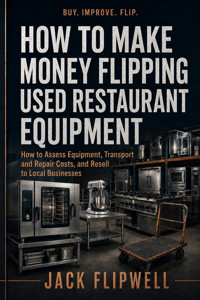
How to Make Money Flipping Used Restaurant Equipment - How to Assess Equipment, Transport and Repair Costs, and Resell to Local Businesses ebook
JACK FLIPWELL
Uzyskaj dostęp do tej i ponad 240000 książek od 14,99 zł miesięcznie
- Wydawca: ALL-IN Rafał Płonkowski
- Kategoria: Biznes, rozwój, prawo•Biznes, rozwój
- Język: angielski
How to Make Money Flipping Used Restaurant Equipment is a practical guide for readers who want to turn secondhand-market knowledge into a disciplined and profitable process. How to Assess Equipment, Transport and Repair Costs, and Resell to Local Businesses. The book takes the reader from sourcing and condition assessment through cost control, listing preparation, negotiation, safe delivery, and responsible scaling.
The author explains how to make decisions with numbers, reduce avoidable risk, and protect margin. Instead of promising effortless profit, the book provides concrete buying criteria, inspection routines, documentation practices, and methods for presenting an item so buyers can decide with confidence. The chapters form a repeatable system that can be adapted to different budgets, local markets, and available time.
This guide is written for first-time resellers, people building an additional income stream, and experienced operators who want a more consistent workflow. It helps readers separate a low price from a genuine opportunity, plan the work before buying, and build the credibility needed to complete sales with fewer disputes.
This publication was prepared using tools that support the creative process, including AI-based solutions. The final concept, structure, and editorial work belong to the author.
Ebooka przeczytasz w aplikacjach Legimi na:
Liczba stron: 77
Rok wydania: 2026
Odsłuch ebooka (TTS) dostepny w abonamencie „ebooki+audiobooki bez limitu” w aplikacjach Legimi na:
Podobne











INTRO
Used restaurant equipment can be an attractive flipping category because success depends on much more than finding something cheap and listing it for more. You need to assess the equipment, estimate transportation costs, recognize possible problems, and identify a buyer who can actually use the item. A commercial refrigerator, stainless steel worktable, or undercounter dishwasher may all look like ordinary business assets, but from a flipper's perspective they have very different levels of liquidity, risk, and handling cost. In this market, profit is often created before the purchase by knowing which deals to reject.
The market itself is broad. Restaurants, bars, coffee shops, bakeries, catering companies, food trucks, hotels, grocery businesses, and small food producers use large quantities of equipment and fixtures. Some businesses close, while others renovate, change concepts, replace machinery, or move to different premises, constantly feeding used equipment back into the market. At the same time, a business opening a new location may not want to buy every item new. Well selected used equipment can therefore have real value when its condition, purpose, and price are presented accurately.
This category is very different from flipping small consumer products. Commercial equipment can be heavy, bulky, difficult to store, and expensive to move. A bad purchase may occupy valuable floor space for weeks or months, while a poorly estimated collection or delivery cost can eliminate the entire margin. For that reason, we will not look only at the difference between buying and selling prices. You will learn to treat every deal as a complete project that includes acquisition, collection, loading, transportation, cleaning, assessment, possible repair, storage, listing, and final delivery.
One of the central skills will be separating equipment that is commercially attractive from items that only appear to be bargains. A simple stainless steel worktable may not promise a spectacular percentage return, but it is easy to inspect and has relatively few hidden technical risks. A sophisticated refrigeration or cooking appliance may appear far more profitable, yet one failed component, a difficult move, or incompatible utilities at the buyer's premises can completely change the economics. The objective is not to buy the most impressive equipment. It is to buy equipment whose risks you can understand and price.
A large part of the book will focus on assessing condition before purchase. You will learn to examine completeness, visible damage, contamination, corrosion, consumable items, doors, hinges, seals, shelves, runners, controls, displays, cords, and identification plates. We will also cover reasonable functional checks that a seller can perform without crossing into work requiring specialist knowledge or qualifications. Electrical, gas, refrigeration, and other technical systems that require professional competence should be handled by an appropriate technician rather than treated as opportunities for improvised repairs.
Logistics deserve equal attention. Before buying, you need to know not only whether the machine will fit inside your vehicle, but also how it will leave the building, whether it will fit through doorways, and whether you need a trolley, ramp, lifting equipment, extra people, or a vehicle with a tail lift. You may also need to know whether the unit has special transportation requirements and how removable parts should be secured. Every extra step creates cost and another opportunity for damage. A good buying decision therefore starts with dimensions, approximate weight, access conditions, location, and a realistic collection plan.
Resale potential matters just as much as purchase price. Before buying an item, you should have an idea of who might need it and why that buyer would consider a used unit. A stainless steel table is sold differently from an ice machine, commercial coffee machine, convection oven, fryer, or highly specialized production appliance. We will examine demand through intended use, size, utility requirements, brand, parts availability, condition, and ease of transportation. This turns sourcing from guesswork into a structured investment decision.
You should not assume that every unit needs to be repaired or restored to near-new condition. Sometimes the greatest value comes from thorough cleaning, replacing a simple missing user-serviceable item, taking strong photographs, and describing the condition accurately. In other cases, a professional repair may make economic sense, but only when the cost and uncertainty leave enough room for the deal to remain worthwhile. We will separate presentation improvements from technical intervention and cosmetic work from repairs that belong in the hands of qualified specialists.
Selling to businesses also requires a different approach from ordinary consumer resale. A restaurant owner or manager usually wants to know exactly what the equipment is, its dimensions, utility requirements, actual condition, whether it can be inspected, and how collection or delivery will work. A strong listing should save the buyer time instead of forcing them to ask for every basic fact one message at a time. You will learn how to create listings that help business buyers make decisions and how to negotiate without hiding faults or overstating condition.
Another important part of the process is calculating the maximum purchase price. An advertised price for similar equipment is not necessarily the price at which that equipment will actually sell within a reasonable period. Your calculation must leave room for transportation, preparation, repairs, negotiation, storage, unexpected problems, and your desired return for the capital and effort involved. The larger, heavier, more specialized, or less thoroughly tested the unit, the more carefully you need to protect your downside. Learning to walk away from an attractive-looking deal will be one of the most valuable skills in this book.
The chapters ahead follow the full process in sequence. We will cover selecting categories, sourcing opportunities, analyzing listings, inspecting and testing equipment, calculating purchase limits, negotiating, transportation, cleaning, repairs, listing creation, direct local sales, liquidation purchases, inventory management, seasonality, risk control, performance measurement, and scaling. We will also look at buying complete restaurant clear-outs, splitting large packages into more liquid individual items, and building relationships with local businesses. The goal is not random bargain hunting, but a repeatable system in which you know what you want, what you can pay, what risks you accept, and who may eventually buy the equipment.
Restaurant equipment flipping can start with simple individual items and expand as your experience, storage capacity, logistics, and local network improve. You do not need to begin by buying an entire closing restaurant or taking on equipment whose technical condition you cannot evaluate with confidence. A more controlled approach is to start with categories that have simpler risks, learn your local market, and expand only when the process supports it. Throughout this book, every purchase will be treated as a business decision rather than a bet that another buyer will eventually appear.
Chapter 1 - Choose Equipment You Can Actually Resell
A common beginner mistake is treating all restaurant equipment as one market. A stainless steel worktable, ice machine, convection oven, and commercial coffee machine may come from the same restaurant, but they have very different risk profiles. They differ in the number of potential buyers, difficulty of testing, transportation cost, failure risk, and installation requirements. Before searching for bargains, decide which categories you can safely buy, assess, store, and resell.
At the beginning, simplicity is an advantage. Equipment that does not require power, such as worktables, shelving, racks, carts, containers, and some stainless steel fixtures, is generally easier to evaluate than electrical, gas, or refrigeration equipment. Much of its condition can be confirmed visually, and defects are usually easier to identify and explain to the next buyer. These items may not always produce spectacular percentage margins, but they reduce the number of expensive unknowns between purchase and resale.
A second category can include relatively straightforward electrical equipment that can be operated and observed without opening or modifying it. Even here, caution is necessary. A machine switching on does not prove that it performs correctly under normal working conditions or that hidden components are healthy. A reseller can perform ordinary user-level checks, while internal electrical diagnosis, bypassing safety devices, or technical repair should be left to someone with the appropriate competence.
Refrigeration equipment can be attractive because almost every food business needs it, but it requires stricter buying discipline. A refrigerator or freezer may look clean, power on, and appear to cool during a short test while still having a problem that becomes obvious only after longer operation. Seals, fans, controls, drains, condensers, and refrigeration components all introduce additional uncertainty. If you cannot confidently assess the unit through safe user-level checks, include professional diagnosis in your calculation or walk away.
Gas appliances, advanced ovens, dishwashers, heating equipment, and specialized machines require even greater caution. Their possible resale values may be high, but the cost of a wrong assumption can also be high. Do not interfere with gas systems, internal safety controls, or technical components that you are not qualified to diagnose. A successful flipper is not someone who tries to repair everything, but someone who recognizes when specialist involvement is necessary and prices that cost before buying.