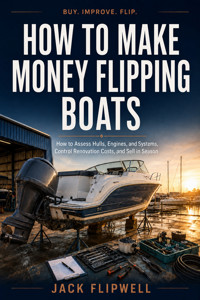
How to Make Money Flipping Boats - How to Assess Hulls, Engines, and Systems, Control Renovation Costs, and Sell in Season ebook
JACK FLIPWELL
Uzyskaj dostęp do tej i ponad 240000 książek od 14,99 zł miesięcznie
- Wydawca: ALL-IN Rafał Płonkowski
- Kategoria: Biznes, rozwój, prawo•Biznes, rozwój
- Język: angielski
How to Make Money Flipping Boats is a practical guide for readers who want to turn secondhand-market knowledge into a disciplined and profitable process. How to Assess Hulls, Engines, and Systems, Control Renovation Costs, and Sell in Season. The book takes the reader from sourcing and condition assessment through cost control, listing preparation, negotiation, safe delivery, and responsible scaling.
The author explains how to make decisions with numbers, reduce avoidable risk, and protect margin. Instead of promising effortless profit, the book provides concrete buying criteria, inspection routines, documentation practices, and methods for presenting an item so buyers can decide with confidence. The chapters form a repeatable system that can be adapted to different budgets, local markets, and available time.
This guide is written for first-time resellers, people building an additional income stream, and experienced operators who want a more consistent workflow. It helps readers separate a low price from a genuine opportunity, plan the work before buying, and build the credibility needed to complete sales with fewer disputes.
This publication was prepared using tools that support the creative process, including AI-based solutions. The final concept, structure, and editorial work belong to the author.
Ebooka przeczytasz w aplikacjach Legimi na:
Liczba stron: 79
Rok wydania: 2026
Odsłuch ebooka (TTS) dostepny w abonamencie „ebooki+audiobooki bez limitu” w aplikacjach Legimi na:
Podobne
















INTRO
Flipping boats is different from selling most used products because the cost of a mistake can be much larger. A bad phone, bicycle, or power tool purchase may create a manageable loss. With a boat, one overlooked problem involving the hull, engine, fuel system, electrical system, trailer, or paperwork can consume a large part of the entire project budget. Success in this category begins with rejecting risky deals before money changes hands.
The business model looks simple from a distance. You buy a boat below the value it could reasonably achieve after improvement, correct justified problems, present it properly, and sell it to the right buyer. Between purchase and resale, however, there may be transportation, storage, inspection, servicing, parts, cleaning, specialist labor, seasonal timing, photography, advertising, and negotiation. Profit is therefore created mainly through disciplined buying and cost control rather than at the moment the listing goes live.
You do not need to be a professional marine mechanic or structural surveyor to operate in this market. You do need to understand exactly where your own competence ends. Visual inspection, checking completeness, reviewing documents, cleaning, organizing the interior, and preparing a clear sales presentation can fall within the safe scope of a seller. Structural repairs, engine work, fuel systems, critical electrical work, steering, and other safety related systems should be inspected or repaired by appropriately qualified people when they exceed your abilities.
One of the most important habits in boat flipping is separating appearance from technical condition. Dirty upholstery, faded surfaces, cluttered lockers, and neglected cosmetic details may look terrible while remaining relatively inexpensive to improve. A shiny hull and freshly cleaned cockpit can hide problems that cost far more than every cosmetic improvement combined. The buyer must learn to search for expensive uncertainty first and visual opportunity second.
The hull deserves particular attention because it is the foundation of the entire boat. Cracks, distortion, suspicious repairs, transom concerns, water intrusion, damage below the waterline, or evidence of major impacts cannot be treated like ordinary scratches. Not every crack is structural and not every repaired area makes a boat unsuitable, but uncertainty must be treated as financial risk. When a problem goes beyond safe visual inspection, professional assessment is a better investment than assuming the damage is minor.
The engine and drive system create another major source of risk. An engine may start during a short demonstration and still require significant work. Service history, storage conditions, cooling, fuel delivery, corrosion, leaks, unusual sounds, behavior under load, and previous repairs all matter more than the simple fact that the engine runs. On higher value boats, a professional mechanical inspection may be one of the most important conditions of purchase.
A boat is also a collection of systems that can become expensive when several problems appear at once. Batteries, charging systems, pumps, lights, gauges, navigation electronics, steering, water systems, switches, wiring, and other equipment should be checked for basic function and visible condition. A seller should resist the temptation to repair unfamiliar systems quickly just to make them work for a demonstration. Improvised electrical work or unsafe changes to a fuel system increase liability and risk rather than creating value.
It is easy to confuse the purchase price with the real cost of entering a project. The boat may need to be collected, moved on an appropriate trailer, stored, inspected, serviced, cleaned, protected, and prepared for sale. Materials, parts, outside labor, repeated travel, and capital tied up until the sale also belong in the calculation. Every boat should therefore be evaluated as a complete project rather than as an attractive asking price.
A useful calculation begins with a cautious scenario. Instead of assuming that every unknown problem will be inexpensive, allow for the possibility that some repairs will cost more than expected. Instead of using the highest asking price you can find online, compare realistic competing boats, their condition, equipment, and the time they appear to remain available. If the project only works when every repair goes perfectly and the boat sells at the top of the market, there is not enough margin for error.
Seasonality matters greatly in this category. The same boat can attract very different levels of interest before the main boating season and when owners are beginning to think about storage rather than buying. A flipper therefore needs to ask not only how much a boat could sell for, but also when it is likely to sell. Purchase timing, repair scheduling, storage, and listing date all belong in the financial model.
Not every boat should be restored until it looks almost new. Over improving is one of the easiest ways to destroy the economics of a flip. Buyers may appreciate a clean, functional, well documented boat without paying enough extra to cover expensive upholstery, upgraded electronics, custom accessories, or improvements chosen according to the seller's personal taste. The goal is to remove problems that restrict value and confidence, then make improvements that have a credible commercial purpose.
Completeness also affects value. A boat sold with the appropriate trailer, keys, covers, available service records, manuals, organized equipment, and a clear explanation of completed work is easier for a buyer to understand. That does not mean every missing item should be replaced. It means you should identify which missing components materially affect transport, operation, documentation, buyer confidence, or the ability to complete the transaction.
Paperwork should be reviewed before money is paid rather than discovered as a problem at resale. Identification details, ownership information, trailer documents, available service records, and the seller's explanation of the boat should be sufficiently consistent to support the transaction. Administrative requirements vary by location, type of boat, and intended use, so this book does not replace checking current local rules. From a business perspective, however, one principle remains useful everywhere: do not buy a paperwork problem simply because the price looks low.
Honest selling is equally important. Flipping does not mean hiding a crack, temporarily suppressing a mechanical symptom, covering a damaged area, or making a cosmetic change so that the next buyer does not notice a known problem. Material defects that are known should be described according to their actual condition, and completed repairs should not be exaggerated. Good records and transparent explanations create far more durable value than trying to transfer an unresolved problem to someone else.
Throughout this book, the boat will be treated as an investment project rather than an emotional purchase. You will learn how to select a segment, find opportunities, screen listings, prepare inspections, assess hulls, engines, systems, trailers, and equipment, calculate a complete budget, and decide when to walk away. From there, the process moves into renovation planning, cost control, cosmetic preparation, documentation, pricing, photography, listing strategy, seasonality, buyer inspections, negotiation, and scaling. The objective is not to perform the greatest number of repairs, but to build a repeatable process in which each decision has a financial reason.
The best opportunity is often not the cheapest boat available. It is a boat whose problems can be identified, whose risks can be limited, and whose improvement can be completed within a controlled budget. The better you become at rejecting projects with uncontrolled uncertainty, the more capital remains available for better opportunities. In boat flipping, money is made not only through what you buy, but also through what you deliberately refuse to buy.
Chapter 1 - Choosing a Boat Segment and Flipping Model
The first decision should not be which specific boat to buy, but which part of the market you want to understand. Used boats range from small fishing boats and recreational runabouts to sport boats, cabin boats, and more specialized designs. Each category creates different requirements for transport, storage, inspection, capital, and resale. The narrower your initial focus, the faster you can learn what represents value and what only looks cheap.
For a beginner, simpler and easier to transport boats are often more manageable. A smaller boat may require less capital, occupy less storage space, and allow you to compare a larger number of similar listings. That does not mean small boats are automatically low risk. A damaged transom, questionable hull, bad engine, or paperwork problem can still destroy the economics of the project.
It helps to choose a segment in which comparable boats appear regularly on the market. When similar models, ages, engines, and configurations can be found, it becomes easier to estimate a realistic resale range. Rare boats may seem attractive because there is little competition, but they are also harder to value correctly. At the beginning, predictable demand is often more useful than the possibility of an unusually large margin.
The type of propulsion should also influence your choice of segment. A boat with a relatively simple outboard creates a different risk profile from a larger boat with a more complicated drive system and multiple supporting systems. The more complex the propulsion, the more important service history, specialist inspection, and repair costs become. If you do not have access to reliable technical support, a complicated boat may be a poor business choice even at an attractive purchase price.
Your segment must also fit your own logistics. You need to know where the boat will be stored, how it will be collected, whether you have access to a suitable tow vehicle or transport service, and whether basic preparation work can be done safely. Buying a larger boat before solving storage can create immediate costs. A boat located far away can also stop being cheap once collection and transport are included.