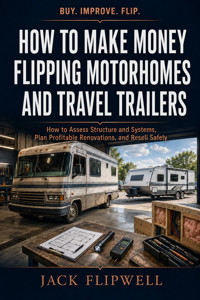
How to Make Money Flipping Motorhomes and Travel Trailers - How to Assess Structure and Systems, Plan Profitable Renovations, and Resell Safely ebook
JACK FLIPWELL
Uzyskaj dostęp do tej i ponad 240000 książek od 14,99 zł miesięcznie
- Wydawca: ALL-IN Rafał Płonkowski
- Kategoria: Biznes, rozwój, prawo•Biznes, rozwój
- Język: angielski
How to Make Money Flipping Motorhomes and Travel Trailers is a practical guide for readers who want to turn secondhand-market knowledge into a disciplined and profitable process. How to Assess Structure and Systems, Plan Profitable Renovations, and Resell Safely. The book takes the reader from sourcing and condition assessment through cost control, listing preparation, negotiation, safe delivery, and responsible scaling.
The author explains how to make decisions with numbers, reduce avoidable risk, and protect margin. Instead of promising effortless profit, the book provides concrete buying criteria, inspection routines, documentation practices, and methods for presenting an item so buyers can decide with confidence. The chapters form a repeatable system that can be adapted to different budgets, local markets, and available time.
This guide is written for first-time resellers, people building an additional income stream, and experienced operators who want a more consistent workflow. It helps readers separate a low price from a genuine opportunity, plan the work before buying, and build the credibility needed to complete sales with fewer disputes.
This publication was prepared using tools that support the creative process, including AI-based solutions. The final concept, structure, and editorial work belong to the author.
Ebooka przeczytasz w aplikacjach Legimi na:
Liczba stron: 80
Rok wydania: 2026
Odsłuch ebooka (TTS) dostepny w abonamencie „ebooki+audiobooki bez limitu” w aplikacjach Legimi na:
Podobne














INTRO
A motorhome or travel trailer may look like one large item to buy and resell, but in practice it is a combination of structure, equipment, systems, and living space. A motorhome also includes a base vehicle with its own drivetrain, brakes, steering, suspension, and electrical systems. This complexity creates opportunities for buyers who know how to assess condition properly, but it also means that one poor decision can become much more expensive than with most other used goods. In this market, the advantage does not belong to the person who is best at repainting cabinets, but to the person who identifies risk before buying.
Flipping motorhomes and travel trailers means buying units whose real potential is higher than their current presentation or market position suggests. Sometimes value can be improved through deep cleaning, better organization, minor repairs, cosmetic work, and complete documentation. In other cases, a broader renovation can make sense, but only when the cost, time, risk, and likely effect on resale appeal have been evaluated in advance. One of the most expensive mistakes is buying a project because it looks cheap and only afterward calculating what it will really take to finish.
The purchase price is only the beginning of the calculation. A project may also require transportation, storage, materials, parts, professional inspections, specialist repairs, sales preparation, and time during which capital remains tied up. With a motorhome, the automotive side can create major additional costs, while a travel trailer may require work on the chassis, brakes, hitch, tires, or other towing related components. A low asking price does not automatically make a unit a good deal.
One of the most important skills is learning to separate cosmetic problems from structural ones. Worn curtains, dated flooring, unattractive handles, or neglected surfaces may reduce the first impression while remaining relatively straightforward to improve. Moisture inside walls, delamination, damaged structural members, long term leaks, or compromised flooring belong to a very different category of risk. If you cannot competently determine the extent of such damage, the correct step is professional assessment, not experimentation on a vehicle that will later be sold to someone else.
Water intrusion and moisture deserve particular attention because many expensive problems begin with a small leak. A mark on the ceiling might be evidence of an old issue that was properly repaired, or it might indicate an active leak with hidden deterioration behind the visible finish. Smell, surface color, and the seller's explanation are not enough on their own. Throughout this book, you will learn to view seals, corners, windows, roof penetrations, flooring, and other vulnerable areas as parts of one system rather than isolated details.
The second major area of risk is the vehicle's technical systems. A motorhome or trailer may contain low voltage electrical circuits, shore power, batteries, chargers, heating, plumbing, water tanks, gas appliances, and additional systems installed by previous owners. Safe owner level tasks may include visual inspection of accessible components, cleaning, checking completeness, replacing simple user serviceable items, and documenting condition when you understand what you are doing. Work involving gas systems, mains electricity, structural repairs, safety critical vehicle systems, or other specialist areas should be handled by people with the appropriate skills and qualifications.
That distinction matters not only for safety but also for the economics of the flip. A successful flipper does not need to become a mechanic, electrician, gas technician, structural repair specialist, and appliance expert at the same time. What matters is knowing where safe owner level work ends and where professional diagnosis or repair begins. Using qualified specialists at the right moment is part of project planning, not evidence that the project was badly chosen.
Renovation should also not turn into an uncontrolled rebuild. It is easy to start with a few tired surfaces and then replace cabinets, flooring, lighting, appliances, systems, and finishes until the project absorbs far more money than the finished vehicle can justify. Buyers on the used market will not always pay back every dollar spent on improvements. For that reason, we will evaluate renovation work mainly through safety, functionality, buyer confidence, marketability, and the likelihood of recovering the investment.
This does not mean appearance is unimportant. Recreational vehicles are emotional purchases, and many buyers immediately imagine weekend trips, holidays, or longer journeys when they step inside. A clean interior, neutral smell, organized storage, complete equipment, and tidy finishes help the buyer see a usable vehicle instead of a list of future jobs. The seller's role, however, is to improve presentation without creating a misleading picture of technical condition.
Preparing the vehicle for sale is therefore just as important as buying and renovating it. Good photographs should show more than an attractive lounge or sleeping area. They should also make the layout, kitchen, bathroom, storage, exterior condition, and important equipment easy to understand. The description should clearly distinguish between installed equipment, completed work, known limitations, and anything that has not been verified. Hiding leaks, structural problems, system faults, or other important defects is not a strategy for improving margin and has no place in the process described in this book.
Documentation also matters. Invoices for professional work, appliance manuals, photographs taken during repairs, inspection records, and organized information about installed components can reduce uncertainty for a buyer. At the same time, a document should never be presented as proof of something it does not actually confirm. Professional resale depends on distinguishing clearly between what is known, what has been tested, and what remains uncertain.
Not every motorhome or travel trailer is suitable for flipping. Some units may have attractive prices but too many unknowns, while others may be technically sound yet purchased too close to their likely resale value. Some renovations are simply too extensive relative to the value of the finished vehicle. One of the most important skills you will develop is the ability to walk away from a deal without feeling that you have missed an opportunity.
We will treat each project as a sequence of connected stages: sourcing, initial screening, inspection, risk assessment, purchase price calculation, renovation planning, cost control, safe owner level improvements, specialist work, documentation, and finally resale. The earlier a problem is identified, the more opportunity you have to include it in the buying decision. The later an unexpected cost appears, the more likely it is to come directly out of the margin you expected to keep.
Motorhomes and travel trailers will be treated separately whenever the differences matter. A motorhome requires assessment of both the base vehicle and the habitation area, and those two parts may age at very different rates. A travel trailer has no engine, but its chassis, braking system, suspension, tires, hitch, weight, and towing related components still require serious attention. In both cases, an attractive interior must never distract from the elements responsible for durability and safety.
This book will not teach you how to disguise a problem and pass it to the next owner. The goal is to build a process in which value comes from better selection, proper organization, sensible renovation, disciplined cost control, and transparent resale. No project is guaranteed to produce the same result, and no calculation should be treated as a promise of profit. What you can do is improve the quality of your decisions by evaluating every opportunity through repeatable criteria instead of price and emotion.
The chapters ahead will move from sourcing and screening through structure, moisture, chassis, vehicle condition, electrical systems, gas, plumbing, equipment, renovation planning, budgeting, preparation, and final resale. You will learn how to identify improvements that genuinely create value, recognize problems that should reduce the purchase price, stop a project before renovation when the risk becomes unacceptable, and prepare an offer that allows the buyer to make an informed decision. One principle will remain central throughout the book: profit begins not when you list the vehicle for sale, but when you assess it correctly before you buy.
Chapter 1 - How Motorhome and Travel Trailer Flipping Works
Flipping a motorhome or travel trailer starts with finding a gap between what a unit costs today and what it could reasonably be worth after careful preparation. That gap does not have to come from a major renovation. It may result from poor presentation, neglected interiors, incomplete documentation, minor defects, or a seller who wants a fast transaction. The safest projects are usually those where the source of added value is easy to understand and does not depend on discovering expensive hidden problems.
In this market, much of the value comes from selecting better than the average buyer. Someone shopping for personal use may fall in love with the layout, equipment, or idea of future travel and overlook important risks. A flipper should reverse that order by examining structure, technical condition, documentation, and required work before becoming interested in the appearance. Emotion can help sell the finished vehicle later, but it should not drive the purchase decision.
The simplest model is buying units that are fundamentally sound but visually neglected. Dirty upholstery, dated fabrics, cluttered interiors, yellowed surfaces, and poor listing photos can significantly reduce buyer interest without creating major technical problems. These projects offer room to improve appeal through work that is relatively easy to plan and budget. The important caution is that dirt and odor must not be allowed to hide moisture, mold, or evidence of previous leaks.