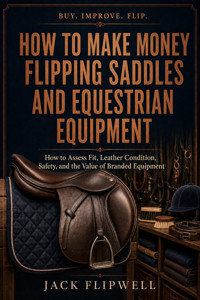
How to Make Money Flipping Saddles and Equestrian Equipment - How to Assess Fit, Leather Condition, Safety, and the Value of Branded Equipment ebook
JACK FLIPWELL
Uzyskaj dostęp do tej i ponad 240000 książek od 14,99 zł miesięcznie
- Wydawca: ALL-IN Rafał Płonkowski
- Kategoria: Biznes, rozwój, prawo•Biznes, rozwój
- Język: angielski
How to Make Money Flipping Saddles and Equestrian Equipment is a practical guide for readers who want to turn secondhand-market knowledge into a disciplined and profitable process. How to Assess Fit, Leather Condition, Safety, and the Value of Branded Equipment. The book takes the reader from sourcing and condition assessment through cost control, listing preparation, negotiation, safe delivery, and responsible scaling.
The author explains how to make decisions with numbers, reduce avoidable risk, and protect margin. Instead of promising effortless profit, the book provides concrete buying criteria, inspection routines, documentation practices, and methods for presenting an item so buyers can decide with confidence. The chapters form a repeatable system that can be adapted to different budgets, local markets, and available time.
This guide is written for first-time resellers, people building an additional income stream, and experienced operators who want a more consistent workflow. It helps readers separate a low price from a genuine opportunity, plan the work before buying, and build the credibility needed to complete sales with fewer disputes.
This publication was prepared using tools that support the creative process, including AI-based solutions. The final concept, structure, and editorial work belong to the author.
Ebooka przeczytasz w aplikacjach Legimi na:
Liczba stron: 75
Rok wydania: 2026
Odsłuch ebooka (TTS) dostepny w abonamencie „ebooki+audiobooki bez limitu” w aplikacjach Legimi na:
Podobne












INTRO
Flipping equestrian equipment is different from reselling many other used products because value depends on far more than brand, age, and appearance. A saddle can look excellent in photographs while still having structural concerns, questionable past repairs, or specifications that make it difficult to match with the right buyer. At the same time, a visually average saddle from a respected maker, with clear markings and sound key components, may be a much better purchase. Profit in this category comes largely from learning to separate valuable equipment from items that carry too much uncertainty.
The market is broad. It includes dressage, jumping, all-purpose, western, and other specialized saddles, as well as bridles, reins, girths, stirrup leathers, stirrups, saddle pads, blankets, boots, storage cases, bags, and many other accessories used by riders and around horses. Each group needs a slightly different assessment process. With some products, brand and leather condition dominate the value equation, while with others hygiene, completeness, mechanical wear, or the safety of load-bearing parts matters more.
A central principle of this book is the separation between commercial assessment and professional assessment of fit and safety. A reseller can check manufacturer markings, record dimensions, inspect visible leather condition, photograph wear, compare completeness, and document whatever history is available. A reseller should not present a personal opinion as professional confirmation that a saddle fits a specific horse and rider correctly. Questions involving internal construction, significant repairs, saddle fitting, or safety-critical components should be referred to appropriately qualified professionals.
This distinction matters financially as well. A beginner may assume that every old saddle can be cleaned, conditioned, and relisted for substantially more money. Cleaning can improve presentation, but it cannot repair compromised construction, weakened stitching, overstretched leather, or problems hidden below the surface. If an item may require specialist work, both the cost and the economic logic of that work should be considered before purchase rather than after the item is already sitting in inventory.
The safest flipping model therefore starts with selection. Instead of buying everything that looks cheap, you build criteria defining which brands, models, sizes, and categories make sense for your business. You ask whether the product can be identified properly, whether its condition can be documented responsibly, and whether there is a realistic group of buyers to whom it can later be marketed. A good transaction begins before money changes hands.
Documentation is especially important in this category. Serial numbers, stamps, embossed markings, labels, model identifiers, and manufacturer information can matter far more than an attractive full-product photograph. They help establish what you are actually selling, reduce the risk of confusing one version with another, and make it easier for a buyer to perform independent verification. If a detail cannot be confirmed, it is better to describe it as unverified than to build the price around an assumption.
Condition should be approached in the same way. Words such as "nice," "well cared for," and "lightly used" are too vague when they are not supported by detailed photographs and specific descriptions. Buyers may need to know about scuffs, cracks, stretching, worn stitching, previous repairs, corrosion, damaged buckles, and deterioration in areas exposed to regular load. The more precisely you describe an item before the sale, the lower the risk of misunderstandings afterward.
Improving a product does not always mean repairing it. In many cases, the highest-value work consists of careful cleaning, organizing the set, storing it correctly, taking strong photographs, and writing a clear description. Attempting to restitch load-bearing parts, interfere with saddle structure, or conceal cracking can reduce value and create a safety problem. If a defect has safety implications, the objective is not to hide it but to identify it, disclose it, and decide whether the product should return to normal use at all.
Capital management is another important part of the strategy. Two saddles bought at apparently attractive prices may be a worse investment than one clearly identified, well-documented example from a desirable maker. Money tied up in slow-moving inventory cannot be used when the next strong opportunity appears. For that reason, we will look not only at potential resale price but also at liquidity, preparation costs, transport, return risk, shipping difficulty, and the time required to find the right buyer.
Specialization can create a major advantage. Someone trying to trade every kind of saddle, riding apparel, stable equipment, and accessory at once may gather a large amount of shallow knowledge while still making expensive mistakes. A better starting point may be one or two product groups in which you learn the markings, common wear points, typical configurations, and questions buyers repeatedly ask. Once that knowledge becomes reliable, the range can be expanded gradually.
This book will take you through the full process, from choosing categories and sourcing inventory to identifying branded equipment, inspecting condition, assessing leather and metal parts, documenting measurements, recognizing warning signs, preparing listings, pricing, packing, selling, and building a repeatable system. Saddles, leather accessories, and other equestrian products will be treated separately where their risks and assessment criteria differ. Throughout the book, we will keep distinguishing between work a reseller can perform safely and decisions involving fit, construction, or safety-related repairs that require professional expertise.
The goal is not to find a magical category that guarantees profit. The goal is to build a process that helps you buy the wrong products less often, recognize good opportunities faster, price uncertainty more accurately, and present equipment honestly to buyers. In saddle and equestrian equipment flipping, the real edge comes from knowledge, patience, and discipline at the buying stage. If you learn to walk away from transactions you do not understand as confidently as you pursue the ones you do, you will be operating much more like a business and much less like a casual reseller.
Chapter 1 - How the Used Saddle and Equestrian Equipment Market Works
The used equestrian equipment market is attractive because some products carry substantial value while sellers vary greatly in how well they understand what they own. One person may know the exact saddle model, seat size, production details, and service history, while another may simply advertise an "old leather saddle" with almost no useful information. That information gap can create opportunities for a knowledgeable reseller. A low asking price alone, however, never proves that an item is a good buy.
Saddles naturally attract attention because their individual value can be much higher than that of most accessories. This does not automatically make them the best category for a beginner. Mistakes involving identification, condition, construction, or specifications can be expensive, and some saddles may take a long time to sell. Smaller products such as bridles, reins, girths, stirrup leathers, and selected protective equipment can provide a lower-cost way to learn about materials, brands, wear patterns, and buyer expectations.
From the beginning, separate the original retail value of a product from the realistic value of the used example in front of you. Expensive equipment does not necessarily remain valuable simply because it once had a high purchase price. Brand, model, current demand, size, configuration, completeness, condition, and the ability to document the item all affect resale potential. A once-expensive product in an unusual specification or poor condition may be much harder to sell than a less prestigious but more usable alternative.
Demand is uneven across the market. Some items appeal to a broad range of riders, while others make sense only within a particular discipline, horse type, riding style, or level of specialization. The narrower the application, the more important it becomes to understand exactly who the eventual buyer might be. When sourcing inventory, ask not only whether the price looks low but also whether you can identify a realistic resale audience.
Brand matters, but it should never replace inspection of the individual item. A recognized maker can improve liquidity because buyers may search specifically for that brand and can often find more information about its products. Even a strong brand, however, cannot compensate for serious damage, undocumented alterations, excessive wear, or safety concerns. Brand establishes potential, while the condition of the specific example determines how much of that potential remains.
One of the biggest mistakes in this market is confusing visual quality with functional quality. Well-conditioned leather may photograph beautifully even when parts of the equipment require specialist assessment. Conversely, superficial dirt can make a fundamentally sound product look unattractive in a poorly prepared listing. A reseller should therefore evaluate presentation, material condition, hardware, repairs, and safety-related concerns as separate questions rather than allowing one attractive feature to dominate the decision.
The market also has a strong local component. Saddles are often easier to sell when buyers can inspect them in person, verify markings, look closely at condition, and decide whether professional fitting assessment is worth pursuing. Smaller products are generally easier to sell remotely because dimensions, condition, and completeness can often be documented more effectively. Your preferred sales method should therefore influence what you buy.