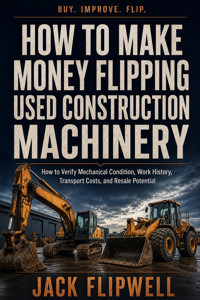
How to Make Money Flipping Used Construction Machinery - How to Verify Mechanical Condition, Work History, Transport Costs, and Resale Potential ebook
JACK FLIPWELL
Uzyskaj dostęp do tej i ponad 240000 książek od 14,99 zł miesięcznie
- Wydawca: ALL-IN Rafał Płonkowski
- Kategoria: Biznes, rozwój, prawo•Biznes, rozwój
- Język: angielski
How to Make Money Flipping Used Construction Machinery is a practical guide for readers who want to turn secondhand-market knowledge into a disciplined and profitable process. How to Verify Mechanical Condition, Work History, Transport Costs, and Resale Potential. The book takes the reader from sourcing and condition assessment through cost control, listing preparation, negotiation, safe delivery, and responsible scaling.
The author explains how to make decisions with numbers, reduce avoidable risk, and protect margin. Instead of promising effortless profit, the book provides concrete buying criteria, inspection routines, documentation practices, and methods for presenting an item so buyers can decide with confidence. The chapters form a repeatable system that can be adapted to different budgets, local markets, and available time.
This guide is written for first-time resellers, people building an additional income stream, and experienced operators who want a more consistent workflow. It helps readers separate a low price from a genuine opportunity, plan the work before buying, and build the credibility needed to complete sales with fewer disputes.
This publication was prepared using tools that support the creative process, including AI-based solutions. The final concept, structure, and editorial work belong to the author.
Ebooka przeczytasz w aplikacjach Legimi na:
Liczba stron: 81
Rok wydania: 2026
Odsłuch ebooka (TTS) dostepny w abonamencie „ebooki+audiobooki bez limitu” w aplikacjach Legimi na:
Podobne















INTRO
Flipping used construction machinery may look like a larger version of flipping cars or power tools, but the economics are very different. A single mistake can absorb a large share of your available capital, while transport alone can turn an attractive purchase into a weak deal. An excavator, wheel loader, mini excavator, roller, telehandler, or backhoe loader is not simply an object that can be bought cheaply and resold at a higher price. Its value depends on mechanical condition, work history, configuration, attachments, location, parts availability, and how easily the next owner can put it to productive use.
The first principle of this business is simple: most of the profit is created when you buy. A strong purchase price leaves room for transport, inspection, diagnostics, servicing, preparation, unexpected problems, and negotiation with the next buyer. If you pay close to realistic retail value, even excellent preparation may not create enough margin. A disciplined flipper therefore asks not how much a machine might sell for, but how much can safely be paid for it after realistic costs and risks are deducted.
A low asking price usually has a reason. Sometimes the reason is harmless, such as a contractor finishing a project, a fleet being replaced, poor advertising, an inconvenient location, or an owner who wants a fast sale. In other cases the discount may reflect hydraulic wear, drivetrain problems, structural damage, neglected servicing, worn undercarriage components, electrical faults, or a defect the seller has not properly diagnosed. Your job is not to assume the worst, but to identify as much uncertainty as possible before committing capital.
This book does not assume that every profitable machine must be restored to near-new condition. In many good deals, value is created through careful inspection, organized documentation, appropriate servicing, sensible cleaning, confirmation of specifications, attachment management, and honest presentation. Buyers often pay more because uncertainty has been reduced, not because every worn component has been replaced. The easier it is for a buyer to understand exactly what is being offered, the easier it becomes to justify the price.
Hour meter readings are useful, but they should never be treated as a complete measure of wear. Two machines showing similar hours can be in dramatically different condition depending on workload, operators, environment, maintenance practices, and the quality of previous repairs. A higher-hour machine that was consistently maintained may be a better purchase than a lower-hour machine with an unclear history. Hours are one piece of evidence, not a substitute for inspection.
Work history matters because different applications create different wear patterns. An excavator used continuously in demolition or rocky ground may deserve different scrutiny from the same model used for lighter utility work. A wheel loader operating in abrasive or dusty conditions creates a different set of questions from one working mainly on a clean material handling site. Heavy use does not automatically make a machine unsuitable, but the purchase price must reflect what that use may have done to its components.
A successful flipper also needs to know where personal inspection should stop and professional technical work should begin. You can document leaks, observe starting behavior, listen for unusual sounds, inspect hoses, pins, tires, tracks, attachments, identification numbers, and available records. You should not improvise around pressurized hydraulic systems, unsupported raised equipment, complex electrical systems, or repairs requiring specialized measurements and tools. When proper diagnosis requires trained technicians, the cost of professional inspection belongs in the investment process.
Transport deserves the same attention as mechanical condition. A machine located far from your market may look cheap until you determine how it will be loaded, moved, unloaded, and stored. Weight, dimensions, operating condition, attachments, site access, and loading capability all affect the logistics. Before you commit to a purchase, you should already understand how the machine can realistically reach your location and what that movement may add to the transaction.
For that reason, a flip cannot be evaluated using only purchase price and expected resale price. The calculation may need to include inspection, diagnostics, transport, parts, professional labor, cleaning, storage, sales preparation, and the cost of holding the machine longer than expected. You also need room for issues that were not visible during the first inspection. A deal that works only if everything goes perfectly is usually too fragile.
Market liquidity matters just as much as theoretical value. A machine may once have been expensive, highly specialized, or technically impressive and still be difficult to resell. A widely used model with understandable specifications, familiar service requirements, and readily available parts can be a stronger flipping candidate than a rare machine offered at a dramatic discount. Potential margin means little if the realistic buyer pool is extremely small.
Improving a machine for resale does not mean hiding its past. Active leaks should not be washed away simply so the next buyer fails to notice them, warning systems should not be bypassed, and significant wear should not be described as irrelevant just because the machine still operates. A stronger strategy is to understand the defect, decide whether repairing it makes economic sense, and disclose what remains. Honest presentation reduces disputes and can create repeat business that is more valuable than squeezing extra money from one transaction.
Not every defect should be repaired before sale. Some problems should be addressed because they affect safety, prevent a meaningful test, or make the machine difficult for most buyers to accept. Other repairs cost more than the additional resale value they create. Learning to separate value-creating work from margin-destroying work is one of the central skills in machinery flipping.
Throughout this book, the machine will be considered from three perspectives: technical condition, commercial value, and usefulness to the next owner. You will learn how to select promising market segments, screen listings, verify identity and work history, conduct organized inspections, and identify warning signs without pretending to be a specialist where professional diagnosis is required. The same process will cover engines, cooling systems, hydraulics, drivetrains, undercarriages, structural components, controls, electronics, and attachments. The goal is not to turn you into a heavy-equipment mechanic, but to help you recognize when you have enough information to make a decision and when you need expert support.
The commercial side is equally important. Clear photographs, accurate equipment descriptions, videos showing operation, organized maintenance records, and a sensible inspection process can make a used machine considerably easier to sell. You will learn to treat asking price as part of a strategy rather than a number copied from nearby listings. The full process runs from finding a possible deal to handing the machine over to its next owner.
You will not find promises of guaranteed profit or a universal margin that can be applied to every machine. Construction equipment varies too widely by model, condition, location, application, transport requirements, and buyer demand. What you will find is a process designed to eliminate weak deals before money is committed. In this market, one of the most profitable decisions can be deciding not to buy.
Professional flipping therefore begins with patience. You do not need the biggest excavator, the cheapest loader, or the largest apparent gap between purchase price and online asking prices. You need a machine whose condition you can understand well enough, whose risks fit your capital, and whose resale market is realistic. When those three elements are consistently combined, flipping used construction machinery becomes less like gambling on bargains and more like managing a controlled business process.
Chapter 1 - Choose Machines You Can Actually Resell
Your first task is not to find the cheapest machine, but to decide what type of equipment you want to buy. The used construction machinery market includes equipment with very different values, applications, transport requirements, and resale liquidity. A mini excavator, backhoe loader, wheel loader, roller, or telehandler may appear to offer a similar potential margin, but each requires a different buyer and a different inspection process. At the beginning, specializing in a few categories is usually safer than trying to buy anything that appears discounted.
The easiest machines to resell are often those with broad and easily understood applications. A small contractor, utility company, landscaping business, agricultural operator, or equipment rental company may all be interested in a similar compact excavator, while a highly specialized machine may appeal to only a small group. The narrower the buyer pool, the more important the purchase price becomes. A large theoretical margin does not help if no realistic buyer appears for months.
Before analyzing individual deals, spend time observing one chosen segment. Watch which models appear frequently, which listings disappear relatively quickly, and which features repeatedly appear on higher-priced machines. Do not assume that an advertised price is the same as the final transaction price. Your goal is to understand what level of pricing appears attractive to actual buyers, not to calculate an average from random listings.
Parts and service availability also matter. A machine may be mechanically interesting, but if potential buyers expect difficulty obtaining parts, electronic support, or specialized diagnostics, they may demand a larger discount. Popular models are often easier to resell not because they are always technically superior, but because contractors already understand their strengths, weaknesses, and maintenance requirements. Access to used parts, aftermarket components, and technicians familiar with the machine can directly support resale value.
Configuration can matter almost as much as brand and model. Two machines from the same year can have different values because of cab type, undercarriage, hydraulic circuits, quick coupler, working equipment, tires, tracks, or additional attachments. Some options expand the range of possible jobs and therefore increase the number of potential buyers. Others are valuable only to a narrow group and should not automatically justify a higher purchase price.