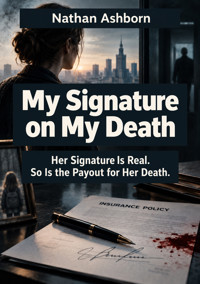
My Signature on My Death - Her Signature Is Real. So Is the Payout for Her Death. ebook
Nathan Ashborn
Uzyskaj dostęp do tej i ponad 240000 książek od 14,99 zł miesięcznie
- Wydawca: ALL-IN Rafał Płonkowski
- Kategoria: Thriller, sensacja, horror
- Język: angielski
Anna Radecka knows what her signature looks like. She has spent years working with contracts, financial reports, approvals, and documents where a single line can carry enormous consequences.
That is why she knows the signature on the life insurance policy is real.
The problem is that Anna never knowingly took out the policy.
It is worth 2.4 million złoty.
Someone has already reported her death.
And the person listed to receive the money appears to live at Anna’s own address.
What begins as an impossible administrative error quickly turns into something far more disturbing. A dead man’s identity has returned to the financial system. Someone has entered Anna’s building. A camera is discovered inside her apartment. Her daughter is photographed outside school. Hospital records, insurance files, old financial audits, and people Anna has not thought about in years begin connecting in ways that should not be possible.
The deeper Anna looks, the less the case resembles a single act of fraud.
Years earlier, she worked on an audit involving companies tied to medical financing. The report uncovered irregular transactions, duplicated assets, unexplained payments, and financial structures designed to hide who was really responsible. Anna believed the matter had been closed.
Someone else remembered.
Now people connected to that old system are disappearing, lying, cooperating, or turning up in places they should never have been. Some are frightened. Some are guilty. Some have convinced themselves that performing only one small task means they are not responsible for what happens next.
One person prepares a document.
Another photographs a phone.
Another installs a camera.
Another moves money.
And somewhere above them is someone who knows how to turn ordinary access, ordinary mistakes, and ordinary fear into a system capable of rewriting a living woman as dead.
Anna must discover why her name has returned to a financial network built on stolen identities, why her daughter has become part of the pressure against her, and whether the policy was created to profit from her death - or for a reason even more complicated.
My Signature on My Death is a psychological thriller about trust, complicity, financial manipulation, surveillance, and the dangerous distance between doing one small thing and becoming part of something much larger. As Anna follows the trail through Warsaw offices, hospital archives, old corporate records, and the private histories of people around her, every answer changes the meaning of what came before.
Her signature is genuine.
The documents are not.
And someone has already begun preparing a world in which Anna Radecka no longer exists.
This publication was prepared using tools that support the creative process, including artificial intelligence solutions. The final concept, structure and editing are the responsibility of the author.
Ebooka przeczytasz w aplikacjach Legimi na:
Liczba stron: 251
Rok wydania: 2026
Odsłuch ebooka (TTS) dostepny w abonamencie „ebooki+audiobooki bez limitu” w aplikacjach Legimi na:
Podobne









Nathan Ashborn
My Signature on My Death
Her Signature Is Real. So Is the Payout for Her Death.
ALL-IN Rafał Płonkowski
2026
ISBN 9788384833445
Table of contents
Title page
INTRO
Chapter 1 - The Man at My Address
Chapter 2 - Documents I Never Signed
Chapter 3 - Sixteen Minutes
Chapter 4 - The Dead Beneficiary
Chapter 5 - People Who Died Twice
Chapter 6 - It Didn’t Start with the Policy
Chapter 7 - The Man Who Only Carried Envelopes
Chapter 8 - The Second Version of My Death
Chapter 9 - The Car Across the Street
Chapter 10 - The Claim That Was Meant to Save Me
Chapter 11 - The Money That Outlived Everyone
Chapter 12 - The Man Everyone Was Supposed to Suspect
Chapter 13 - The Laptop No One Returned
Chapter 14 - The Report Someone Edited for Me
Chapter 15 - The Call Tomasz Didn’t Answer
Chapter 16 - Patient Zero
Chapter 17 - The Man Who Had a Key
Chapter 18 - The Price of Staying Alive
Chapter 19 - The Final Settlement
Chapter 20 - My Signature Belongs to Me
Landmarks
Cover
Title page
Table of contents
Start of content
INTRO
When Anna Radecka saw her own signature beneath the date of her death, the first thing she felt was not fear.
It was irritation.
The document lay on the conference table inside a transparent plastic sleeve, as though someone was worried she might soil it. Three pages of fine print, several stamps, the logo of Meridian Insurance Company, and her name written exactly as it appeared on her ID card.
Anna Maria Radecka.
The national identification number was correct.
So was the address.
At the bottom of the second page was a signature.
Her signature.
“That doesn’t look like my signature,” she said. “It is my signature.”
The woman sitting across the table did not answer immediately. She was perhaps forty-five, with her hair tied low at the nape of her neck and the kind of calm face Anna associated with people who delivered bad news for a living.
Her badge read: Marta Sowińska, Compliance Department.
“That is precisely why we asked you to come in.”
Anna pulled the document a few centimeters closer. She could not take it out of the sleeve. Sowińska had already explained that the original formed part of the company’s internal records and could not leave the room.
The value of the policy was printed on the first page.
Two million four hundred thousand zlotys.
Anna read the amount for the third time.
“I have never had insurance like this.”
“I understand.”
“No, I don’t think you do. I have group life insurance through work. A standard policy. I think it pays about three hundred thousand if I die. I have never taken out anything worth two million.”
“Two million four hundred thousand.”
Anna looked at her.
“Was that supposed to help?”
“I want us to be precise.”
Beyond the glass wall of the conference room, Warsaw was drowning in October rain. People moved beneath umbrellas on the pavement near Rondo Daszyńskiego, cars sat motionless in traffic, and a tram waited at the lights. An ordinary Tuesday. That morning Anna had driven her daughter to school, argued on the phone with a furniture supplier about her new apartment, drunk coffee in the car, and arrived eleven minutes late for a meeting she had been convinced was about an error in a database.
Two hours earlier, Meridian had called her.
A request for her to verify her identity in person in connection with an insurance policy.
Nothing more.
Now she was staring at a document claiming that eight months ago she had voluntarily insured her own life for more than her apartment was worth.
“Who pays the premiums?”
Sowińska hesitated.
It was the first thing the woman had done that did not look rehearsed.
“The premium was paid as a single payment.”
“By me?”
“No.”
Anna placed both hands on the table.
“But you just said this was my policy.”
“You are the insured person.”
“Then who took it out?”
“That is one of the matters we are currently investigating.”
“Who?”
Sowińska opened a thin gray folder even though she clearly did not need to look anything up.
“Your husband.”
For several seconds, all Anna could hear was the hum of the ventilation system.
“I don’t have a husband.”
This time Sowińska looked at her immediately.
“According to the documentation, the person who entered into the contract was Tomasz Radecki.”
Anna felt irritation give way to something colder.
“Tomasz is my ex-husband.”
“When did you divorce?”
“Three years ago.”
“Are you still in contact?”
“We have a daughter. So yes.”
“Would he have known that you had this policy?”
“I didn’t have any policy.”
Sowińska closed the folder.
“Ms. Radecka, I need to ask you several questions now that may sound strange.”
“I think we’re already past that point.”
The woman accepted the remark without smiling.
“In February of this year, did you sign any financial documents while you were with Tomasz Radecki?”
Anna wanted to say no.
Instead, she saw Tomasz’s kitchen.
A Sunday.
Jagoda doing a math assignment at the kitchen island.
A mug of tea.
Tomasz sliding two sheets of paper and a pen toward her.
An authorization concerning their daughter’s school account.
That was what he had said.
Anna had signed them.
She had read one page.
Not the other.
“Possibly,” she said.
“By hand?”
“Yes.”
“With a black pen?”
Anna looked at the signature again.
Black ink.
The downward stroke from the R dropping slightly too low. A tiny break near the end of her surname. The distinctive tremor that appeared only when she signed something quickly.
Not a copy.
Not a scan.
A signature made by the same hand she was now gripping against the edge of the table.
“What is going on?” she asked.
Sowińska took a slow breath.
“Yesterday morning, a claim was submitted under this policy.”
Anna did not understand.
“What kind of claim?”
The woman did not look away.
“A claim arising from the death of the insured person.”
Anna let out a short laugh, but the sound seemed foreign even to her.
“Meaning me.”
“Yes.”
“Someone reported that I was dead.”
“Yes.”
“Yesterday?”
“At eight seventeen in the morning.”
Anna reached for the phone lying beside her handbag. The screen showed three missed calls, a message from Jagoda, and a notification from her banking app. Everything looked normal.
“And that’s why you called me?”
“No.”
Her finger stopped above the screen.
“No?”
“We contacted you because an automated data check detected activity on your phone number after the stated time of death. If it had not, the claim would have continued through the standard process.”
Anna slowly put the phone down.
“The stated time?”
Sowińska opened the folder again.
She removed a single sheet of paper.
This time she did not hand it to Anna.
She placed it in front of herself.
“The claim did not simply state that you were dead. It included documentation confirming the death.”
Anna watched her for a moment.
“A death certificate?”
“No.”
“Then what?”
“A hospital information sheet and a medical certificate. The documents are being verified.”
“From which hospital?”
Sowińska was silent for a second too long.
“St. Elizabeth Hospital.”
Anna stopped breathing.
Sowińska noticed.
“Do you know the hospital?”
Anna stared at the rain-slicked windows behind her.
She did.
Eight years earlier, she had spent nine days there after a car accident. Two years later, Jagoda had undergone surgery there. And for the past six months, someone Anna knew far better than she wanted to admit had been working there.
Tomasz.
Not as a doctor. He ran the administration of one of the hospital divisions.
“Ms. Radecka?”
Anna looked back at the document.
“Who was supposed to get the money?”
Sowińska went still.
And that was when Anna understood that this was the question the woman had been trying to avoid from the beginning.
“The beneficiary was changed three weeks ago,” she said.
“From Tomasz?”
“Tomasz Radecki was never the beneficiary.”
“Then who?”
Sowińska turned the third page of the policy toward her.
Anna read the name.
Then she read it a second time.
And a third.
She did not know the person.
But she knew the address printed beside the name.
It was her own.
Chapter 1 - The Man at My Address
The name sounded ordinary.
Michał Bielski.
If Anna had seen it on an intercom, a courier parcel, or the attendance list at one of Jagoda’s school meetings, she probably would have forgotten it within minutes. Now, however, it appeared beside her own address on a document concerning two million four hundred thousand zlotys to be paid out after her death.
She read the name again.
“I don’t know him.”
Marta Sowińska sat motionless. Anna had the impression that from the beginning of their conversation, the woman had been weighing every word, as though a lawyer were working beneath the table, pressing a red or green button after each sentence.
“Has anyone with that surname ever lived at your address?”
“No one but me and my daughter.”
“Your former husband?”
“Never. I bought the apartment after the divorce.”
“Have you ever rented a room to anyone? Allowed someone to use the address for correspondence?”
Anna stared at her in disbelief.
“I’m forty-two years old, I have a daughter in elementary school, and a mortgage. Do you really think I might have forgotten about some strange man living with me?”
“I’m not suggesting anything.”
“Well, I’m starting to. Someone took out a policy on my life, someone named a man I don’t know, someone gave my address as his address, and yesterday someone reported that I was dead. What exactly are you planning to do about that?”
Sowińska folded her hands on top of the folder.
“The payout has been suspended.”
“That is enormously reassuring.”
“Ms. Radecka, I understand your reaction, but I need to separate two issues very clearly. We are an insurance company. We can secure the claim, conduct an internal investigation, and provide information to the authorities if we confirm that there is reason to suspect a crime. We are not in a position to assess whether there is a threat to your personal safety.”
“Who filed the claim?”
“Formally, the beneficiary.”
“Michał Bielski.”
“Using his details.”
“So someone logged in as him?”
Sowińska hesitated.
“The claim was submitted electronically.”
“From what email address?”
“I can’t disclose all of a third party’s information to you.”
Anna pushed back her chair.
“A third party? That person has just applied for two million four hundred thousand zlotys because of my death.”
“That is why our legal department will prepare the information we are permitted to provide. I don’t want to violate procedure now and compromise any later proceedings.”
Anna stood, but she did not leave. She looked down at the third page of the policy.
Beside Bielski’s name was the date on which the beneficiary had been changed.
September twelfth.
Twenty-two days earlier.
“Who was the beneficiary before him?”
Sowińska lowered her eyes to the document.
“Your daughter.”
Anna sat down again.
This time very slowly.
“Jagoda?”
“Yes.”
“How many children do you have?” Sowińska asked suddenly.
The question was so unexpected that Anna did not answer for a moment.
“One.”
“So Jagoda Radecka is your daughter?”
“Yes.”
“She was ten when the contract was signed?”
“Yes.”
Sowińska nodded as if she had just confirmed another piece of the puzzle.
Anna stared at the document.
In February, the policy had been taken out on her life. Insured: Anna Radecka. Policyholder: Tomasz Radecki. Beneficiary: Jagoda Radecka.
It could have looked like an odd but understandable decision by the father of their child. It did not excuse the secrecy. It did not explain the amount. It did not explain her signature on a document she had never knowingly seen.
But it was something entirely different from the name of a stranger appearing three weeks before her official death.
“Was my consent required to change the beneficiary?”
“No. Under this contract, designation and change of beneficiary are controlled by the policyholder.”
Anna turned her head.
“Meaning Tomasz.”
“Yes.”
“So Tomasz changed Jagoda to Michał Bielski?”
“I said the authority belonged to the policyholder. I did not say who actually carried out the operation.”
For the first time since the conversation began, Anna felt that Sowińska was trying to communicate something beyond the official wording.
“You have login records.”
The woman said nothing.
“IP address, device, SMS confirmation, something.”
“We have data relating to how the operation was authorized.”
“Tomasz’s number?”
“I can’t confirm that at this stage.”
“Does he know I’m here?”
“He has not been informed by us today.”
Anna took out her phone.
“Then he’s about to find out.”
Sowińska raised a hand.
“Ms. Radecka.”
“What?”
“If I were in your position, I would file a report before speaking to Mr. Radecki.”
“A report about what? The fact that I’m alive?”
“That someone used documents relating to your death in an attempt to obtain an insurance payout.”
“Will you give me those documents?”
“I won’t release copies of materials covered by our investigation today. You will receive written confirmation that the claim was submitted, that payment has been blocked, and that you have challenged the authenticity of both the contract and the claim. If the police request the full documentation, we will provide it.”
Anna did not answer.
Instead, she did something she had never done before in a business meeting, an official interview, or even during her divorce.
She began writing everything down on paper.
The time the claim had been filed.
The beneficiary’s name.
The date he had been designated.
St. Elizabeth Hospital.
Two million four hundred thousand.
Tomasz.
Jagoda.
When she finished, the page looked like the beginning of something she did not want to understand.
In the parking garage beneath the office building, she called Tomasz.
He did not answer.
She called a second time.
After six rings, voicemail picked up.
“It’s urgent. Call me back.”
She said nothing more.
The rain was heavier than it had been an hour earlier. Water streamed down the windshield faster than the wipers could clear it. Anna sat in the car with the key in her hand, watching people run between buildings.
The police.
She should go to the police.
Marta Sowińska had said so plainly, and Anna was not the kind of person who looked for signs from the universe in a crisis or consulted the internet for answers. Seventeen years in finance had taught her that problems had to be reduced to documents, dates, and responsibility.
But the thought of the police station gave way to another.
Jagoda.
She checked the time.
1:46 p.m.
Classes ended at three.
Anna started the engine.
She arrived early and spent twenty minutes sitting in the school parking lot, watching the entrance. She could not have said what she expected to see. Michał Bielski? Tomasz? Someone who had reason to believe she was dead?
When Jagoda emerged in a group of children, waving a burgundy umbrella at a friend, Anna felt relief so strong it was almost painful.
The girl opened the car door.
“You weren’t supposed to pick me up until tomorrow.”
“Plans changed.”
Jagoda tossed her backpack onto the back seat.
“Because of the furniture guy again?”
Anna smiled automatically.
“No.”
“Because this morning you said if he postponed the installation one more time, you were going to his warehouse to take the wardrobe yourself.”
“I don’t think it would fit in the car.”
“We can fold the seats down.”
Anna pulled away.
For the first few minutes, she let Jagoda talk. About the history quiz. About Zuzia crying during recess because someone had sent her a picture of a dead hamster. About their teacher postponing the class trip again.
Normal things.
Every word from her daughter erased the document on the conference-room table for a moment.
Only when they stopped at a red light did Jagoda fall silent.
“Did you have a fight with Dad?”
Anna looked at her in the rearview mirror.
“No.”
“Then why do you keep looking at your phone?”
“I’m waiting for him to call me back.”
“So you did have a fight.”
“Jagoda.”
“What? When you’re not fighting, you text each other like normal people. When you are, you call.”
Anna almost laughed.
Almost.
“I need to ask him something.”
“About me?”
“No.”
A moment later, the phone vibrated in its holder.
Tomasz.
Anna answered through the hands-free system, but before she could speak she remembered Jagoda was sitting in the back.
“Jagoda’s with me. Give me a second.”
She turned off the speaker and lifted the phone to her ear.
“What happened?” Tomasz asked. “I have a meeting in ten minutes.”
“Did you take out a life insurance policy on me?”
Silence on the other end.
The car ahead moved. Someone honked.
Anna kept waiting.
“What?”
“A policy. For two million four hundred thousand.”
“What are you talking about?”
“Meridian. February. You as policyholder. Me as the insured. Jagoda as beneficiary.”
Silence again.
Different this time.
Not empty.
Anna had known Tomasz too long not to know the difference between surprise and the moment when someone was deciding what to say.
“Where are you?” he asked.
“In the car.”
“Alone?”
“I just told you Jagoda is with me.”
“Go home. I’ll come over.”
“Answer the question.”
“Not over the phone.”
Anna tightened her fingers around the steering wheel.
“So you know about the policy.”
“Anna, I didn’t say that.”
“You’re acting exactly like you do.”
“I’ll be there in an hour.”
“A claim under that policy was filed yesterday.”
Tomasz said nothing.
“Because of my death,” she added.
She heard the sound of a chair scraping back.
“Say that again.”
“Someone reported that I was dead.”
“What?”
“And tried to collect the money.”
“Jagoda?”
Anna looked in the mirror. Her daughter was staring through the side window, but she had stopped pretending not to listen.
“She isn’t the beneficiary anymore.”
“What do you mean, she isn’t?”
“She was changed three weeks ago.”
“To who?”
Anna hesitated.
“Michał Bielski.”
A short intake of breath came through the phone.
So quiet she could have ignored it.
She did not.
“Do you know him?”
“No.”
He answered too quickly.
“Tomasz.”
“I don’t know any Michał Bielski.”
“You know what’s interesting? He lives with me.”
“What?”
“At least according to the documents. He has my address.”
Tomasz swore.
“Don’t go to the police alone.”
“Why?”
“I told you, I’m coming.”
“Why shouldn’t I go alone?”
“Because I need to see those documents first.”
“They wouldn’t give me copies.”
“Who did you speak to?”
“A woman from compliance.”
“Name?”
Anna glanced at the sheet lying on the passenger seat.
“Sowińska.”
“Okay. Don’t do anything yet. I’m coming.”
He hung up.
Anna kept the phone against her ear for several seconds.
“Mom?”
She lowered it.
“Yes?”
“What does beneficiary mean?”
Anna felt pressure beneath her ribs.
“It’s the person who can receive money from an insurance policy.”
“When someone dies?”
She did not want to lie.
“Yes.”
Jagoda fell silent.
Then she asked:
“So why did you say my name to Dad?”
Anna turned onto their street.
“We’ll talk about it later.”
“Mom.”
“Jagoda, please.”
The girl leaned her head against the window.
Anna knew the conversation would come back. Jagoda was eleven and had the memory of a prosecutor. She did not let things go simply because adults found the timing inconvenient.
In the underground garage, Anna sat in the car for a moment before opening the door.
She studied the mirrors, the concrete pillars, the rows of parked cars.
Nothing.
It was absurd.
That morning she had been worrying about an invoice for the kitchen. Now she was checking whether the man who stood to receive money after her death was hiding between the cars.
In the elevator, Jagoda pressed the button for the eighth floor.
“Can I skip English today?”
Anna looked at her.
“Yes.”
“Awesome.”
“Don’t look so happy about it.”
The elevator doors opened.
The hallway was empty.
An envelope lay on the doormat outside their apartment.
Anna stopped several steps from the door.
Jagoda almost walked into her.
“What is it?”
The envelope was white, ordinary, with a plastic address window. It did not look like something someone had dropped off by hand. A bank logo was printed at the top.
Anna approached.
The address was hers.
The name was not.
MICHAŁ BIELSKI.
Her apartment number was printed underneath.
Jagoda read it faster than Anna could cover the envelope with her foot.
“Is that the insurance guy?”
Anna did not answer.
She bent and picked up the letter.
It was dry.
Someone must have taken it from the building mailbox and left it outside her door, or delivered it directly to the floor.
“Go inside,” she said.
“What about you?”
“I’ll be right there.”
“Mom…”
“Jagoda. Go inside.”
For the first time that day, her daughter did not argue.
Anna stood alone in the corridor with someone else’s letter in her hand.
The return address was printed on the back.
Vistula Bank.
Beneath it, in smaller letters:
“Personal account documents.”
Anna looked at the door to her apartment.
Then at the name on the envelope.
Michał Bielski did not merely have her address.
Michał Bielski was apparently beginning to live there.
Chapter 2 - Documents I Never Signed
Tomasz arrived forty-seven minutes later.
Anna knew exactly because she had checked the time constantly.
Jagoda was sitting in her room with headphones over her ears, though Anna was almost certain she was not listening to anything. She had left the door ajar. She always did that when she wanted to pretend she was not eavesdropping.
The Vistula Bank envelope lay on the kitchen counter.
Anna had not opened it.
She had photographed both sides, then slipped it into a transparent plastic sleeve she found in the document drawer. She did not really know why. Perhaps the meeting with Sowińska had made her start treating everything like evidence.
Tomasz came in without a coat. He must have left it in the car. He was wearing a navy shirt and gray trousers, and his hospital ID still hung from a lanyard around his neck.
Anna noticed it immediately.
St. Elizabeth Hospital.
The place that, according to the documents, had certified her death.
“Where’s Jagoda?”
“In her room.”
“Does she know?”
“She knows whatever she managed to overhear.”
Tomasz looked down the hallway.
“Great.”
“I’m not the one who called her to tell her that her mother was dead.”
“I didn’t say it was your fault.”
“Not yet.”
He went to the counter.
Saw the envelope.
Stopped.
“What is that?”
Anna watched his face.
“You tell me.”
He did not touch the letter.
“This isn’t funny.”
“I’m not trying to be funny.”
He read the name.
The muscles in his jaw tightened almost imperceptibly.
“Where did you get it?”
“It was outside my door.”
“Who brought it?”
“I don’t know.”
“Did you check the cameras?”
“I don’t have access to the floor cameras.”
“Building management does.”
“I know.”
Tomasz reached for his phone.
Anna placed one hand on the counter.
“The policy first.”
He stopped.
“Anka…”
“Don’t call me Anka when you’re trying to buy time.”
“I’m not.”
“Did you buy it?”
Tomasz looked her straight in the eyes.
“No.”
“You insured me for two million four hundred thousand and named our daughter as beneficiary.”
“I did not insure you.”
“Meridian says otherwise.”
“Meridian is wrong.”
“They have your information.”
“Information can be stolen.”
“They have my signature.”
Tomasz looked down.
“You said it was real.”
“It is.”
“Then you signed something.”
“In February, at your place, I signed documents about Jagoda’s account.”
“Yes.”
Anna went still.
“So you remember.”
“Of course I remember.”
“On the phone you acted as if you had no idea what I was talking about.”
“Because I didn’t know you were talking about that.”
“About what, exactly?”
Tomasz ran a hand through his hair.
“In January, the school sent out information about a change to the payment system. Lunches, trips, some consents. They needed the second parent added.”
“And you gave me papers.”
“Yes.”
“Where did you get them?”
“I printed them.”
“From what?”
Tomasz hesitated.
“An email.”
Anna said nothing.
“I think it was an email,” he corrected.
“From the school?”
“That’s what I thought.”
“Tomasz.”
“It was eight months ago. I don’t remember the sender’s address.”
Anna took out her phone.
“Find it.”
“Now?”
“Yes.”
Tomasz sighed but opened his email.
For a minute he scrolled through the screen.
Then he entered several terms into the search bar.
“Nothing.”
“Jagoda. Account. Payments.”
“I know how email works.”
“Then use that knowledge.”
He looked at her but did not reply.
He searched for another two minutes.
“It’s not there.”
“Did you delete it?”
“Maybe.”
“Trash.”
“It empties automatically after thirty days.”
Anna rested one hip against the counter.
“Do you remember what the documents looked like?”
“Two sheets.”
“I remember two too.”
“One consent for account access. The other was about data processing or something like that.”
“Did you read both?”
Tomasz opened his mouth.
He did not need to answer.
“Fantastic,” Anna said.
“You didn’t read both either.”
“I’m not claiming someone used my information without my involvement. I know I signed a page I didn’t read. The question is where you got it.”
“I told you. I received an email.”
“From who?”
“I don’t know.”
“Work or private address?”
Tomasz hesitated again.
“Probably work.”
Anna moved away from the counter.
“Probably?”
“I have four inboxes. I don’t keep a register of every email I receive.”
“At the hospital too?”
“What do you mean, ‘at the hospital too’?”
“You don’t keep records there either?”
Tomasz understood immediately.
“Don’t start.”
“The document confirming my death came from your hospital.”
“It isn’t my hospital.”
“You work there.”
“I manage administration for the diagnostic division. I don’t issue death certificates.”
“You have system access.”
“To some systems.”
“Patient data?”
“The administrative part of some records.”
“Mine?”
“I don’t know.”
Anna laughed without humor.
“It’s remarkable how many things you don’t know today.”
“And you’ve already decided it was me?”
“Not yet.”
“Doesn’t sound like it.”
Anna pointed at the envelope.
“Three weeks ago, someone changed the beneficiary on a policy you supposedly never bought. Yesterday someone reported my death using documents from the facility where you work. Today I receive a bank letter addressed to the man who was supposed to profit from my death. At my address. And you want to tell me I have no right to look at you this way?”
Tomasz was silent for a moment.
Then he removed his ID badge and set it on the counter.
“You do. But if it’s me, then I’ve just walked into the apartment of a woman I’m trying to have declared dead, and I’m standing in front of her without a lawyer, without a plan, and without even a decent excuse.”
“Maybe you’re bad at planning.”
“You never thought so before.”
That was the old Tomasz. The man she had once loved. Sarcasm used not to hurt but to release pressure.
Anna did not allow herself to react.
“Do you know Michał Bielski?”
“No.”
“You paused when I said the name on the phone.”
“Because I was trying to remember.”
“What?”
“Whether the name had come up at work recently.”
“And?”
“I don’t know.”
“Again.”
“Anna, hundreds of names pass through a hospital. Patients, suppliers, employees, contractors, technicians. ‘Bielski’ isn’t a name I’d remember after hearing it once.”
“Will you check?”
“I can’t just go into the system and search for some random person because you got an envelope.”
“Can you check who issued my documents?”
Tomasz looked at her.
“If they exist in the system, there should be a trace.”
“So?”
“So I can report suspected abuse to security and ask them to preserve the logs.”
“Will you?”
“Today.”
“Now.”
“I’m outside the hospital network.”
“Call.”
Tomasz reached for his phone.
“I’m not going to stand here in front of Jagoda and tell people in IT that someone issued a document about her mother’s death.”
“You can go into the hallway.”
He looked toward their daughter’s room.
“Fine.”
When he went out, Anna walked to Jagoda’s door.
She knocked.
“Can I come in?”
“You already did.”
Jagoda was sitting at her desk. The headphones lay beside the laptop.
Anna sat on the edge of the bed.
“Your dad and I need to clear something up.”
“The thing that makes me the beneficiary?”
Anna closed her eyes for a second.
“You were listening.”
“You were talking loudly.”
“Jagoda.”
“Okay. I listened a little.”
Anna considered how much to tell her.
“Someone made a mistake in some insurance documents.”
Her daughter gave her exactly the same expression Tomasz wore when he heard a weak excuse.
“And because of that mistake, you’re dead?”
“I’m not dead.”
“I know.”
“Exactly.”
“But somebody wrote that you were.”
Anna ran a hand over her hair.
“Adults sometimes do things for money. Sometimes very stupid things. Now we have to find out exactly what happened.”
“Did Dad do something?”
The question hurt more than Anna had expected.
“I don’t know.”
“Then why are you shouting at him?”
“Because he’s part of the documents.”
“But he says he isn’t.”
“That’s why we’re checking.”
Jagoda lowered her eyes.
“If you die, do I get two million?”
Anna went rigid.
“We are not going to think about it that way.”
“You said yourself that a beneficiary gets money.”
“The policy is suspicious. Nobody is getting anything.”
“That Michał wanted to.”
Anna did not answer.
For a moment, Jagoda picked at the skin beside one fingernail.
“Maybe it’s someone who wants you to die.”
In the mouth of an eleven-year-old, the sentence sounded simple. No theory. No euphemism.
That was exactly why Anna felt its weight.
“We don’t know that.”
“But maybe.”
“Maybe,” Anna admitted.
Jagoda looked up.
“Then why are we at home?”
Anna did not have a good answer.