


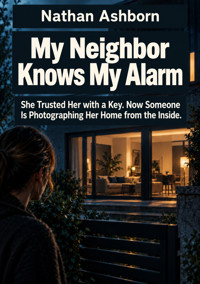
My Neighbor Knows My Alarm - She Trusted Her with a Key. Now Someone Is Photographing Her Home from the Inside. ebook
Nathan Ashborn
Uzyskaj dostęp do tej i ponad 240000 książek od 14,99 zł miesięcznie
- Wydawca: ALL-IN Rafał Płonkowski
- Kategoria: Thriller, sensacja, horror
- Język: angielski
Alicja thought she understood the limits of her home. She knew who had a key, who knew the alarm code, and who could be trusted to step inside when she was away. Her neighbor Magda was one of those people.
Then an anonymous photograph arrives from inside Alicja's entry hall.
The alarm says the house was never disarmed.
Another image follows. Then another. A kitchen. A bedroom. A drawer left open. Each photograph turns an ordinary room into evidence that someone has been watching her far more closely than she ever imagined.
At first, the explanation seems simple: someone must have entered the house. But the deeper Alicja looks, the less anything fits. The alarm history does not match the photographs. Technical service sessions appear at strange times. Old access accounts still exist. A hidden camera is discovered behind a picture frame. Her neighbor's security camera goes dark. And the people who should have the clearest answers all seem to know only part of the truth.
Her ex-husband has old technical access he barely remembers. Magda has a spare key and secrets of her own. Magda's son Bartek is asking questions about events that happened years earlier. A former installer is connected to the house in ways Alicja never understood. And somewhere behind the walls of the estate lies an old infrastructure no resident was supposed to think about anymore.
Then the danger moves beyond the house.
Someone proves they know Alicja's routines, her family, and the places where she feels safest. Her eleven-year-old son Franek becomes part of the threat, and suspicion is no longer an abstract fear. Every message forces Alicja to decide whom to trust, which clues are genuine, and whether the person guiding her toward the truth is the same person trying to control her.
My Neighbor Knows My Alarm is a psychological domestic thriller about surveillance, privacy, manipulation, and the fragile line between trust and access. It asks what happens when the systems meant to make a home safer become tools for watching, and when harmless details - a key, a school routine, an old password, a neighbor's favor - combine into a map of someone's life.
As the mystery reaches back into the estate's past, Alicja discovers that the most frightening part of being watched is not simply that someone can see you. It is that they can learn how you react, whom you protect, and what they must threaten to make you move.
A tense story of family, suspicion, hidden technology, old guilt, and the cost of taking back control of your own life.
This publication was prepared using tools that support the creative process, including artificial intelligence solutions. The final concept, structure and editing are the responsibility of the author.
Ebooka przeczytasz w aplikacjach Legimi na:
Liczba stron: 262
Rok wydania: 2026
Odsłuch ebooka (TTS) dostepny w abonamencie „ebooki+audiobooki bez limitu” w aplikacjach Legimi na:
Podobne







Nathan Ashborn
My Neighbor Knows My Alarm
She Trusted Her with a Key. Now Someone Is Photographing Her Home from the Inside.
ALL-IN Rafał Płonkowski
2026
ISBN 9788384833452
Table of contents
Title page
INTRO
Chapter 1 - The Message Magda Didn’t Send
Chapter 2 - Nineteen Minutes
Chapter 3 - The Camera in the Wall
Chapter 4 - The Other Side of the Wall
Chapter 5 - Now You'll Leave the House
Chapter 6 - What Was on the Flash Drive
Chapter 7 - What They Did on the Estate
Chapter 8 - The Wrong Neighbor
Chapter 9 - Not the Same Man
Chapter 10 - The First Photographs Were Not Threats
Chapter 11 - The Account That Didn't Exist
Chapter 12 - Seventeen Minutes
Chapter 13 - Seventeen Minutes of Truth
Chapter 14 - The Man on the Other Side of the Image
Chapter 15 - The Estate’s Second Interior
Chapter 16 - The Source of the Problem
Chapter 17 - What the Camera Doesn't See
Chapter 18 - The Place Without an Image
Chapter 19 - The Man Who Wanted to Know Everything
Chapter 20 - The House After the Cameras Came Down
Landmarks
Cover
Title page
Table of contents
Start of content
INTRO
The first photograph showed my entryway.
For a few seconds, I was certain I had taken it myself. My phone sometimes resurfaced old pictures at the worst possible moments - forgotten receipts, the washing machine’s serial number, Franek’s shoes photographed in a store before the start of the school year. So I stared at the screen while waiting at a red light on Rokicińska and tried to remember why I would ever have photographed my own shoe cabinet.
Then I noticed the time.
2:17 p.m.
The picture had arrived four minutes earlier.
It wasn’t old.
The car behind me honked. I pulled away before the driver could do it again and put the phone facedown on the passenger seat. Seven minutes to home. Maybe six if I didn’t hit traffic at the roundabout.
Franek finished school at three twenty. It was three oh three.
The house should have been empty.
At the next intersection, my phone vibrated again.
I didn’t look.
I kept telling myself there had to be a reasonable explanation. Magda might have gone in without telling me. She sometimes picked up parcels left outside my door when a courier refused to wait. She had a key. She knew the alarm code. Over the past six months, I had probably told her more about how my house worked than I had told anyone else.
After the divorce, Michał no longer had a key. I changed the lock cylinder two days after he moved out his last boxes. I changed the alarm code a week later, when I discovered he still remembered the old one.
Three people knew the new code.
Me.
Franek.
Magda from next door.
I turned onto our street so fast that the rear wheel scraped the curb. The row of semi-detached houses looked the way it always did: pale facades, identical graphite roofs, hedges everyone kept promising to trim before winter. Magda’s white car was parked outside her house.
That reassured me.
For about two seconds.
Then I saw Magda herself.
She was kneeling on the lawn in front of her house, stuffing dry leaves into a black garbage bag. She was wearing a green jacket, gardening gloves, and headphones over her ears. She didn’t look up until I slammed my car door.
She waved.
She didn’t look like someone who had been walking through my house forty-some minutes earlier, taking pictures.
“You’re home early,” she called.
“Were you at my place today?”
She pulled one headphone away from her ear.
“What?”
“In the house. Mine.”
She frowned.
“No.”
She answered immediately.
Too immediately, I thought, and then hated myself for thinking it.
I took out my phone.
The second message was still waiting unopened. The same unknown number. No text.
I tapped the screen.
This time someone had photographed the kitchen.
They were standing beside the island, roughly where I put my work bag every morning. The frame showed the table, the coffee machine, part of the patio door, and my reflection in the black glass of the oven.
Not my reflection now.
The reflection of the person holding the phone.
I zoomed in.
There was no face. Just a dark shape against the window.
“Alicja?”
Magda had come closer.
I locked the screen.
I don’t know why.
A minute earlier, the first thing I had wanted to do was show her the photographs. Now the knowledge that she was the only person besides me and my eleven-year-old son who knew the code made me close my hand around the phone as if it were something I needed to protect.
“Did your alarm go off?” she asked.
I looked at her.
“No.”
“Then why are you asking if I was inside?”
“I think I left a window open.”
The lie came too easily.
Magda glanced toward my house.
“I can go in with you.”
“You don’t have to.”
“Ala.”
“Really. I probably just remembered it wrong.”
I headed toward the gate.
The alarm app showed a green icon.
SYSTEM ARMED.
Last status change: 7:41 a.m.
I had armed it that morning when I left with Franek.
There had been no disarming at 2:17 p.m.
I stopped.
Checked again.
7:41 - full arming.
No later activity.
Someone could have taken the photograph earlier and only sent it now.
That thought should have made me feel better.
It didn’t.
I pressed my finger to the lock reader. There was a soft click. The door opened a few inches.
I didn’t go in.
The house was silent. The steady hum of the refrigerator drifted in from the living room, and somewhere upstairs the automatic air freshener was running. I knew those sounds. They were ordinary.
The entryway looked ordinary too.
Shoe cabinet. Mirror. Coat rack. Franek’s blue hoodie thrown across the bench despite three consecutive reminders to put his things in the closet.
I took out my phone and opened the first photograph.
I compared the image to what I saw in front of me.
That was when I noticed the difference.
In the photograph, the closet door was slightly open.
Now it was closed.
“Everything okay?” Magda called from behind the fence.
I turned my head.
She was still standing in front of her own house.
“Yes.”
I stepped inside and closed the door.
I didn’t take off my shoes.
First I checked the living room. Then the kitchen. The downstairs bathroom. My office. I didn’t call out or ask whether anyone was there. I had no intention of warning someone who might be standing only a few yards away from me.
My morning coffee mug was still on the kitchen counter.
There were no muddy footprints by the patio door.
The windows were shut.
I went back to the entryway and opened the closet.
Jackets.
A coat.
Franek’s backpack from last year.
A box of cables.
Nothing else.
My phone vibrated for the third time.
This time the message contained a single sentence.
DON’T JUST CHECK THE DOORS.
Below it was a photograph.
Of my bedroom.
I sat down on the first stair before my legs could make the decision for me.
The photographer had been standing right beside the bed. The frame showed the window, part of the wardrobe, and the bedside table. On it were a book, a charger, and the glass of water I had left there that morning.
But the picture did not show the entire room.
Someone had deliberately aimed the camera lower.
At the open drawer of the bedside table.
The one where I kept my passport, a few documents, and a small envelope of cash for emergencies.
The drawer was open.
I looked up toward the first floor.
From where I was sitting, I could see the bedroom door.
It was closed.
I didn’t remember closing it that morning.
My phone rang.
Franek.
I answered immediately.
“Mom, are you home already?”
I could hear children and a teacher’s voice in the background.
“I am. Why?”
“Because our teacher let us out early.”
I looked at the time.
3:14.
“Stay at school.”
“But Magda texted me that she could pick me up.”
I didn’t answer.
“Mom?”
I looked through the narrow window beside the front door.
Magda was no longer on the lawn.
Her black bag of leaves lay open beside the hedge.
“Franek, listen to me very carefully. Don’t leave the building. Don’t go with anyone. Not even Magda.”
There was silence on the other end.
“Why?”
A fourth message appeared on the screen.
No photograph.
DO YOU REALLY THINK THE PROBLEM COMES IN THROUGH THE DOOR?
Chapter 1 - The Message Magda Didn’t Send
For several seconds, I couldn’t hear Franek. I stared at the last message until the letters stopped forming a sentence and became nothing more than black marks on a white screen.
DO YOU REALLY THINK THE PROBLEM COMES IN THROUGH THE DOOR?
“Mom?”
My son’s voice restored the proper scale of things. The photographs, the closed bedroom, Magda disappearing from her yard - all of that could wait.
Franek couldn’t.
“Are you still inside the school building?”
“Yeah.”
“Where exactly?”
“By the cloakroom.”
“Go back to the office.”
“But why?”
“Because I’m asking you to. Go to the woman in the office and tell her you’re supposed to wait inside until I come and get you.”
“Magda was going to pick me up.”
“Don’t go with Magda.”
This time I didn’t try to soften my tone. I realized too late how that must have sounded.
“Did you two have a fight?”
“No. Franek, listen to me. Don’t leave the school. Don’t leave with anyone. I’ll call you right back.”
“Not even with Dad?”
I hesitated for a second.
“You can go with Dad, but only after you speak to me first. Do you understand?”
“Mhm.”
“Say it in a full sentence.”
He sighed.
“I have to stay in the office and not leave until you or Dad says I can.”
“Good. Go there now.”
I didn’t hang up until I heard one of the teachers in the background and Franek saying, “My mom told me to wait.”
I called the school immediately. The secretary answered on the third ring. I introduced myself, explained that no one except Michał or me was allowed to pick Franek up, and asked her not to let him leave even if someone he knew showed up.
“Has something happened?” the woman asked.
I looked at the closed bedroom door.
“I’m not sure yet.”
It sounded absurd.
Someone had been inside my house.
Someone had taken photographs.
Someone knew where my son was.
And I was still trying to behave as though I’m not sure could describe any of it.
I dialed the emergency number before I even reached the bottom of the stairs. The dispatcher asked short, direct questions: Was the intruder still inside? Had I seen anyone? Were there signs of forced entry on the doors or windows? Was anything missing? Had I received threats?
I didn’t answer the last one immediately.
“Messages,” I said at last. “Someone is sending me pictures from inside my house.”
“Are you inside the building now?”
Only then did I realize how stupidly I had behaved.
“Yes.”
“Please leave and wait somewhere safe.”
She didn’t have to say it twice.
I took only my handbag from the chair in the kitchen. I didn’t go upstairs again. I didn’t check the bedroom. I didn’t look inside the drawer shown in the photograph.
When I opened the front door, Magda was just coming out of her house.
She walked toward me.
“What’s going on?” she asked. “Franek called.”
I stopped just inside the gate.
“He called you?”
“Yes. He asked if I was coming to get him.”
For a moment I couldn’t tell what frightened me more: her answer, or how naturally she gave it.
“You texted him that you’d pick him up.”
Magda stopped.
“No.”
“He said he got a message from you.”
“Alicja, I didn’t text Franek.”
She took out her phone.
I hadn’t asked her to. She simply unlocked it and opened her conversation with him.
Magda’s last message was from two days earlier.
Remember your umbrella. Apparently meteorologists are occasionally right.
Franek had replied with a photograph of a frog.
She handed me the phone.
“See for yourself.”
I scrolled up and down through the conversation as if I might uncover a hidden section.
“You can delete a message.”
Magda pulled her hand back.
Something appeared on her face that I had never seen there before. Not wounded pride.
Fear.
“What happened?”
I didn’t answer.
“Ala.”
“When were you last inside my house?”
“I told you. Monday. I brought over milk because I’d bought two cartons.”
“I mean every visit. Even if I wasn’t home.”
“Monday.”
“Do you have my key?”
Her gaze moved toward my house.
“Of course.”
“Show me.”
“What?”
“The key.”
“It’s in my house.”
“Bring it.”
“Alicja, what is this about?”
We heard a car turning onto the street. A police cruiser maneuvered between the parked vehicles and stopped outside my property.
Magda looked at it, then at me.
“You called the police?”
“Bring the key.”
She didn’t argue a second time.
Two officers came inside. A woman around forty who introduced herself as Senior Constable Joanna Kałuża, and a younger man named Wrona. I showed them the messages before we even entered the house.
Kałuża didn’t comment. She examined every photograph, the sender’s number, the times, then told me not to delete anything and not to reply.
“Have you ever had contact with this number before?”
“No.”
“Did you call it?”
“No.”
“Please don’t call it for now.”
Wrona walked around the outside of the house, then we went in together. It wasn’t a forensic team from a television show. They weren’t dusting every surface for fingerprints or scattering powder everywhere. They checked the doors, windows, visible damage, and asked what I had touched after coming home.
Too much.
Door handles. My phone. The closet. The front door. The edge of the kitchen counter.
“I didn’t open the bedroom,” I said.
Kałuża went upstairs.
I stayed in the hall.
The bedroom door wasn’t locked. She pressed the handle and disappeared inside. A moment later, she called me in.
The bedside-table drawer was closed.
In the photograph, it had been open.
“Please check the contents without touching anything you don’t need to.”
I put on the thin gloves she handed me.
My passport was there.
So was the envelope.
I opened it.
Two thousand two hundred złoty.
Exactly what should have been there.
The car documents, an old USB drive, the deed to the house, several warranty cards.
Nothing was missing.
“What could he have been looking for?” Kałuża asked.
“I don’t know.”
“Did he know what was in this drawer?”
“Apparently.”
It sounded worse when I said it aloud.
We went back downstairs. Wrona was standing beside the alarm panel.
“There’s no record of anyone entering,” I said. “I checked.”
“Only in the app?”
“Yes.”
“What system is it?”
I gave him the company name.
He wrote it down.
“Do you have sensors on every door and window?”
“On the ground floor. Upstairs, only the balcony windows and the motion sensors in the hallway.”
“And the garage?”
“The garage connects to the house. It has its own sensor and door contact.”
“Basement?”
“No.”
“Attic?”
I looked toward the stairs.
“There’s a small utility attic. Access is from the upstairs hallway.”
Kałuża looked at Wrona.
They didn’t need to say anything.
They went upstairs again.
That was when Magda returned.
She was holding a key ring with four keys.
“This one,” she said, pointing.
I didn’t want to touch it.
“Do you always keep it there?”
“In the kitchen drawer.”
“Who has access to that drawer?”
“Me.”
“Only you?”
“Alicja…”
“Only you?”
She pressed her lips together.
“And Bartek, when he’s home.”
Bartek was her twenty-three-year-old son. He studied in Wrocław and came back irregularly, usually for weekends and holidays. The last time I had seen him was probably at the end of August, when he helped Magda carry a new dresser into the house.
“Is Bartek in Łódź now?”
“No. Wrocław.”
“Are you sure?”
“I spoke to him this morning.”
“That’s not an answer.”
“I’m sure he studies in Wrocław. I don’t track him by GPS.”
“Does he know my alarm code?”
Magda went pale.
Her silence was enough.
“Magda.”
“He heard it once.”
“What does once mean?”
“In June. You were at a conference in Kraków. Your alarm went off.”
I remembered.
The living-room sensor had detected movement at two in the morning. The security company called me, and I called Magda. It turned out that the decorative branch standing in a tall vase had fallen in front of the sensor, probably because of a draft from a window left slightly open.
“Bartek went with you?”
“He happened to be at my place. I was afraid to go in alone.”
“And you gave him the code?”
“He was standing next to me when I disarmed it.”
“Four months ago.”
“Ala, I don’t even know if he was watching.”
I wanted to answer, but Wrona called from upstairs.
“Ms. Alicja?”
I went up.
He was standing on a folding ladder beneath the rectangular hatch leading to the attic. The cover had been pushed aside.
“When were you last up there?”
“Never. The ventilation company, maybe in spring.”
“Does this hatch have a lock?”
“No.”
“Is it covered by the alarm?”
“No.”
He looked into the darkness above him.
“Do you have a flashlight?”
Kałuża took out her own.
The attic was low and mostly unfinished, with insulation between the beams and cables running beneath the roof. Wrona climbed higher until half his body disappeared.
A minute later he came back down.
“Nothing obvious. I don’t see signs that anyone came through here. There isn’t an easy way outside anyway.”
“An easy way?”
“Part of the roof structure is shared with the other half of the semi-detached building, but it looks separated by a panel.”
I looked through the wall.
Magda’s house was on the other side.
For a moment, no one spoke.
Then Kałuża asked, “Who built these houses?”
“A development company. Eight years ago.”
“Do you have the plans?”
“With the documents.”
The drawer in the bedroom.
The one someone had deliberately opened for the photograph.
I went downstairs and took out the deed and the technical folder. The floor plan was folded into quarters. We spread it across the dining-room table.
Wrona pointed to the wall between the two houses.
“There should be separation here.”
“There is,” I said.
“There should be. According to the plan.”
“They didn’t exactly build a secret passage between the houses.”
I said it half-jokingly.
No one smiled.
Kałuża returned to the messages.
“Please look at the first photograph again.”
She enlarged the picture of the entryway.
“In the mirror.”
It took me three tries to see it.
Part of the staircase was visible in the reflection. A wooden frame hung on the wall above it.
It should have held our old family photograph from the Masurian Lakes.
In the message, the frame was crooked.
Now it was straight.
I hadn’t noticed before.
I moved toward it.
“Don’t touch it,” Kałuża said.
I stopped.
Behind the frame was a small round hole from a wall plug we had once used for a different picture.
Nothing else.
At least nothing I could see.
“When was this photograph taken?” Kałuża asked.
“According to the message, today.”
“No. I’m asking whether you can confirm that from what’s inside the house.”
I looked more carefully.
Franek’s hoodie on the bench.
He had left it there that morning.
The paper bakery bag beside the cabinet.
I had bought bread in it the night before and hadn’t thrown it away yet.
“Today,” I said. “It had to be today.”
My phone rang.
Michał.
For several seconds I considered rejecting the call. Then I remembered Franek was sitting in the school office.
“Hi.”
“Franek says you told him he isn’t allowed to leave school. What’s going on?”
“Can you pick him up?”
“I’m fifteen minutes away. But are you going to tell me why?”
I looked at the officers.
“Someone was in the house.”
Silence.
“A break-in?”
“I don’t know.”
“What do you mean, you don’t know?”
“Someone took pictures inside and sent them to me.”
Michał stopped asking questions.
That wasn’t like him.
“I’m going to get Franek,” he said.
“Bring him here.”
“No.”
“Michał.”
“If somebody got into your house and you don’t know who, Franek is not sleeping there tonight.”
“The police are here.”
“All the more reason.”
“Bring him. We’ll decide what to do next.”
He hung up without answering.
When I lowered the phone, I noticed Magda watching me from the other side of the living room.
“Michał?” she asked.
I nodded.
“Does he still have access to the alarm app?”
“No.”
“Are you sure?”
“I removed his account.”
“But he installed it with you.”
“Magda.”
She raised her hands and stepped back.
“I’m not suggesting anything.”
“You just did.”
“Because you’ve spent the last fifteen minutes questioning me and my son like we’re suspects.”
I didn’t answer.
She was right.
That didn’t mean I should stop asking questions.
The officers took down her details. They asked to see the key, then told her to keep it without using it. Kałuża told me to contact the alarm company and request the full technical event log, not merely the history available to a regular user. She also recommended replacing the lock cylinder, disabling all codes, and checking the list of devices logged into the app.
“Today?” I asked.
“The sooner, the better.”
I called the company that serviced the alarm.
After twelve minutes of hold music, a consultant answered. He took me through identity verification, then confirmed that the system had not been disarmed since 7:41 a.m.
“So no one got in?” I asked.
“That’s not what I said.”
“Then what did you say?”
“That the control panel did not record a disarming event.”
“What about the sensors?”
I heard typing.
“Ground-floor motion, kitchen, living room, entrance - no activation after arming.”
“Upstairs?”
“There’s a hallway sensor upstairs as well?”
“Yes.”
More typing.
“Nothing.”
Kałuża watched my face.
“Can someone enter the system in service mode?” I asked.
The consultant hesitated.
“Technically, service connections can occur, but that is not the same as disarming the alarm.”
“Was there one today?”
A longer silence.
“I can see a diagnostic session.”
I stopped breathing.
“What time?”
“2:12 p.m.”
I looked at the first photograph.
2:17.
“Who started it?”
“I don’t have operator details at this level.”
“Who does?”
“Technical support.”
“Why did someone connect to my alarm at 2:12?”
“There’s no service-request description.”
“Because I didn’t report anything.”
“I understand.”
“Then who connected?”
“Ms. Alicja, I genuinely cannot see that with my access.”
Kałuża extended her hand. I switched to speaker.
“Police,” she said. “Please preserve the complete logs for that session. Officers will contact your company through official channels.”
The consultant’s voice immediately lost its routine warmth.
“Of course.”
“And please don’t reset anything,” she added.
After the call, no one spoke for a moment.
Magda broke the silence first.
“Who installed your alarm?”
I looked at the panel by the entrance.
“The same man who installed yours.”
“Radecki?”
The name brought back a face. A tall, thin man around forty, always wearing his shirt sleeves rolled up, even in winter. Sebastian Radecki. He had worked as an outside installer for the company recommended to the entire development by the developer.
“Yes.”
“Does he still work there?”
“I don’t know.”
Magda took out her phone.
“I do.”
She looked at me.
“I saw him here three weeks ago.”
“Where?”
“On the estate.”
“At whose house?”
“No idea. His car was parked near the end of the street.”
Kałuża wrote down the name.
By the time the officers left, it was beginning to get dark.
Magda stood by the gate.
“I can stay with you.”
“No.”
“Alicja…”
“Not tonight.”
It hurt her.
I could see that.
But I couldn’t pretend everything between us was the same as it had been that morning.
Michał arrived with Franek at 5:38 p.m.
Franek ran into the house first and hugged me immediately.
Michał came in more slowly.
He looked around the living room, at the alarm panel, at the windows.
“Pack his things,” he said.
“We’re talking first.”
“No. First I’m getting him out of here.”
Franek pulled away from me.
“Who was here?”
Michał and I looked at each other.
“We don’t know yet,” I said.
“Did they steal anything?”
“No.”
“Then why did they come in?”
It was the simplest question of the day.
I didn’t know the answer.
Franek looked at his phone.
“Magda didn’t text me after all.”
“How do you know?”
He held out the device.
“Because the message disappeared.”
I took the phone.
His conversation with Magda ended with the frog from two days earlier.
Exactly the same as on her phone.
“You saw it?” I asked. “That message?”
“Yeah.”
“You read it?”
“‘I can pick you up today, your mom will be home later.’ Something like that.”
“You’re sure it was from Magda?”
“It had her picture and her name.”
Michał stepped closer.
“Show me.”
I handed him the phone.
“It could be spoofing,” he said.
I looked at him.
“How do you know?”
He shrugged.
“You don’t have to be a hacker to fake a number.”
“The message appeared in her existing conversation.”
He stopped looking at the screen.
“That’s worse.”
“Why?”
He handed the phone back to Franek.
“Because if it really appeared in the same thread, then whoever did this doesn’t just know Magda’s number. They know the two of them message each other.”
The living room went quiet.
Franek looked at me.
“Mom?”
“Yes?”
“How does this person know Magda has a key?”
I didn’t answer.
Because at that exact moment, I realized something else.
Not one of the messages I had received mentioned a key.
Or Magda.
I was the one who had connected those things.
Whoever was doing this didn’t need to know that I suspected my neighbor.
They only needed me to start suspecting everyone who could have gotten inside.
My phone vibrated.
Unknown number.
There was no photograph.
Only five words.
GOOD. YOU’RE STARTING TO LOOK PROPERLY.
Chapter 2 - Nineteen Minutes
Michał read the message twice.
The first time, he looked like a man searching for a logical explanation. The second, like a man who had just realized logic didn’t have to be comforting.
“You’re packing Franek’s things,” he said.
“Stop giving me orders.”
“Alicja, someone is watching the house.”
“I know.”
“They know what you’re doing.”
“I know.”
“And they probably know Franek is here.”
Our son was sitting on the stairs a few yards away. He was pretending to look at something on his phone, but the screen had gone dark a long time ago.
“Not in front of him,” I said more quietly.
Michał clenched his jaw.
“All the more reason I’m taking him.”
This time I didn’t argue.
For the next half hour, I packed Franek’s things and tried to act as though I were preparing him for an ordinary weekend with his father. Pajamas, hoodie, charger, math textbook, the inhaler he almost never used but which we always kept close in autumn. Franek followed me around.
“Are you coming too?”
“No.”
“Why?”
“I need to stay here.”
“What for?”
I couldn’t come up with a good enough lie.
“The police may still need something.”
“You can sleep at Dad’s.”
“I can.”
“So why don’t you want to?”
I folded his T-shirt and put it into the bag.
Because someone wanted to scare me.
Because if I left now and didn’t come back, every message after this would decide where I slept, who I spoke to, and who I trusted.
I couldn’t say that to an eleven-year-old.
“Because this is my home,” I said.
Franek watched me for a moment, then nodded as though that answer made more sense than any explanation could have.
At the door, he hugged me longer than usual.
“Call before bed.”
“I will.”
“And don’t go into the attic.”
I almost smiled.
“Okay.”
“I’m serious.”
“So am I.”
Michał heard him.
“You shouldn’t be here alone.”
“If anything happens, I’ll call.”
“Me?”
“The police.”
“Of course.”
I didn’t answer.
On his way out, he stopped by the alarm panel.
“Can I look at it?”
“Why?”
“I want to check the settings.”
“The police said not to reset anything.”
“I don’t have to reset it.”
“No.”
He looked at me.
“Seriously?”
“Seriously.”
“After seven years of marriage, you suddenly suspect me of breaking into your house?”
“I didn’t say that.”
“You don’t have to.”
Franek was already standing by the car.
“Go,” I said.
Michał left.
I closed the door.
I turned the mechanical lock, even though I almost never used it before because the electronic bolt locked automatically.
Then I stood in the entryway and listened to the house.
When the three of us had lived here together, silence had never felt complete. Someone was always moving a chair, turning on a tap, opening a cabinet, or leaving the television running in a room nobody had been in for fifteen minutes. After the divorce, I had learned a different kind of silence - one with a structure of its own. The refrigerator. Ventilation. Wood shifting in the stairs. The distant hum of passing cars.
That evening, every sound felt like an exception.
I called a locksmith.
He arrived after seven. An older man with hands covered in tiny scars examined the cylinder, asked whether I had lost a key, and when I said no, didn’t push for an explanation. He replaced the lock and handed me five sealed keys.
I put one on the kitchen counter.
The rest went into my handbag.
I didn’t take one to Magda.
Then I changed the alarm code.
The system allowed separate user codes. Mine. Franek’s. Service. Temporary.
I deleted all of them except mine.
The service code showed as inactive.
For a moment I stared at the word SERVICE, remembering the diagnostic session at 2:12 p.m.
I tapped the details.
Access denied.
Information available to system administrator.
I should have been the administrator.
Apparently not that kind of administrator.
I photographed the screen with Franek’s old second phone, which had remained in the house after his last device upgrade. I didn’t want to generate any changes in the app beyond the ones that were absolutely necessary.
Then I sat down at the table and opened my laptop.
Searching Sebastian Radecki’s name brought back dozens of results. Social-media profiles, an old installer-directory entry, a sole proprietorship that no longer existed, a photograph from a local smart-building conference.
He looked exactly as I remembered him.
Long face. Short dark hair. High forehead.
In a photo taken six years earlier, he stood beside the booth of the company that had installed my alarm.
I clicked his professional profile.
He hadn’t worked there for two years.
Now he ran a consultancy specializing in building automation.
Nothing explained why, three weeks earlier, his car had been parked on my street.
I sent his name to Senior Constable Kałuża using the number she had left me.
She replied a few minutes later.





