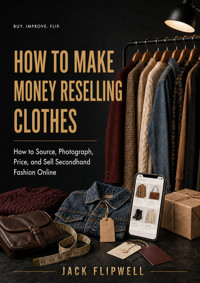
How to Make Money Reselling Clothes - How to Source, Photograph, Price, and Sell Secondhand Fashion Online ebook
JACK FLIPWELL
Uzyskaj dostęp do tej i ponad 240000 książek od 14,99 zł miesięcznie
- Wydawca: ALL-IN Rafał Płonkowski
- Kategoria: Biznes, rozwój, prawo•Biznes, rozwój
- Język: angielski
Can you really make money reselling secondhand clothes, or have all the best opportunities already been found?
Every day, thousands of jackets, dresses, sneakers, coats, jeans, sweaters, and accessories change hands for prices that do not always reflect their real resale potential. The opportunity is not simply to buy cheap clothing and list it for more. The opportunity comes from understanding demand, condition, pricing, presentation, and inventory better than the average seller.
How to Make Money Reselling Clothes is a practical guide to secondhand fashion flipping for anyone who wants to source undervalued items, prepare them properly, sell them online, and build margin without depending on lucky one-off finds.
JACK FLIPWELL takes you through the complete resale process, from the first sourcing decision to the final profit calculation. You will learn how to research demand, compare real market prices, choose brands and categories, evaluate materials and sizes, assess defects, reduce counterfeit risk, and calculate the maximum price you can afford to pay.
The book explains how to clean and prepare used clothing without damaging it, when repairs make financial sense, how to take consistent measurements, and how to photograph products so buyers can understand what they are purchasing. You will learn to create listings that are searchable, concise, accurate, and complete without relying on hype or misleading claims.
Pricing receives the same practical treatment. Instead of guessing, you will learn to work with realistic selling ranges, minimum acceptable prices, negotiation room, seasonal demand, and expected holding periods. You will see why a slower sale with a higher margin is not always better than a faster sale that returns your capital sooner.
The book also covers platform selection, cross-listing, shipping, packing, returns, complaints, customer service, fraud prevention, and marketplace risk. You will learn why the same product may perform very differently on two selling platforms and why every additional channel should be evaluated by net contribution, not simply by the number of users it offers.
A major part of the book focuses on numbers. You will learn how to track acquisition costs, cleaning, repairs, packaging, selling expenses, returns, holding time, and inventory value. You will see why the difference between purchase price and selling price is not the same as profit, how dead stock can quietly absorb cash, and why a full shelf can coexist with poor liquidity.
The later chapters explain how to scale without losing control. You will learn how to create inventory codes, storage locations, work queues, weekly operating routines, sourcing limits, and aging-stock policies. The book shows when automation and delegation make sense and when they simply make a weak process more expensive.
You will also learn to manage working capital, maintain reserves, test weaker financial scenarios, and avoid turning every successful payout immediately into more inventory. A profitable resale operation still needs liquidity. Growth is only useful when the business can continue paying its obligations and buying future opportunities without being forced to clear good inventory cheaply.
This is not a promise of easy money. It is not a list of twenty brands that supposedly guarantee profit. Fashion trends change, marketplace rules change, and a product that sells quickly today may become ordinary tomorrow. The book instead gives you a framework for answering the questions that matter: Is there real demand? What can this item realistically sell for? What is the full cost? How long might the capital remain tied up? When should I buy, negotiate, discount, or walk away?
The book also explains why regular commercial reselling may create tax, consumer-law, recordkeeping, business-registration, and platform obligations depending on your jurisdiction and legal status. Readers are encouraged to verify current official rules and obtain qualified professional advice where appropriate. The book is educational and does not pretend to provide individualized legal or tax advice.
Whether you want to resell a few carefully selected items each month, build a profitable side business, or develop a larger structured inventory operation, How to Make Money Reselling Clothes gives you a practical system for doing it with greater control.
BUY. IMPROVE. FLIP. Find the Deal. Add the Value. Keep the Margin.
Artificial intelligence tools were used as part of the writing, editing, structuring, and development process for this publication. The material was prepared as practical educational content and does not constitute individualized legal, tax, accounting, or financial advice. Marketplace policies, tax regulations, consumer rights, and business requirements may change and should always be verified using current official sources applicable to the reader's jurisdiction.
Ebooka przeczytasz w aplikacjach Legimi na:
Liczba stron: 200
Rok wydania: 2026
Odsłuch ebooka (TTS) dostepny w abonamencie „ebooki+audiobooki bez limitu” w aplikacjach Legimi na:
Podobne


















INTRO
Secondhand fashion has become a serious resale market. Clothing that once moved mainly through thrift stores, flea markets, charity shops, or family hand-me-downs can now be sourced locally and offered to thousands of buyers online within hours. Selling platforms have made entry easier, but they have also increased competition. Buying something cheaply is no longer enough. To make reselling work consistently, you need to understand what people actually want, what they are willing to pay, how quickly an item is likely to sell, and when the smartest decision is to leave it behind.
That is the basic idea behind clothing flipping. You buy an item below its realistic resale value, improve the way it is prepared, presented, and described, then sell it at a margin. Sometimes the value you add comes from cleaning, steaming, repairing a loose button, taking accurate measurements, or producing better photographs. Sometimes it comes from identifying a model, fabric, collection, or category that the previous seller did not recognize. The most valuable skill, however, is not making an average item look better. It is buying the right item at the right price.
A $10 shirt is not automatically a deal, and a listing priced at $150 does not prove that the market values the product at $150. An item can sit online for months at an unrealistic asking price without generating a transaction. What matters more is evidence: comparable sales, current competition, seasonality, condition, demand, and how quickly similar products are actually moving. Throughout this book, we will separate asking prices from realistic selling prices because confusing the two is one of the fastest ways to overpay for inventory.
Another common mistake is confusing revenue with profit. If you buy a jacket for $30 and sell it for $90, the $60 difference is not necessarily your true profit. You may also have cleaning costs, packaging materials, platform fees, shipping expenses, transportation, repairs, returns, taxes, and time invested in handling the transaction. A resale model that looks excellent when only purchase and selling prices are compared can become mediocre once the full cost is included. You cannot improve what you do not measure.
The purpose of this book is to help you treat secondhand clothing as inventory rather than as a collection of exciting finds. You do not need a warehouse, expensive camera equipment, or encyclopedic knowledge of every fashion label. You need a repeatable decision process. That process should help you evaluate category, brand, model, size, material, condition, seasonality, demand, likely selling price, expected selling time, and maximum purchase price. A framework like that remains useful even when trends change.
Brands matter, but they should be treated as one variable rather than as guarantees. A famous label cannot rescue an unwanted style, severe wear, an awkward size, or a purchase price that leaves almost no room for profit. At the same time, a less recognizable brand can perform well if the item has a desirable cut, excellent fabric, unusual design, practical function, or demand within a particular niche. Strong resellers learn combinations rather than memorizing logos. They ask whether the entire product makes sense.
Condition is one of the biggest drivers of resale value and one of the easiest areas in which to make expensive mistakes. A small stain, stretched cuff, worn lining, broken zipper, pilling, sole damage, or missing button can reduce both price and buyer confidence. Higher-value brands create an additional challenge because counterfeits enter the market. If you cannot reasonably support an authenticity claim, you should not present an item as genuine simply because it has the right logo or because the previous owner said it was authentic. Uncertainty must be treated as risk.
Preparing an item for sale means improving presentation without hiding reality. A clean, properly steamed garment displayed in good light can look significantly more desirable than the same garment photographed wrinkled on a cluttered floor. That does not give you permission to conceal flaws, alter colors aggressively, or describe a worn item as nearly new. Good presentation makes the product easier to understand. It should reduce the difference between what the buyer expects from the listing and what arrives in the package.
Measurements play an important role because clothing sizes are inconsistent. A medium from one brand can fit like a small or large from another, and older collections often use proportions that differ from current sizing. A strong listing therefore does more than repeat the size tag. It gives useful measurements taken with a consistent method and lets the buyer compare them with clothing they already own. Accurate measurements cannot guarantee fit, but they reduce uncertainty and unnecessary questions.
Pricing requires a balance between margin and speed. Price too high and your money can remain trapped in inventory for months. Price too low and you may sell quickly while giving away margin you could reasonably have kept. We will use realistic price ranges, minimum acceptable returns, planned markdowns, and target holding periods rather than treating one asking price as permanent. In many resale models, turning the same capital several times can be more valuable than holding out indefinitely for the highest possible price on every item.
Consider two sellers with the same $1,000 starting budget. One invests most of it in a handful of expensive pieces that may take months to move. The other buys a larger number of lower-cost items with proven demand and faster rotation. Neither strategy is automatically superior. The correct choice depends on margin, risk, available storage, workload, and selling time. What matters is recognizing that money tied up in unsold inventory cannot be used to buy the next opportunity.
The platform also affects the economics of a product. Everyday fashion, vintage clothing, sneakers, children's wear, premium brands, and luxury goods can attract very different buyers depending on where they are listed. Platforms differ in search behavior, fees, shipping systems, dispute procedures, buyer expectations, authentication policies, and rules for commercial sellers. Those conditions can change. Always verify the current rules of the platforms you use rather than assuming that a procedure or fee described in any book remains permanent.
The same caution applies to taxes, consumer rights, and business status. Selling unwanted clothes from your own closet may be treated differently from regularly purchasing goods with the intention of reselling them for profit. Depending on your jurisdiction and operating model, business registration, tax reporting, recordkeeping, return rights, consumer protections, or other obligations may apply. This book is not individualized legal or tax advice. As your activity becomes more regular or more valuable, check current official rules and seek professional guidance where appropriate.
Scaling too early is another frequent source of trouble. A few successful sales can create the impression that buying ten times more inventory will produce ten times more profit. In reality, more stock creates more cleaning, measuring, photographing, listing, messages, packing, storage, accounting, and mistakes. Scaling makes sense only after the basic process is reliable. First prove that you can source intelligently, calculate real margins, control inventory, and turn stock back into cash.
This book will not build a strategy around spectacular one-off finds. Buying a jacket for $20 and selling it for $500 is possible, but it is not a dependable business plan. A repeatable ability to buy items at sensible prices and sell them with predictable margins is far more useful. Consistency matters more than excitement. A seller who understands fifty ordinary transactions often has a stronger model than someone waiting for one extraordinary score.
Across the twenty chapters ahead, we will move through the complete resale cycle: sourcing, category and brand selection, condition and authenticity checks, cleaning, preparation, measurements, photography, listings, pricing, platform selection, shipping, returns, customer service, cost tracking, taxes, inventory management, cash flow, scaling, security, and long-term optimization. You will also learn when not to buy, when to cut a price, when to remove dead stock, and when additional scale would create more problems than profit.
That is the logic of BUY. IMPROVE. FLIP. Find the Deal. Add the Value. Keep the Margin. The deal is not simply the cheapest item you can find. The value is not created by hiding defects or inventing a higher worth. The margin comes from better selection, better information, better preparation, better execution, and better control of your numbers. When those decisions become repeatable, reselling stops being a series of lucky finds and starts becoming a business process.
Chapter 1 - Start With the Market, Not the Rack
The most expensive mistake a new reseller makes usually happens before the first purchase. They see a recognizable label, a low price, or a garment that looks fashionable and assume somebody will pay more for it online. A better resale process works in the opposite direction. First you study what buyers are actually purchasing, then you estimate a realistic selling price, and only then do you decide how much you can afford to pay. You are not buying an item because it is cheap. You are buying it because the numbers suggest that it can produce an acceptable return within a reasonable period.
The secondhand clothing market is not one single market. The same brand may sell quickly in outerwear and poorly in shirts, one sneaker model may have strong demand in a few sizes and weak demand in others, and the resale value of a coat can change dramatically with the season. That is why useful research starts with categories rather than logos. Jackets, jeans, dresses, knitwear, sneakers, children's clothing, activewear, vintage garments, and luxury accessories all behave differently. They have different buyers, price ranges, condition expectations, return risks, and selling speeds.
At the beginning, build a narrow area of competence. Do not try to learn every brand and every category at once. Choose two or three categories that appear frequently in the places where you source and that you can learn to inspect quickly. If your local thrift stores are strong in denim, jackets, and sweatshirts, start there. If you repeatedly see premium children's clothing or technical outdoor wear, that may be a better niche. Specialization improves decision speed and makes your early data much easier to compare.
Your best source of market information is current marketplace evidence, not a generic article listing "the best brands to resell." Where a platform shows completed or sold listings, study actual transaction prices. Where it only shows active listings, look at the number of comparable items, how long they appear to remain available, buyer engagement signals, and how much price competition exists. A jacket listed for $300 does not prove a $300 market value if twenty similar jackets are sitting between $110 and $160. Asking prices are advertisements. Transactions are evidence.
Comparables should be as close as possible to the item you are evaluating. A sweatshirt from a specific label is not automatically comparable with every sweatshirt made by that label. Model, line, gender category, size, color, material, condition, age, and season can all matter. If your comparison set is too broad, the resulting price range becomes almost meaningless. Five genuinely similar sales can be more useful than fifty random listings with the same logo.
You also need to think about supply relative to demand. If a search produces hundreds of active listings and only occasional signs of sales, competition may be too high. If similar products appear and disappear regularly while active supply stays limited, the category may have stronger rotation. You do not need sophisticated statistics to begin. Learn to distinguish between scarce and wanted, scarce and unwanted, common and fast-moving, and common but permanently oversupplied.
Your next decision is the maximum purchase price. A practical starting formula is realistic selling price minus all expected costs minus your minimum required profit. Suppose you believe a jacket can realistically sell for $150. You expect $12 in cleaning, packing, and transaction-related costs, and you want at least $55 in profit before any taxes that apply to your situation. That places the maximum purchase price at $83. If authenticity, repair, or selling time is uncertain, you should lower the limit further.
Do not use one minimum profit rule for every product. Making $30 on an item that costs $10 and sells in two days can be excellent. Making the same $30 on an item that costs $180, needs professional cleaning, and takes three months to move is much weaker. Look at profit in dollars, return relative to the money invested, workload, and expected holding time. A good item should compensate you for both capital risk and the work required to complete the sale.
One useful decision framework has three outcomes: buy, buy only at a lower price, or pass. The first category contains items with visible demand, strong condition, reasonable competition, and enough margin to absorb small mistakes. The second includes promising products carrying one significant uncertainty, such as a slower size, a repair, unusual seasonality, or limited price evidence. The third group contains items with weak demand, thin margin, serious defects, authenticity concerns, or excessive competition. This framework prevents every interesting garment from becoming inventory.
Brand still matters, but treat it as a filter rather than a verdict. A recognizable name makes a listing easier to search and may increase buyer trust, but it cannot rescue an undesirable style, severe wear, or a purchase price that leaves almost no margin. Less famous labels can perform very well when the garment has high-quality fabric, a desirable fit, unusual design, practical function, or demand inside a particular niche. Build your own brand knowledge from actual results rather than assuming every recognizable label is valuable.
Size can influence both market depth and speed. Mainstream sizes usually have more potential buyers, but they may also have heavier competition. Less common sizes can take longer to sell, yet certain niches have loyal buyers willing to pay well because supply is limited. Do not assume that one size range is always superior. Track your own days-to-sale data by category and size. Over time, your records may reveal patterns that broad marketplace advice misses.
Material can create value independent of brand. Wool, cashmere, linen, silk, leather, and high-quality technical fabrics can attract buyers when the condition and construction justify the premium. Always verify the fiber content from the care label where possible. A sweater that feels luxurious may still be mostly acrylic, while an ordinary-looking coat may contain a high percentage of wool. Do not build a price estimate around a material you have not confirmed.
Seasonality affects both purchase timing and cash flow. Buying a winter coat in midsummer may create excellent margin if the sourcing price is low enough, but you may have to hold it for months. Buying that same coat at the beginning of winter can mean a higher acquisition price but much faster conversion back into cash. Neither strategy is automatically correct. Decide whether you are being compensated for waiting, and make sure the purchase fits your storage capacity and liquidity.
The source of inventory changes the economics as well. A charity shop with weekly restocks is different from a liquidation warehouse, garage sale, local marketplace bundle, estate clear-out, or private wardrobe purchase. Lower-cost sources often require more sorting time and produce more unusable items. More curated sources may cost more but save labor and reduce defects. The goal is not to find the lowest headline price. It is to find the best relationship between sourcing time, usable inventory, selling value, and margin.
Bundles require especially careful thinking because average cost can hide weak inventory. If you buy twenty pieces for $400, the mathematical average is $20 per item. But perhaps only eight are strong sellers, seven are mediocre, and five are effectively dead stock. The economic cost of the useful pieces is therefore higher than the simple average suggests. Evaluate bundle performance using every item purchased, including rejects, not only the products you eventually sell at a profit.
From the first purchase, keep a basic inventory record. Record the date, source, category, brand, model if known, size, purchase cost, expected sale price, and reason you decided to buy. After the sale, add the final selling price, transaction costs, profit, and days held. After a few dozen items, you can compare your forecasts with reality. If you repeatedly expect $150 and actually sell around $105, the market is not unlucky. Your entry assumptions are too optimistic.
A simple spreadsheet is enough at the beginning if you update it consistently. Each piece should have its own record, and small costs should not disappear just because they are inconvenient to track. Cleaning, replacement buttons, packaging, transportation, and platform charges become meaningful at scale. Good records also make it easier to prepare for tax reporting, accounting, and other formal requirements that may apply. Operational data and compliance data are not identical, but organized records support both.
Limit the amount of capital you use for experiments. You might allocate 10 to 15 percent of your sourcing budget to unfamiliar categories while keeping the rest in areas where you already have evidence. Each experiment should have a reason behind it. Write down why you believe the item can sell, at what price, and within what timeframe. If you cannot explain the thesis, you are not running an experiment. You are buying on impulse.
Your personal taste is another source of bias. A coat you would happily wear yourself is not automatically a good resale item, and a sweatshirt you dislike may sell extremely well. You are selling to the market, not building your own wardrobe. Taste can help you identify quality, styling, and presentation, but it should not overrule transaction evidence. Strong resellers become comfortable buying products they would never personally wear.
A short pre-purchase checklist can keep your decisions disciplined: Is there clear evidence of demand for this type of item?; Is the condition acceptable and honestly sellable?; Can I justify a realistic selling price from current evidence?; Does the item leave enough profit after all expected costs?; Am I willing to hold this amount of capital for the likely selling period?
If you answer "I don't know" to several of those questions, uncertainty should reduce the amount you are willing to pay. Uncertainty itself is not a reason to panic. Paying full price for uncertainty is the problem.
Do not measure sourcing success by how many bags you carry home. A trip that ends with no purchase can be an excellent business decision if the prices were too high or the quality too weak. Cash that remains available for a better opportunity has not been wasted. One of the most damaging habits in resale is buying mediocre inventory simply because you spent time traveling to a store and do not want to leave empty-handed. Time already spent should not determine the next purchase.
After your first thirty to fifty purchases, start looking for patterns. Which brands moved faster? Which categories required bigger discounts than you expected? Which defects reduced value the most? Which sources produced the highest percentage of usable inventory? Your own transaction history gradually becomes more useful than generalized advice. Marketplace data tells you what is happening broadly. Your records tell you what works with your capital, sourcing locations, skills, storage space, and sales channels.
The central lesson is simple: profit begins at the purchase. If you overpay for weak inventory, excellent photographs and a polished description may only reduce the size of the loss. If you buy the right product at the right price, every later step can improve the outcome. That is why sourcing should feel disciplined rather than exciting. The better you become at saying no, the more capital you preserve for the items that deserve a yes.
Chapter 2 - Condition, Defects, and Authenticity - Do Not Buy Problems You Cannot Price
A low purchase price can look impressive until you inspect the product like a reseller rather than a shopper. A defect you would personally tolerate may cause a buyer to negotiate aggressively, request a return, or challenge the accuracy of the listing. Condition assessment therefore needs to be systematic. The objective is not to buy only perfect items. The objective is to know the difference between a minor problem you can price and a defect that permanently damages value or creates disproportionate risk.
Start by defining the condition standards you intend to use. New with tags, unused without tags, excellent, very good, good, and visibly worn should represent different buyer expectations. Problems arise when sellers call an item "like new" even though it has fading, pilling, stretching, or obvious wear. It is usually better to describe a garment slightly more conservatively and let the buyer be pleasantly surprised. Trust is easier to maintain than to rebuild after an overstated listing.
Good inspection starts with light. Many defects that disappear under dim store lighting become obvious beside a window or under a neutral bright lamp. Move the fabric and view it from several angles to look for discoloration, stains, shiny wear, fading, detergent marks, and fabric distortion. When sourcing online, zoom into the available photographs and pay attention to areas the seller did not show. Missing photos of cuffs, soles, collars, linings, or labels do not prove a problem, but they justify additional questions.
Inspect garments in the same order every time. For tops and outerwear, you might start at the collar, move to the shoulders and underarms, then check sleeves, cuffs, front, back, hem, seams, lining, and closures. For trousers, inspect waistband, zipper, crotch, thighs, knees, pockets, hems, and inner seams. For coats and jackets, test pockets, snaps, drawcords, hood attachments, and interior construction. A repeatable inspection path reduces the chance that fatigue causes you to skip exactly the area containing an expensive defect.
Stains are deceptive because different substances behave differently. Surface dust or a fresh water-based mark may be easy to remove, while grease, ink, cosmetics, paint, rust, dye transfer, or old discoloration may remain permanently. Never assume "that will wash out" unless you have a good reason. If the economics of the item only work when the stain disappears completely, treat the purchase as risky. Either lower your maximum price enough to absorb failure or walk away.
Smell matters too. Smoke, mildew, strong perfume, pets, cooking odors, or long-term storage can penetrate fabric and survive normal cleaning. Sometimes airing and proper washing solve the problem. Sometimes professional treatment is required, and some odors never disappear fully. Do not plan to cover them with fragrance. A buyer who opens a parcel and smells perfume layered over smoke will usually view the masking attempt more negatively than an honest disclosure.
Learn to distinguish pilling from structural wear. Pilling can often be reduced safely with a fabric shaver when the textile is still healthy. Abrasion means fibers have physically worn down and may be close to tearing. Pay particular attention to elbows, cuffs, underarms, inner thighs, seat areas, pocket edges, and hems. If the fabric looks thin, shiny, or translucent, the damage may progress quickly even if no actual hole exists yet.
Holes, tears, and open seams are not equal. A simple seam split may be inexpensive to repair almost invisibly, while a hole in the middle of a fine knit may remain obvious after professional work. Always evaluate both repair cost and final appearance. If the garment must still be sold as damaged after repair, the improved condition may not justify the expense. Do not spend $40 fixing a defect that only raises the realistic selling price by $20.
Mechanical components need to be tested rather than visually inspected. Run zippers up and down several times, fasten every snap, count buttons, test buckles, and move adjustable cords or stoppers carefully. With shoes, check laces, zippers, insoles, buckles, and the attachment between sole and upper. A small broken component may be cheap to replace, but a branded zipper pull, unusual buckle, or specialized closure can be difficult to source. On collectible or premium items, replacing an original component may also reduce value.