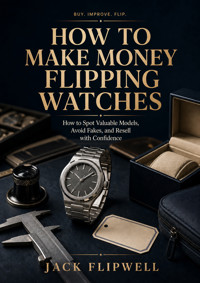
How to Make Money Flipping Watches - How to Spot Valuable Models, Avoid Fakes, and Resell with Confidence ebook
JACK FLIPWELL
Uzyskaj dostęp do tej i ponad 240000 książek od 14,99 zł miesięcznie
- Wydawca: ALL-IN Rafał Płonkowski
- Kategoria: Biznes, rozwój, prawo•Biznes, rozwój
- Język: angielski
Can you make money flipping used watches?
Yes, but not because every watch can be bought cheaply and listed for more.
The used watch market is full of details that beginners often overlook: references that look almost identical but trade at very different prices, expensive servicing, missing bracelet links, replaced parts, refinished dials, counterfeit paperwork, sophisticated replicas, illiquid models, and asking prices that have little connection to what buyers are actually willing to pay.
How to Make Money Flipping Watches is a practical guide to treating the used watch market like a business rather than a lottery.
JACK FLIPWELL walks through the complete process of finding, evaluating, buying, preparing, pricing, and reselling watches while protecting margin and controlling risk.
You will learn why the brand name is only the beginning and why the exact reference can change a watch's value dramatically. The book shows how to distinguish asking prices from realistic transaction values, compare genuinely comparable examples, calculate quick-sale value, and understand why a highly liquid watch with a moderate margin can sometimes be a better business than a rare piece with a large theoretical profit.
A major part of the book focuses on movements and servicing. You do not need to become a watchmaker, but you do need to understand what poor timekeeping, weak power reserve, chronograph problems, unknown service history, moisture damage, or restricted parts availability can mean financially. One unexpected service bill can consume the entire planned margin. The book shows how to build technical reserves into your purchase calculation and when professional diagnosis is the correct decision.
Authenticity receives detailed treatment as well.
Today's counterfeit market is not limited to crude copies with obvious spelling errors. High-quality replicas can imitate cases, bracelets, paperwork, serial numbers, and even movement architecture. There are also genuine watches with aftermarket parts, factory service components, refinished dials, replacement bezels, or combinations of genuine parts that never belonged together.
You will learn how to think about authentication as a process rather than a trick. The goal is not to pretend that a few online checks make you an expert. The goal is to understand which elements should agree, which inconsistencies matter, and when the cost of being wrong justifies professional authentication or specialist inspection.
The book covers sourcing from private sellers, classified platforms, collector groups, specialist marketplaces, dealers, pawn shops, auctions, consignment, estate sales, and direct relationships. Each source has a different balance of margin and risk. You will learn how to calculate your maximum purchase price before negotiation, so a large discount from the seller's asking price does not fool you into overpaying.
You will also learn how to assess condition properly.
A watch that looks cleaner is not always more valuable. Heavy polishing can permanently alter case geometry. A naturally aged vintage dial may be worth more than a refinished one. A full bracelet can matter more than a shiny replacement strap. The book explains how to assess cases, crystals, dials, hands, bezels, crowns, bracelets, clasps, documentation, service history, and provenance as parts of one complete valuation.
Preparing the watch for resale is another major focus.
What photographs should you take? Which scratches should be shown? How should you describe unknown service history? What do you say if current water resistance has not been tested? How do you photograph papers without exposing personal data? How do you disclose aftermarket parts accurately?
A strong listing does not make a used watch look new. It makes the buyer confident that the watch received will match the watch described.
Artificial intelligence tools were used as part of the drafting, organization, and editorial process for this book. The content is intended as practical educational material and does not replace individualized advice from a competent watchmaker, professional authenticator, appraiser, lawyer, accountant, tax adviser, insurer, customs specialist, or other qualified professional.
Watch prices, marketplace rules, tax laws, consumer regulations, customs requirements, insurance terms, carrier restrictions, authentication procedures, service policies, and manufacturer practices can change over time and may differ by jurisdiction. Readers should verify current information before making financial, legal, tax, technical, shipping, insurance, or authentication decisions involving valuable watches.
Ebooka przeczytasz w aplikacjach Legimi na:
Liczba stron: 224
Rok wydania: 2026
Odsłuch ebooka (TTS) dostepny w abonamencie „ebooki+audiobooki bez limitu” w aplikacjach Legimi na:
Podobne












INTRO
A watch is one of the few products that can be useful, collectible, fashionable, technically interesting, and financially valuable at the same time. Two watches that appear almost identical can sell for very different amounts because one has the correct reference, original dial, complete bracelet, documented service history, and clean provenance, while the other has been heavily polished, fitted with replacement parts, or assembled from components that do not belong together. This is why flipping watches can be profitable, but it is not a simple matter of buying cheaply and listing higher. The margin usually comes from understanding the product, the buyer, the costs, and the risks better than the person on the other side of the transaction.
The market is enormous and fragmented. At one end are inexpensive quartz watches, digital models, fashion watches, entry-level Seiko, Citizen, Casio, Timex, Orient, and similar products. Move upward and you reach affordable mechanical watches, divers, chronographs, pilot watches, microbrands, vintage pieces, and established Swiss brands such as Tissot, Hamilton, Certina, Mido, and Longines. Higher still are Omega, Tudor, Breitling, Cartier, Grand Seiko, Rolex, IWC, Zenith, Panerai, Audemars Piguet, Patek Philippe, and many other names where a single mistake can cost more than a beginner's entire starting budget.
You do not need to trade across all of these levels. In fact, trying to understand everything at once is usually a mistake. A better approach is to choose a narrow part of the market, learn a manageable group of references, understand what buyers in that segment care about, and build experience through repetition. The person who knows twenty references exceptionally well can often make better decisions than someone who recognizes two hundred brand names but cannot explain the differences between specific versions.
This book is not about predicting which watch will double in value. Speculation around discontinued references, limited editions, celebrity associations, or temporarily fashionable models can sometimes produce gains, but it is a weak foundation for a repeatable flipping business. A more controlled model is to buy below realistic market value, understand what is wrong or missing, improve the quality of the offer, reduce uncertainty for the next buyer, and sell through the channel that gives the best combination of price, speed, and safety.
Adding value does not necessarily mean physically restoring the watch. In many cases, the most valuable improvements are informational. You may correctly identify a poorly listed reference, assemble missing documentation, verify a service history, obtain a professional authentication, replace an inexpensive worn strap, clean the watch safely, photograph it properly, or write a description that answers the buyer's real questions. Sometimes the best improvement is simply moving a badly presented watch from the wrong marketplace to the right audience.
The first major mistake beginners make is confusing the difference between purchase price and sale price with profit. If you buy a watch for $4,000 and sell it for $5,000, you have not necessarily made $1,000. There may be platform fees, payment processing, insured shipping, servicing, replacement parts, packaging, authentication costs, returns, currency conversion, taxes, travel, and other expenses. If the watch sits unsold for four months, there is also a cost attached to having capital tied up in inventory instead of available for the next opportunity.
For that reason, this book treats watch flipping as a business based on net margin, capital rotation, and risk control. A smaller profit earned repeatedly on liquid watches can be more valuable than a larger theoretical profit on a watch that takes six months to sell. A spectacular-looking margin does not help if the watch needs an unexpected service, if the buyer negotiates heavily, or if you discover that the market price you relied on was only an optimistic asking price.
Asking price and market value are not the same thing. A watch listed at $10,000 is not automatically worth $10,000. What matters is what comparable examples actually sell for, how long they remain available, how condition affects demand, and how easily the reference can be converted back into cash. A highly recognizable model may be extremely liquid at the right price, while a technically impressive but obscure watch may sit for months waiting for the one buyer who wants it.
Reference numbers are therefore fundamental. "Omega Seamaster," "Rolex Datejust," or "Seiko Prospex" describe product families, not single products. Different references can use different movements, case sizes, bracelets, dial configurations, materials, production periods, and technical specifications. Small variations can produce large differences in price and desirability. Before buying, you need to know exactly what the watch is, not merely which collection name appears on the dial.
Authenticity is another major pillar of the business. The counterfeit market is far more sophisticated than the crude fake watches many people imagine. Some copies are easy to reject immediately, but others replicate cases, bracelets, engravings, paperwork, packaging, and even the visual appearance of movements to a convincing degree. There are also genuine watches containing aftermarket dials, replacement bezels, incorrect hands, service parts, or components taken from other watches.
This creates an important distinction. A watch does not always fall neatly into the categories of "real" or "fake." It may be genuine but modified. It may be built from authentic parts that never belonged together. It may have an original movement but an aftermarket case. It may have received legitimate factory service parts that reduce its appeal to collectors while improving its usefulness as a daily wearer. You need to understand what you are buying and disclose what you know when you sell it.
You should also understand the limits of your own competence. Reading guides, studying reference photographs, and comparing movements can make you much better at screening watches, but it does not automatically make you a professional authenticator or watchmaker. When the value of the watch or the complexity of the question exceeds your expertise, use a competent watchmaker, brand specialist, reputable dealer, authorized service center, or other qualified professional. Paying for a proper opinion can be far cheaper than discovering later that your inventory contains a serious problem.
Condition must also be separated into cosmetic and mechanical condition. A watch can look beautiful while having poor amplitude, weak power reserve, damaged winding components, a malfunctioning chronograph, or previous moisture damage. Another watch can show honest scratches and wear while being mechanically strong and highly desirable to collectors because the case remains sharp and original. Heavy polishing can make a watch look cleaner while permanently removing metal and changing the geometry of the case.
This is particularly important in vintage watches. Beginners often assume that cleaner means better and newer-looking means more valuable. Collectors may think very differently. An original dial with attractive age can be more valuable than a refinished dial that looks perfect. Original hands may matter more than freshly replaced ones. A faded bezel may be desirable, while an incorrect replacement bezel can reduce value even if it looks newer.
Servicing is one of the easiest places to lose a planned margin. A watch that "just runs a little fast" might only need regulation, or it might need a complete service. A complicated chronograph can cost much more to overhaul than a simple three-hand movement. Vintage parts may be difficult to source. Some manufacturers restrict access to components or require work to be completed through authorized channels. Before buying, you need a realistic idea of what could go wrong and what the expensive version of that problem might cost.
Documentation and provenance can increase value, particularly in higher-priced watches. Original box, warranty card, receipt, service papers, spare links, manuals, hang tags, and historical records may make a watch easier to sell and reduce uncertainty for the buyer. But a "full set" should never be accepted blindly. Documents can be mismatched or falsified, and serial numbers, reference numbers, dates, and service records should make sense together.
Where you buy matters just as much as what you buy. Watches can come from private sellers, classified platforms, specialist marketplaces, forums, collector groups, dealers, pawn shops, consignment stores, auctions, estate sales, watch fairs, and direct relationships. Professional sellers may offer greater confidence but less margin. Private sellers may provide better prices but require more verification. Auctions can produce opportunities but also introduce fees, bidding pressure, and incomplete information.
The strongest deals often appear where there is an information or presentation gap. A seller may use poor photographs, misidentify the reference, list the watch in the wrong category, or underestimate the value of a complete bracelet and service history. Your job is not to exploit people through deception. It is to understand the product accurately, accept the transaction on agreed terms, and take on the work and risk required to present it properly to the next buyer.
Negotiation should be driven by numbers rather than excitement. Your maximum purchase price should be calculated before you become emotionally committed. Start with a realistic selling price, subtract expected selling costs, potential servicing, shipping, insurance, taxes where applicable, the profit you require, and a contingency reserve. What remains is the maximum amount you can justify paying.
Selling also requires discipline. Photographs should show the true condition of the watch, including scratches, dents, bracelet wear, crystal damage, clasp condition, and relevant accessories. Your description should separate confirmed facts from assumptions. If you do not know the service history, say so. If water resistance has not been tested recently, do not promise that the watch is safe for swimming simply because the original specification said 200 meters.
Payment and delivery deserve the same attention as sourcing. Fake transfer confirmations, phishing links, chargeback abuse, account takeovers, return fraud, package theft, and swapped products are real risks. High-value watches require secure payment procedures, documentation of serial numbers and condition, proper packaging, suitable insurance, and a clear understanding of the marketplace's dispute rules. Standard shipping insurance may exclude watches, jewelry, or high-value goods, so coverage should always be verified before the package is sent.
Physical security becomes increasingly important as inventory grows. Ten watches can fit into a small space while representing a very large amount of capital. Storage, access control, safes, insurance, transportation, meeting locations, and discretion about what you own all become part of the business. Publishing expensive inventory online while revealing where it is stored is an unnecessary risk.
Taxes and legal obligations cannot be treated as an afterthought. Selling your own personal belongings occasionally may be treated differently from repeatedly purchasing watches with the intention of reselling them for profit. Marketplace reporting rules, consumer rights, business registration requirements, taxes, import duties, VAT or sales tax, record retention, and other obligations depend on jurisdiction and can change over time. This book provides a decision-making framework, not individualized legal or tax advice. When the stakes justify it, consult a competent accountant, tax adviser, or lawyer and verify the current rules that apply to you.
Scaling should happen only after the underlying process becomes repeatable. More capital does not repair poor buying discipline. If you cannot accurately calculate a transaction on a $2,000 watch, moving to a $20,000 watch only increases the size of the possible mistake. As the business grows, you will need better inventory records, cost tracking, serial-number control, service documentation, cash reserves, security procedures, and performance data.
The goal of this book is not to turn you into a watchmaker, appraiser, or professional authenticator. It is to teach you how to operate intelligently around those disciplines. You will learn what you can reasonably inspect yourself, what should be verified by someone more qualified, how to calculate uncertainty, and when the best trade is the one you choose not to make.
Throughout the next twenty chapters, we will move from market structure, references, movements, condition, provenance, authenticity, and sourcing into pricing, negotiation, servicing, photography, listings, payments, shipping, disputes, taxes, security, inventory management, losses, operational systems, and scaling. The purpose is to build a repeatable framework that makes each transaction easier to evaluate and harder to ruin through avoidable mistakes.
In watch flipping, much of the money is made before the watch is ever listed for sale. The sale simply reveals whether your earlier assumptions were correct. If you learn to buy with discipline, document what you own, understand real liquidity, control technical and authentication risk, and create confidence for the next buyer, you stop looking at watches only as attractive objects. You begin to see them as products with measurable value, costs, liquidity, and risk.
That is where professional watch flipping begins. Not with the question, "How much can I make on this?" but with three better questions: What exactly am I buying? What is it realistically worth? And what could go wrong before I turn it back into cash?
Chapter 1 - How the Used Watch Market Really Works
The used watch market is much less uniform than it appears when you first browse listings online. In the same marketplace you can find inexpensive quartz watches, mainstream mechanical models, vintage pieces, collectible sports watches, luxury brands, and rare references priced like cars. Each segment behaves differently. The buyers are different, the expected margins are different, the technical risks are different, and the time needed to resell is different.
That is why the first useful question is not, "Which brand should I buy?" A better question is, "Which part of the market can I understand well enough to make repeatable decisions?" Someone who knows five popular references in depth may have a stronger commercial position than someone who recognizes fifty brands but cannot explain why two visually similar watches trade at very different prices. Watch flipping rewards depth of knowledge more than broad familiarity.
The most important concept to understand early is liquidity. A liquid watch is one that can be sold relatively easily at a price close to its fair market value. Liquidity does not mean instant sale, and it does not mean that every example of a popular model will move quickly. It means there is a large enough pool of buyers for the reference that, at the right price and in the right condition, the watch can be converted back into cash without extreme discounting.
Liquidity is often more important than headline margin. Imagine two possible deals. Watch A can realistically make you $400 and usually sells within two weeks. Watch B could make you $1,200, but similar examples often sit for six months. If you are working with limited capital, Watch A may be the better business because you can recycle the same money several times while Watch B remains tied up in inventory. A large theoretical profit is not automatically superior to a smaller, faster, repeatable one.
You should therefore learn to think in terms of capital rotation. If you have $10,000, you might buy one watch for $9,000 and hope to make $1,000. Or you might buy three watches around $3,000 each and target $350 to $500 on each one. The second approach requires more work, but it spreads risk and creates more learning opportunities. One bad outcome is less likely to immobilize your entire budget.
The market also has different levels of price sensitivity. Buyers of a $400 everyday watch may make decisions quickly. They often care primarily about condition, reliability, appearance, and whether the price feels reasonable. Buyers of a $10,000 or $20,000 watch are more likely to ask detailed questions about reference, service history, originality, serial numbers, documentation, bracelet condition, authentication, and provenance. As price rises, confidence becomes more valuable.
This means that a higher-priced watch is not simply a bigger version of a cheaper transaction. It often requires a different standard of preparation, verification, payment security, shipping, insurance, and communication. A beginner who is comfortable reselling entry-level Seiko or Tissot models should not assume the same procedure is sufficient for high-value Rolex, Omega, Cartier, or vintage pieces. The size of the financial risk changes the process.
Another important distinction is between retail value and wholesale value. A watch may reasonably sell to an end customer for $8,000, while a dealer would only pay $6,500 or $7,000. The dealer needs room for servicing, operating costs, warranty exposure, tax, marketing, negotiation, and profit. That gap is normal. For a flipper, dealer bids are useful because they help reveal a lower liquidity level.
If you can buy a watch for $6,200 and know that several reputable dealers would likely pay around $6,500, your downside may be relatively controlled. If you buy for $7,500 because retail listings show $8,500, but dealers are only bidding $6,200, your position is much more fragile. Retail asking prices can hide this risk. Wholesale reality often exposes it.
The difference between asking price and transaction price is one of the central ideas in watch trading. Listings tell you what sellers hope to receive. They do not tell you what buyers are actually paying. If ten watches are listed at $5,000 but remain unsold for months, that figure is weak evidence of value. If similar pieces repeatedly disappear around $4,400 to $4,600, that range is more useful.
Whenever possible, look for completed sales, auction results, archived transactions, dealer buy offers, or repeat patterns in listings you have personally tracked. No source is perfect. Auction results can be distorted by fees, exceptional condition, or unusual bidding. Dealer offers are lower than retail. Classified listings often show only asking prices. The goal is not to find one magical number, but to triangulate a realistic range from several signals.
Condition also changes the meaning of price. Two watches of the same reference can differ materially because one has a sharp original case, full bracelet, clean crystal, and documented service, while the other has been heavily polished, has missing links, needs mechanical work, or has replacement parts. Comparing them as if they were identical is a common beginner mistake. Market analysis only works when the comparables are genuinely comparable.
Completeness matters too. On a low-cost watch, the absence of a box may have little impact. On a high-end or collectible model, the original box, warranty card, purchase receipt, spare links, manuals, hang tags, service papers, and accessories can increase buyer confidence and affect price. The size of the premium varies by reference. You should observe how the specific market values completeness instead of using a universal rule.
The used watch market is also segmented by function and style. Divers, chronographs, pilot watches, field watches, dress watches, GMT models, digital watches, integrated-bracelet sports watches, and vintage pieces attract different buyers. A person shopping for a rugged daily diver does not evaluate the product in the same way as someone hunting a historically correct vintage chronograph. Understanding the buyer helps you understand which details create value.
For example, polishing is viewed differently across segments. A lightly refinished modern watch may appeal to a buyer who wants a clean daily wearer. A collector may prefer a scratched but untouched vintage case because the original geometry is still intact. The same intervention can increase saleability in one segment and reduce value in another. You need to know what the target buyer actually wants.
Personal taste is therefore a dangerous guide. You may love large chronographs and dislike small dress watches, but the market does not care about your preference. A model you would never wear may be highly liquid. A model you personally consider beautiful may be difficult to move. Successful flipping requires the ability to separate your identity as a collector or enthusiast from your role as a trader.
Brand reputation matters, but it should never replace reference-level analysis. A prestigious logo does not guarantee strong resale. Within Rolex, Omega, Breitling, Cartier, Tudor, IWC, Grand Seiko, Zenith, and other respected brands, some references are highly liquid while others move much more slowly. The same is true in lower price segments. Certain Seiko, Casio, Citizen, Tissot, Hamilton, or Orient references may outperform less popular products from more prestigious brands.
This leads to another core rule: rarity is not the same as demand. A watch can be genuinely scarce and still be difficult to sell. Scarcity only matters commercially when buyers care. A rare configuration with almost no audience may be less useful to a flipper than a widely available reference with steady demand. You are not paid for owning unusual inventory. You are paid for converting inventory back into cash at a profit.
The market also changes over time. Case-size preferences shift. Dial colors become fashionable. New releases affect older references. Manufacturers raise retail prices. Certain models receive sudden attention from social media, celebrities, auction results, or collector communities. None of these trends should be treated as permanent. A model that was extremely liquid three years ago may behave differently today.
This is why current observation matters. Historical reputation can guide your research, but present liquidity should drive your decision. If a watch was once impossible to find at retail but is now widely available, secondary-market behavior may have changed. If a once-overlooked reference has gained collector attention, old pricing assumptions may be outdated. Watch trading rewards people who update their views instead of defending them.
Seasonality can affect demand, but it should not be overstated. Gift periods, holidays, bonuses, and major shopping seasons can increase activity. Summer may improve interest in sports and dive watches in some markets. However, seasonality is less reliable than price, liquidity, and product quality. It should be treated as a secondary factor, not the foundation of a buying decision.
Geography also matters. A reference may be popular in one country and weak in another. Certain dial colors, case sizes, brands, or bracelet configurations can have regional preferences. International marketplaces can create a broader pool of buyers, but they also introduce currency conversion, shipping, customs, tax, insurance, and fraud risk. The largest possible audience is not automatically the best audience once all costs are included.
The most valuable skill you can build is pattern recognition through repetition. If you watch the same twenty references every day for a month, you start noticing which prices disappear quickly, which listings never move, what conditions buyers tolerate, and which configurations command a premium. You begin to notice when a missing bracelet matters more than a scratched bezel, or when a full set adds little compared with a documented recent service.
You can accelerate this learning by creating a reference watchlist. For each model, track exact reference number, typical asking range, likely transaction range, quick-sale level, service concerns, common completeness issues, and approximate time on market. Add notes on the most common variants. After a few weeks, you will stop seeing random listings and start seeing a structured market.
At first, do more analysis than buying. This is one of the cheapest ways to improve. You can study hundreds of listings without risking a dollar. Build hypothetical deals and calculate what you would pay. Then watch what happens to those listings. If a watch you thought was attractive remains unsold for four months, learn from it. If another disappears in one day, ask what made it different.
You also need a margin of safety. A deal that only works if everything goes perfectly is not a strong deal. If you need the highest possible sale price, no servicing, no negotiation, and no platform fees to make money, you are relying on an ideal outcome. A better purchase still makes sense if the buyer negotiates somewhat, the watch needs minor work, or the sale takes longer than expected.
The margin of safety should increase with uncertainty. A modern watch with documented service, clear provenance, complete accessories, and strong liquidity may justify a tighter spread. An older watch with no service history, missing papers, a possible replacement bezel, and uncertain demand should require a larger discount. Uncertainty has economic value, and you should price it.
There is another form of liquidity that matters: your personal ability to sell. A well-known dealer may move a watch faster and at a higher price than a new private seller because the dealer has reputation, existing clients, guarantees, and payment infrastructure. Two sellers can therefore achieve different outcomes with the same watch. Your realistic exit price should reflect your own selling position, not the best price achieved by the strongest seller in the market.
This is especially important when studying professional listings. A dealer with a showroom, warranty, return policy, authentication process, and hundreds of reviews may reasonably ask more than you can. If you use that dealer's price as your own expected sale value, you may overpay. Always ask whether the comparable seller offers something you do not.
Your goal in the beginning is not to discover the rarest watch or make the biggest single profit. It is to build a repeatable decision framework. Choose references you can study, observe liquidity, understand realistic transaction levels, calculate downside, and learn how different buyers behave. Small, controlled deals give you information that later supports larger ones.
A good used-watch trade therefore combines four things: a sensible purchase price, manageable technical and authenticity risk, sufficient buyer demand, and an exit path you understand. If one of those elements is missing, the apparent opportunity weakens. The cheapest watch is not necessarily the best deal, the most prestigious watch is not necessarily the easiest sale, and the highest possible margin is not necessarily the best use of capital.
Once you start evaluating the market this way, the listings look different. You stop asking whether a watch seems cheap and start asking why it is cheap. You stop focusing on the retail price and start thinking about transaction range and quick-sale value. You stop admiring the brand name and start checking the reference. That shift is the foundation of professional watch flipping.
Chapter 2 - Brands, Models, References, and Segments You Need to Understand
In watch flipping, the brand name is only the first layer of product identification. Saying "Omega Seamaster" or "Rolex Datejust" is not precise enough to establish value. Major collections can contain decades of production, multiple case sizes, different movements, dial variants, bracelet configurations, materials, and generations. Two watches that look nearly identical in a photograph may trade at very different prices because the reference and configuration are different.
A reference number is one of the most important pieces of information in any transaction. Depending on the manufacturer, it can identify the model family, case material, dial, bracelet, movement generation, size, or other specifications. Reference systems differ widely between brands and can change over time. You do not need to memorize every code, but you do need a reliable method for confirming what a reference should represent.
The basic procedure is consistent. Start with the brand and model family, then identify the exact reference. Confirm case size, material, movement, dial configuration, bezel, bracelet or strap, and approximate production period. Compare these details with reliable manufacturer archives, authorized dealer records, respected databases, catalogs, or specialist resources. If the seller provides a reference number, verify it instead of assuming it is correct.