Tytuł możliwy do wypożyczenia z oferty Depozytu Bibliotecznego.
- Dostawca treści: Fundacja Krajowy Depozyt Biblioteczny
- Kategoria: Literatura popularnonaukowa•Nauki humanistyczne
- Język: angielski
[PK]
Tę książkę możesz wypożyczyć z naszej biblioteki partnerskiej!
Książka dostępna w katalogu bibliotecznym na zasadach dozwolonego użytku bibliotecznego.
Tylko dla zweryfikowanych posiadaczy kart bibliotecznych.
Książka dostępna w zasobach:
Depozyt Biblioteczny
Ebooka przeczytasz w aplikacjach Legimi na:
Liczba stron: 487
Rok wydania: 2014
Odsłuch ebooka (TTS) dostepny w abonamencie „ebooki+audiobooki bez limitu” w aplikacjach Legimi na:
Podobne


















Contents
Introduction and acknowledgements “The imposing vastness of the space in which our troops are now assembling cannot fail to strike a deep impression . . .”
‘Operation Barbarossa ’
The German Army
The last days of tank destruction unit DORA II in Brandenburg during April 1945
The foreignness of it all “Few western Europeans ha ve any idea of the actual habits and mode of life of the Russians...”
The Waffen SS on the Eastern Front “Meine Ehre heisst Treue” (Loyalty is my honour)
The Red Army of Workers and Peasants
Two German views of the Red Army
The development of the Red Army
Partisans
The influence of terrain
The influence of climate
The effect of winter upon a Red Army unit
The frustrating mud and the scouring dust
The weapons of the Eastern Front “Bring up the assault artillery ...”
Assault artillery in action on the central front in the early days of the war with the Soviet Union
An SP detachment in the closing stages of the encirclement battles around the Kiev pocket
A platoon of SP guns in action against the Soviet thrust to capture Rzhev
The 249th Assault Artillery Brigade in action during the battle for Berlin, 1945
Hugo Primozic
Hyazinth von Strachwitz
Anti-tank weapons and tactics
Rocket propulsion
A phenomenon of the Eastern Front: encirclement
The destruction of the encircled Soviet forces in the fighting around Kiev
The Cholm pocket
Epilogue “Since midnight the guns have been silent.. THE LAST OKW COMMUNIQUE, MAY 1945
Bibliography
Index
WAR
on the
EASTERN FRONT
WAR
on the
EASTERN FRONT
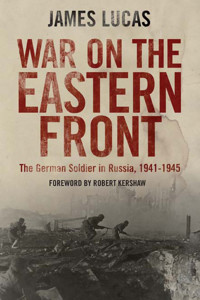
The German Soldier in Russia 1914-1945
James Lucas
Foreword by Robert Kershaw
ran
I I
Frontline Books, London
War on the Eastern Front
A Greenhill Book www.greenhillbooks.com
This paperback edition published in 2014 by Frontline Books
I I
an imprint of Pen & Sword Books Ltd,
47 Church Street, Barnsley, S. Yorkshire, S70 2AS www.frontline-books.com
Copyright © Cooper and Lucas Ltd, 1979 Foreword © Pen & Sword Books Ltd, 2014
The right of James Lucas to be identified as the author of this work has been asserted by him in accordance with the Copyright, Designs and Patents Act 1988.
ISBN: 978-1-84832-787-0
Publishing History
First published in Great Britain in 1979 by Jane’s Publishing Company, London. Published in 1991 by Greenhill Books, London.
All rights reserved. No part of this publication may be reproduced, stored in or introduced into a retrieval system, or transmitted, in any form, or by any means (electronic, mechanical, photocopying, recording or otherwise) without the prior written permission of the publisher. Any person who does any unauthorized act in relation to this publication may be liable to criminal prosecution and civil claims for damages.
CIP data records for this title are available from the British Library
For more information on our books, please visit www.frontline-books.com, email [email protected] or write to us at the above address.
Printed and bound by CPI Group (UK) Ltd, Croydon, CRO 4YY
Contents
II Contents
A Nebelwerfer regiment in the German summer offensive towards
Voronezh, 1942
169
26
A phenomenon of the Eastern Front: encirclement
177
27
The destruction of the encircled Soviet forces in the
fighting around Kiev, autumn 1941
183
28
The Cholm pocket, winter 1941-1942
196
Epilogue
206
Bibliography
208
Index
209
Maps
Foreword
James Lucas was an admirer of the fighting qualities of the German Army in the Second World War, having been captured by them in Tunisia in 1942. Working for the Imperial War Museum he had unprecedented access to contacts and German documentary wartime material, which he used to the full. War on the Eastern Front, first published in 1979 was one of the first English accounts at the German soldier level on what was then, a little known conflict. Lucas offered this invaluable small unit perspective when there were so few definitive ‘soldier’ accounts of the Russo-German war of 1941-5.
Few of these early accounts, Lucas included, dealt satisfactorily with the Vernichtungskrieg, or ‘war of annihilation’, that occurred on the Eastern Front. It was almost absent from Paul Carell’s German translated histories of Hitler Moves East and Scorched Earth in the early 1960s. Carell wrote about closely fought titanic battles invariably lost on the German side because of Hitler and the lack of resources at crucial moments in the epic struggle. The Russo-German conflict was fought between two totalitarian and ideologically motivated enemies, who indulged in inhuman excesses. Germany waged a genocidal war against the Jews. Recent modern wars have time again illustrated the extent to which moral responsibility becomes blurred around political edges. As one Wehrmacht veteran admitted in a TV interview, ‘if some people say that most Germans were innocent, I would say they were accomplices.’
Not all the combatants, as Lucas indicates, committed or witnessed atrocities, but an uncomfortable number did. Of the 19 to 20 million soldiers who fought for the Wehrmacht, about 17 to 19 million fought in Russia. The survivors were to populate and influence opinion in contemporary Germany today, so the subject is important.
Adolf Hitler was well aware of this when he announced on the 22 June 1941 ‘The World will hold its breath’ when three million German soldiers and their allies conducted a surprise attack on the Soviet Union. Within four months the fighting power of the invasion force was irretrievably sapped. Lucas, telling the story from the German soldier’s perspective, correctly identified the main factors: the Russians, climate and terrain, and the huge distances involved.
The ‘Russian Colossus’ was completely underestimated by the Wehrmacht planners. A short campaign of six weeks was envisaged. ‘Kick in the door’ Hitler proclaimed ‘and the whole rotten edifice would come crashing down’. The potential Russian strength of 200 divisions had to be reassessed at 360 by German intelligence within two months of the invasion. Despite a maligned and shabby ‘worker’s paradise’ reported in propaganda newsreels German soldiers saw instead the massive Dnieper dams and huge modern shipyards at Nikolayev on the Black Sea. They were confronted moreover by the technological surprise of hitherto unknown heavy tank types, the KV-1 and T-34, which outclassed any known tank and were impervious to German anti-tank guns. 88mm flak guns had to be improvised and used in a ground role. Soviet Katyusha M13 multi-barreled rocket launchers were a particularly unpleasant surprise for the German infantry and technically unprecedented. Lucas describes how small German units had to cope with these technological shocks.
Lucas correctly emphasized the peculiarities of terrain and vast distances that the feerman soldier found physically and psychologically difficult to comprehend. The German army was not the totally mechanized Panzer force trumpeted in propaganda films like Victory in the West shown after the successful French Blitzkrieg campaign of 1940. The Ostheer, or German Army, in the East was not much unlike its Kaiserheer predecessor of the First World War; some 3A million horses still hauled much of the artillery and logistic trains of the marching divisions of the infantry armies. Only about 16% of the German striking force was panzer and motorized. The fan-shaped front quickly overrun by its spearheads widened to 2,800 kilometres within four months and was over 1,000 kilometres deep. The breadth of this front required 280 divisions to cover it, but the Ostheer was attacking with just 127 divisions.
The fighting power of the invading German force became channeled and dissipated by the challenging terrain of the Pripet marshes and forests in front of Moscow, with few modern road and rail networks, as in Western Europe. To the south were the cornfields of the Ukraine and dusty rolling steppe extending to the Caucasus Mountains. Raising the swastika on Mount Elbrus, its 5,642-metre peak provided a momentary propaganda coup but represented a sterile waste of military resources. Rolling agricultural and steppe land facilitated the huge mobile battles of panzer encirclement from Minsk, through Smolensk and Vyazma to Moscow; but forests were ‘no-go’ areas dominated by partisans.
The climate, and as Lucas points out: ‘the foreignness of it all’ came as a huge surprise. Mud then snow and ice brought the panzers to a halt as much as the scouring dust of the steppe wore out engines. Between 1941-2, an exhausted German Army became ensnared in one of the worst Russian winters in living memory. Zhukov’s counter-strike in the midst of this winter in front of Moscow may have been primitive in delivery, but it brought the Ostheer to its knees.
‘General Winter’ did not defeat Hitler; it was rather the dogged ferocity of the Russian soldier. German fighting power had already been degraded by losses in the summer encirclement battles. Although the Ostheer had inflicted three to four million casualties on the Russians before Moscow, it had lost the equivalent of 30 divisions itself. This was greater than the Northern Army Group that had launched toward Leningrad at 26 divisions strong. The dead included the cream of the veteran German leadership, more than one third of its young officers and NCOs. These men were the core of German ‘Auftragstaktik’ or mission control expertise, able to operate fluidly and with great initiative. Their loss, alongside 50% of the panzer and motorized vehicles, was irreplaceable. Willpower haemorrhaged from the force as it became less mobile and able to think and react decisively tactically. In essence, the German Army in the east, ‘victored’ itself to death. Hitler took over in the midst of the 1941 winter crisis and his ‘hold in place’ and die order ushered in a period of inflexible and dogmatic leadership.
Lucas’s writing about German Army viewpoints of the Red Army, garnered through bitter experience, attracted the attention of NATO observers seeking to assess the Soviet Army during the Cold War years in Europe. The stoicism of Red Army soldiers was juxtaposed against the poor leadership and lack of initiative displayed by its officers. The innate cunning and excellent individual field-craft of Russian soldiers was recognized. Wild human-wave attacks and seemingly inhuman powers of resistance could suddenly result in illogical ‘herd mentality’ instances of mass surrender. The Red Army soldier was an enigma. Lessons were drawn by the modern NATO armies for combatting mass Soviet tanks at close quarters. Interest was also shown in the German Army’s response to dealing with the practical problems of winter warfare in sub-zero conditions. Wehrmacht training publications were translated and incorporated into NATO winter survival handbooks.
Lucas describes the sheer immensity and intensity of the titanic battles on the Russian Front. Huge encirclement battles at Kiev and Vyazma netted 665,000 and 663,000 Russian prisoners respectively, as well as hundreds of tanks and thousands of guns. The Russians were to learn and apply these lessons and turn them against their teachers. Defeat for the Ostheer came after the encirclement of a complete Army Group - Army Group Centre - in the summer of 1944. This broke the back of the German Army in the east and was the precursor to the Soviet attack on Berlin by April 1945.
Lucas has vividly presented the reader with the simple German soldier’s view of these epic events by narrating a series of small unit actions set amid the titanic battles on the Eastern Front.
Robert Kershaw, 2014
Introduction and acknowledgements “The imposing vastness of the space in which our troops are now assembling cannot fail to strike a deep impression . . .”
‘Operation Barbarossa ’
The German Army
The last days of tank destruction unit DORA II in Brandenburg during April 1945
The foreignness of it all “Few western Europeans ha ve any idea of the actual habits and mode of life of the Russians...”
The Waffen SS on the Eastern Front “Meine Ehre heisst Treue” (Loyalty is my honour)
The Red Army of Workers and Peasants
Two German views of the Red Army
The development of the Red Army
Partisans
The influence of terrain
The influence of climate
The effect of winter upon a Red Army unit
The frustrating mud and the scouring dust
The weapons of the Eastern Front “Bring up the assault artillery ...”
Assault artillery in action on the central front in the early days of the war with the Soviet Union
An SP detachment in the closing stages of the encirclement battles around the Kiev pocket
A platoon of SP guns in action against the Soviet thrust to capture Rzhev
The 249th Assault Artillery Brigade in action during the battle for Berlin, 1945
Hugo Primozic
Hyazinth von Strachwitz
Anti-tank weapons and tactics
Rocket propulsion
A phenomenon of the Eastern Front: encirclement
The destruction of the encircled Soviet forces in the fighting around Kiev
The Cholm pocket
Epilogue “Since midnight the guns have been silent.. THE LAST OKW COMMUNIQUE, MAY 1945
Bibliography
Index
Introduction and acknowledgements “The imposing vastness of the space in which our troops are now assembling cannot fail to strike a deep impression . . .”
THE CHIEF OF THE GENERAL STAFF JUNE 1941
At 03.30hrs on the dawn of Sunday 22 June 1941 seven German infantry armies, their advance spearheaded by four panzer groups, attacked the Soviet Union and opened, thereby, the greatest struggle in the history of military operations.
A commander when planning a campaign must have always in mind certain factors which will determine its successful outcome. Chief among these are the limitations of time and space, the strength of his own army as well as that of the enemy and the considerations of terrain and climate.
The war which the German Army undertook against the Soviet Union was the struggle of Titans; a war of superlatives both for the area it covered and for the numbers involved. The frontier at the opening of hostilities was nearly 1,600 kilometres long, excluding the 100 kilometre-long border between Finland and Russia. Then, as the German Army moved eastwards and entered Russia proper the Front expanded like a fan, so that the battle line eventually reached from northern Finland to the Caucasus, a distance of nearly 3,000 kilometres. The depth of the fighting area was 960 kilometres. Within these vast areas of longitude and latitude there marched and manoeuvred the German Army on its way, or so it thought, to a new, short and victorious war. Three million German soldiers, 600,000 vehicles, 3,580 panzers and 7,184 guns, covered by a Luftwaffe umbrella of 1,830 aircraft, rolled across the frontier in the first offensives. Propaganda had led the world to believe that the German Army was a vast mechanised, all-motorised force, but this belief was false. Pulling the guns and the carts of the supply columns or working as pack animals went nearly three quarters of a million horses - more than had entered the Kaiser’s war in 1914. The imposing half-tracked troop carriers were few in number and the German infantry foot-marched vast distances, often covering seventy kilometres per day for periods of several weeks together.
The army which contested the German invasion was the Red Army of Workers and Peasants - an unknown factor and an army which Hitler had dismissed as being a clay colossus without a head. It was known to be mighty in numbers with a huge field force backed by a vast reservoir of reservists. It was thought to be poorly commanded and badly armed but, unknown to the OKW (Oberkommando der Wehrmacht, Supreme Command of the German Armed Forces) planners, was the fact that the Russian host was equipped with some weapons, particularly tanks, which were qualitatively superior to those on issue to their own divisions. These shocks were yet to come.
The country into which the armies were advancing was a vast land mass made up of every type of terrain. From the pine-forested emptiness of northern Finland the line ran through the wide expanses of Russia’s western border zone. Much of that region was covered by almost impenetrable swamps, the greatest of which extended for a distance equivalent to that between London and Carlisle. South of this and crossing the wide and monotonous steppes of the Ukraine the land changed and was succeeded in the extreme southern part of the battle front by the sub-tropical climate and terrain of Georgia and the Caucasus. Across whole regions of the line from Finland to the Caucasus were great forests of such density that they were almost jungle. The presence of the natural obstacles of mountain, desert, marsh and jungle forced the German armies into predictable routes of advance and it was to break through these passages, defended by the Red Army, that many of the bloodiest battles were fought.
The appreciation of terrain which von Greiffenburg, at one time Chief of Staff of the 12th Army, wrote, can be applied to regions other than the one about which he was reporting. “East of the Bug-San line in Poland [he wrote] terrain conditions and the shortage of roads restrict movement. . . the rivers often overflow and cause widespread flooding. This disadvantage becomes more pronounced the farther east one penetrates, particularly in the marshy, heavily-forested regions of the Pripet marshes and the Beresina river . . .”.
The terrain was usually bad, the river obstacles were wide, the roads few in number and poor in construction and the main railway lines could be counted on the fingers of one hand. The German Army which was armed for, and had prepared for a short and tactical war, was expected to use the equipment designed for operations in western Europe, in all the types of terrain which were contained within the Soviet Union.
Three of the four military considerations had been considered. Only that of climate needed to be added to the calculation and this factor, OKW was confident, could be disregarded, for it was planned to finish the war with Russia before the onset of bad weather. All things considered there seemed to have been no impediment which might cause Hitler to shrink back from that decision which Josef Goebbels was to declare had caused the whole world to hold its breath. At dawn on the day following Midsummer-Day and preceding that day on which Napoleon had invaded Russia, the guns spoke and their voice was to remain unstilled for forty-six months of battle during which tens of millions were to die. The greatest war in recorded history had begun.
This book sets out to describe only certain features of the Russo-German war of 1941-1945 - those as seen by the Germans and their allies. It is not a history of that war, neither is it a chronology of its battles, nor a potted description of the progress of the campaigns. Rather it is a random selection of experiences and events which serve to illustrate the peculiarities of life on the Russian Front. It is a compilation of experiences which were unique to war on that Front, of conditions which were first encountered there or which impressed their own stamp upon the fighting there.
That it has to be a random selection of personal experiences is unavoidable. In all more than ten million men served on the Axis side during the years of war. Each of these had personal reminiscences. Each division which fought there should be accorded the mention of its service. Each battle, the tactics and the weapons used in it, should be adjudged, weighed and analysed. Conclusions should be drawn from this gallimaufry but this book is not the one to draw them.
It will also be seen that there is a heavier emphasis on the first two years of the war. The principal reason for this is that by 1943 the weapons, tactics and experiences which had made the Russian Front unique had become commonplace. A secondary reason for this imbalance is that the German Army had begun to lose the war by 1943, and its death at the hands of the Red Army was only a matter of time. Diaries and letters written in later years seldom reveal a writer’s true thoughts for in retreat or defeat the principal consideration is survival. Writers of letters home resort to cliches and to circumspection so that they do not worry those at home and diary entries, in so far as these exist, usually record only the distances marched, the names of fallen comrades or the number of ‘kills’ made.
All wars are concerned with aggression and it can be seen that often this aggression recoils and strikes the aggressor. Some wars follow a pattern in which the victim emerges victorious, after having suffered bitter reverses, while the attacker, after brilliant initial successes, crashes down into defeat. The Russo-German war followed that pattern. There was, however, one difference which set it apart from any other campaign of the Second World War: the hatred with which it was fought. The reasons for this are dealt with in the opening chapter. This mutual animosity produced on both sides acts of so terrible a nature that I have deliberately excluded them, except in those places where their inclusion sets the seal upon some particular tragedy.
It is not my intention to weigh the political and moral attitudes of the protagonists. That their policies and methods were alien to us does not need to be stressed and I have attempted no judgements.
For the text of this book I have drawn upon interviews with former soldiers, upon diaries, letters and similar unpublished material. To supplement these personal narratives recourse has been made to war-diaries, hand books, reports and to official histories. For much of the research that was carried on I am indebted to a number of very good friends: Terry Charman, Phillip Reed and George Clout, all of the Imperial War Museum, and particularly to Matthew Cooper for the work which he carried out on many of the unpublished documents.
To all those other gentlemen with whom I corresponded or whom I interviewed go my grateful thanks. These range in rank from a former SS General Officer down to private soldiers; from a Hungarian Field Officer to an Alpini rifleman who fought with Army Group South. My thanks go also to the institutions and museums in Great Britain and on the Continent whose archives were consulted.
At a deeply personal level my thanks go, as always, to those who have supported and encouraged me: to Traude, my wife, to Barbara Shaw, to Mary Harris and to Sheila Watson, as well as to the staff of Macdonald and Jane’s. Particularly I should like to mention the expert advice and assistance given by my friends in that company: Judy Tuke, Isobel Smythe-Wood, Michael Stevens and Alex Vanags.
‘Operation Barbarossa ’
“Since the early hours of this morning there has been fighting along the Soviet Russian frontier . .
OKW COMMUNIQUE, 22 JUNE 1941
At the end of the summer of 1940, Adolf Hitler was the master of continental Europe. The armed forces of the Third Reich, whose Supreme Commander he was, had conquered an Empire which ran from the Channel coast to the river Bug in Poland and from the North Cape to the Alps. Surveying the situation at the end of that victorious summer Hitler could be pleased. Taking as a starting point March 1938, the month in which German troops occupied Austria, a country outside of Germany proper, he had gained much through diplomacy, bluff and short campaigns. He had taken Czechoslovakia in two bites, between September 1938 and March 1939; Memel, that city emotive to the German mind, had been absorbed in the autumn of 1939 and then had come the invasion of Poland.
Within a month Poland had been destroyed. Two short campaigns had captured the Scandinavian countries of Denmark and Norway and had reduced to the status of vassals the Empires of France, Belgium and Holland. Only two countries stood outside the influence of Greater Germany. The one was Great Britain, now bereft of allies on the mainland of Europe, and the other the Soviet Union, an ally of Germany through a non-aggression pact signed in 1939.
There was a partial demobilisation of older age groups of servicemen, but at the same time on the western coasts of France Army divisions were practising embarkation into and debarkation from barges in which they expected to cross the Channel and invade England.
Luftwaffe squadrons had begun the ‘softening-up’ process of bombing airfields from which the RAF might attack any German sea-borne landing upon the coasts of Sussex or Kent. All seemed set for ‘Operation Sea Lion’, the invasion of the United Kingdom, but the Führer lacked enthusiasm for the enterprise. Indeed he retired to Berchtesgaden for a holiday at the end of which he announced that the projected invasion would not take place. His mind was made up. He had decided upon his next move which would make Germany’s the only voice in Europe. He would destroy Russia.
THE BATTLE AREA ACROSS WHICH THE RUSSO-GERMAN WAR WAS FOUGHT
In a speech on 21 July 1940 to the heads of his armed forces he announced his intention, made necessary, he claimed, by Stalin’s flirtation with Britain and, during the discussion which followed, the strategic outline of the new war was drawn. The notes made by Haider for his war diary and dated 22 July 1940 record that the intention was . the defeat of the Russian Army, or the capture of at least as much Russian territory as necessary to prevent enemy attacks against Berlin and the Silesian industrial areas ... strength required: at most 100 divisions.” This last sentence is significant, for such was the confidence of the German military commanders in the ability of their own army and such was the low opinion of the fighting qualities of the Red Army, that they considered one hundred German divisions to be more than enough to win the war.
When a comparison is made between the campaign in France during 1940 and the plan for the assault upon Russia, the astonishing fact emerges that for the new war it was proposed to commit only a handful of divisions more than were used during the second stage of the war in the west. In terms of area the German Army was to be deployed in about a million square miles of Russia, whereas the area of western Europe in which victory had been gained in 1940 with slightly fewer divisions had been approximately 50,000 square miles.
By any standards the plans of OKH (Oberkommando des Heeres, Army High Command) were optimistic but a reason lay behind the enthusiasm with which they began planning. It was not that they were keen to attack the Soviet Union. The generals all realised the menace to Germany which that nation represented but there were considerations of grand strategy which suggested to the Army Command that there were more urgent priorities than the attack upon Russia. As they saw it, there was a far greater need to reduce Great Britain and her Empire. The defeat of the Italian Army in North Africa by the British Army under Wavell convinced OKH that, necessary though a war against Russia might one day be, the first priority had to be to destroy Britain.
The principal reason for the Army’s keen acceptance of the Fiihrer’s directive for a new war lay in the desire of the General Staff to make Hitler realise that he needed theirprofessional skills. In the past the attitude of the generals vis-ä-vis Hitler had fluctuated between unenthusiastic acceptance of his orders and hostility to them. They had opposed almost all of his pre-war political adventures, but these had won the Rhineland, Austria, Sudetenland and Czechoslovakia. With the outbreak of war the Führer had taken an increasingly more dominant role in the making of military decisions. His plan for the main effort of the attack upon western Europe to be launched through the Ardennes had been reluctantly accepted by the generals but had proved to be the move which brought victory. The attitude of the Army commanders had perforce changed from that of being pessimistic opponents of Hitler’s policies to men who attempted to anticipate what these might in future be and to plan for them, in order to show their loyalty to their Supreme Commander. It was with this attitude in mind that von Brauchitsch, Commander-in-Chief of the German Army, had ordered his Chief of Staff to prepare a plan for the invasion of Russia, in order that “... OKH would not be unprepared ...” Thus, when Hitler announced his intention of turning eastwards the Army General Staff could tell the Führer with pride they had already undertaken active planning.
As a result of the information which had already been gained from that planning the Army Commanders were able to convince Hitler that his original intention to open the new operation in the autumn of 1940 was*impossible to realise and this was thereupon postponed to the spring of 1941.
The new campaign was predicated upon the ability of the German Army to destroy the Red Army west of the Dnieper river. If the Russian Army did not give battle but withdrew into the vastnesses of the Soviet Union, then the Germans would be sucked into a long drawn-out war for which they did not have the resources. The writer, A.J.P. Taylor, underlined the last point when he wrote “.. .while his potential opponents [the other Great Powers] were rearming for a great ‘war in depth’, Hitler rearmed Germany ‘in breadth’ - everything for the front line and no reserves for a second campaign...”.
With the benefit of hindsight we can encapsulate not only the situation which confronted Germany’s military planners but also the way in which it developed. Their armies, weaker in strength than those of their opponents, were expected to destroy the enemy in so short a time that the problems of winter warfare could be avoided and the greatest terrain problem of western Russia - the Pripet Marsh ignored.
As it happened the Red Army was not destroyed west of the Dnieper. True, a host equal to the number of divisions which OKH had estimated to constitute the Soviet field force had been killed or captured by the end of autumn, but always there were more Russian divisions to contest the German advance. Such was the nature of that opposition put up by the Red Army and such was the effect of terrain upon the speed of the drive that the war did drag on, producing in the first winter a defeat for the Germans, despair among the soldiers and a growing belief that victory was not possible.
The factor of the Pripet Marsh, its influence upon the course of operations and its subsequent use as a base for partisan operations was to prove an ulcer in the German body.
We have been able to encapsulate the problems and their development. We can, in like fashion, summarise the principal faults of which the German Command were guilty. For the war against Russia, the General Staff had overestimated their own Army’s
OPERATION BARBAROSSA - THE ARMY HIGH COMMAND'S PLAN
potential, they had underestimated that of the Red Army and Soviet ability to lead and to equip that Army. They had ignored the factor of terrain and had left unconsidered that of climate. The sum of these faults was a plan for disaster and the war did end disastrously for Germany. What is surprising is that the German war machine won important strategic victories right up to the middle of 1943, and a great number of tactical ones thereafter. Such was the measure of its capabilities.
The active planning for the new war was based upon plans drawn up by various senior officers. Marcks, Chief of Staff of the 18th Army, envisaged a two-phase campaign. In the first stage the Red Army would be encircled and destroyed close to the frontier. During the second the German Army would then go on to occupy the valuable industrial areas of western Russia and at the end of the campaign would have reached a general line running from Archangel to Rostov. The two groups of forces needed to carry out Marcks’ plan would at first be separated by the obstacle of the Pripet Marsh but would then combine on its eastern edge to carry the all-out assault towards Moscow, while a small holding group detached from the main body prevented the Red Army from attacking the Roumanian oil-fields, which were vital to the German economy.
In a revision of his plan Marcks advanced the logical, but as it turned out completely inaccurate premise, “... the Russians cannot avoid a decision as they did in 1812. Modern armed forces of one hundred divisions cannot abandon their sources of supply. It is anticipated that the Russian Army will stand to do battle in a defensive position protecting Great Russia and the Eastern Ukraine.”
Marcks was not to know that the Soviets had developed other sources of supply than those in Western Russia and that a relocation of Soviet heavy industry was under way which would place the factories east of the Ural mountains. Those two facts negated the whole premise of the Marcks plan.
That put forward by von Paulus, Deputy Chief of General Staff, amended parts of the Marcks’ plan and proposed that there should be not two but three Army Groups, each with a specific objective. He, too, made Moscow the prime target and according to Haider’s war diary “...the capture of Leningrad and the Don basin beyond Kharkov would depend upon the progress of the general offensive against Moscow ...”.
Plans drawn up by Chiefs of Staff of each of the three Army Groups foresaw the importance of Moscow as the target. Two agreed on its importance as the prime target. Von Sodenstern, however, doubted the ability of the German Army to bring the Red Army to battle west of the Dnieper and proposed lightning advances upon Moscow, Leningrad and Kharkov with the aim of crippling the Soviet leadership. The plan presented to Hitler by the Commander-in-Chief of the Army and his Chief of Staff on 5 December 1940, produced the response from Hitler that Moscow was of no great importance. This was a complete reversal of the principle upon which the Army’s plan was based.
The Fiihrer’s directive stated: “The main weight ... will be delivered in the northern area... The more southerly of the two army groups [of this northern grouping], will have the task of advancing ... and routing the enemy forces in White Russia .. .[ and will help] to destroy the enemy forces operating in the Baltic area. Only after the fulfilment of this essential task [including the occupation of Leningrad] will the attack be continued with the intention of occupying Moscow.”
By March 1941, there were fears at OKW on whether the German forces were sufficient in number. In view of Hitler’s reluctance to use troops of nations allied to Germany, the southern thrust had to be weakened and the Führer also claimed the Pripet marshes presented no serious obstacle to a linear advance. The arguments of his senior commander notwithstanding, the final plan for ‘Operation Barbarossa’ was as follows: Army Group North would attack from East Prussia in the general direction of Leningrad, Army Group Centre would advance from Poland to force a break through towards Smolensk. These two groups would then join to destroy the enemy formations in the Baltic area. Meanwhile Army Group South would move from southern Poland and through Kiev to the great bend of the lower Dnieper.
There then followed a vague statement that once the northern objectives had been attained freedom of movement for further tasks was assured. This implied a co-operation with Army Group South, presumably to assist that Army Group to complete its tasks. Thereafter, there would come the advance towards Moscow.
The German dispositions
Army Group North, commanded by von Leeb, had two armies on its establishment. Busch’s 16th with eight divisions and the 18th Army, under Küchler, with seven. To lead these infantry forces there was a Panzer Group, Hoepner’s 4th, made up of three panzer, three motorised and two infantry divisions. There were six other divisions (three infantry and three security) in Army Group reserve and two more infantry divisions in the OKH reserve, held behind Army Group’s front.
The strongest of the Army Groups was that of the centre under von Bock. The 4th Army (von Kluge) had fourteen divisions while that of Strauss (9th Army) had nine. With this Army Group there were two panzer groups: Guderian’s 2nd with fifteen divisions (five panzer, three motorised, a cavalry and six infantry) and Hoth’s 3rd with eleven divisions (including four panzer and three motorised).
Army Group Centre had one infantry division in reserve and a further six in OKH reserve.
Von Rundstedt’s Army Group South disposed three armies. The 17th, under Stulpnagel, had thirteen divisions, the 6th, commanded by von Reichenau had six and the 11th Army with seven divisions was commanded by von Schobert. The 1st Panzer Group (von Kleist) with Army Group South had fourteen divisions, of which five were panzer and three motorised infantry. Army Group South reserve was one infantry division and the OKH reserve was made up of six divisions.
Thus, on 22 June 1941 a host made up of seven armies and four panzer groups was ready to move across the frontier. The whole force consisted of one hundred and thirty-four divisions, of which seventeen were panzer, thirteen armoured infantry, the only cavalry division in the German Army, four mountain divisions and nine security. The remainder were infantry.
To this purely German force must be added the armies of her allies, of which there were fourteen Roumanian and twenty-one Finnish divisions. Later these would be joined by Hungarian forces, a Spanish division, a whole Italian Army together with a number of smaller contingents from other European nations. Later still the number of foreign units would include regiments and divisions of the Waffen SS raised from French, Belgian, Dutch and Scandinavian volunteers. The presence of those men in the war against Russia is dealt with in another chapter.
Although the number of armoured divisions available for ‘Barbarossa’ had more than doubled (fifteen in May 1940; thirty-two in June 1941) the number of vehicles had increased by only a third (2,574/3,332). Hitler, aware of the importance of the armoured thrust to the new campaign had raised the number of panzer divisions by the simple expedient of cutting in half the establishment of existing divisions and thus creating two divisions out of one. It will be appreciated that, of course, the regular formations retained the best of the equipment and parcelled out the remainder to the new units as these were formed. Those who were among the last to be raised were issued equipment of the most diverse nature. The 18th Panzer Division, for example, had no vehicles at all until June 1941, when French trucks were supplied. With no delay the troops were then carried straight from the 18th division’s concentration area to the form up zone, east of Warsaw, and put into action. When the division entered the fighting it did so with 162 different types of soft skin vehicle, among the twenty-one major groupings of which it was composed. One of those groupings had seventeen different types of lorry within a unit establishment of thirty-three vehicles. The artillery regiment had 445 vehicles on establishment and there were sixty-nine different types of lorry. The problem of spares for these many, and often unusual, different types of machine can best be imagined. There was, however, one vehicle which was not included on the war establishment and which was yet to be found in every unit.
This was the Russianpanje cart, a horse-drawn waggon, robustly constructed, light and extremely mobile. One transport officer was to remark bitterly, “The panje cart was the only standardised transport we had, and that was not even an official issue.”
Three million German soldiers went into ‘Operation Barbarossa’ supported by more than seven thousand artillery pieces and with their advances led by 3,332 tanks. When this mighty force moved forward on the dawn of 22 June 1941 a turning point was reached in the Second World War. Britain, which for a whole year had stood alone and unconquered against Hitler, once more had an ally and the spectre of a two-front war arose again to haunt the German General Staff. All that they had feared was coming true.
The Red Army's dispositions
The Soviets, conscious of the threat imposed by the growing power of Hitler’s Germany, had deployed the Red Army in four special military districts along the common frontier. In the belief that Germany’s aim would be to seize economic prizes and, in particular, the oil and wheat of southern Russia, the Red Army’s High Command had concentrated the greatest number of its armies in the districts which covered the Ukraine.
The Soviet line of battle, starting in the south and working northwards, had at its most southerly point the Odessa Special Military District with 9th Army under command. This Army controlled twelve infantry and two armoured divisions which were deployed in the area between the rivers Pruth and Dniester, covering a front which ran from the Black Sea and along the whole length of Moldavia.
The next Special Military District was that of Kiev and this disposed four main armies. These were, running from south to north, 12th, 26th, 6th, and 5th. Behind those front line armies a new one had been raised, 28th, whose task it would be to act as a deep reserve. The Kiev district had forty infantry and sixteen armoured divisions in its command; excluding the divisions of the newly formed 28th Army, and the line which the district held stood along the Carpathian mountains and continued northwards conforming to the line of the lower Bug.
Of the four districts the next, the Western, was in the most exposed position for it projected strongly into Poland as it followed the river Bug, which formed the frontier between Germany and Russia.
One of the Western District’s armies, the 10th grouped around Bialystok, was outflanked both to the north and south by two German panzer groups. The Kiev district had three armies in the line: 4th, 10th and 3rd, with the newly-raised 13th Army in reserve. Of the thirty-six divisions under command, excluding those of 13th Army, twenty-six were infantry and ten armoured.
The most northerly of the four Special Military Districts facing the German Army was the Baltic, with 11th and 8th Armies under Command. Like the Kiev and Western district the Baltic had a newly formed Army, the 27th, in reserve. In the Baltic district there were twenty infantry and six armoured divisions disposed along the East Prussian frontier and extending northwards to touch the Baltic Sea in the area of the republic of Latvia.
Thus, ten Russian armies were in the line with a further three in reserve. A force of ninety-eight infantry or motorised divisions and thirty-four armoured divisions was in the field together with a number of cavalry and*other divisions. The German appreciation of Russian strength was based on summaries completed during 1938 and 1940 and, therefore, grossly underestimated the forces which the Soviets could produce. The frustration which was felt at the outpouring of men can be seen in Haider’s war diary. During mid-August there is an entry which admits: “we reckoned with two hundred divisions, but now we have already identified three hundred and sixty”.
The Germans found that the fighting quality of the Red Army units varied considerably and one reason for the poor showing of the early days was that there was no great unifying force, no emotional object with which the soldiers could identify themselves and for which they would fight.
Not until the declaration of the war as being that fought for the Fatherland did the attitudes of the ordinary Russian soldiers change and their resistance to the invader become more fierce. This is not to say that there was no heroism shown by the Red Army in the early days of the campaign, nor does it mean that there were not units which even in 1945 did not collapse and retreat in panic. There were such units, of course, but the Red Army after 1942 was an entirely different one in spirit from that of the days of June 1941.
The concept of the ‘Great Patriotic War’ was also responsible for the growth of the Russian partisan movement from small and scattered bands into an unseen army which worked against the rear echelons and supplies of the German forces. The feeling of omnipresent danger was expressed by an officer of the SS Leibstandarte Adolf Hitler, ‘Panzer’ Meyer, when he remarked “The Front is everywhere.”
The greatest blunder committed by the German Supreme Command was that of underestimating Russia’s capacity to put vast numbers of men into the field armies and into the partisan movement and to supply them with weapons. Of much less significance were the problems of climate and terrain. Both of those factors can be met and mastered. But to have considered an enemy to be a powerless rabble and then to be made aware that it is none of those things but a powerful, well-armed and aggressive force was the experience of the German General Staff when it first became clear that the intelligence appreciations upon which they had based their plans for conquest had been totally false.
For the ordinary soldier the unending battle against an enemy which his generals had told him had been defeated produced a peculiar depression. Particularly when he contrasted the dwindling numbers of his own companies with the flood of men whom the Red Army could put into action and of whom there seemed to be no end.
But all this was in the future, in the years of struggle which lay ahead. Let us instead go back in time to the early hours of the morning of 22 June. No order came to cancel the operation. The minutes ticked away and then at 03.15hrs the die was cast. The Führer, whose decision it was that Russia be destroyed, sent his armies pouring across the frontier. The statistics with which he had been supplied had led him to believe that the war machine which he had constructed would win another short war. It had to be short for Germany could not risk a long one.
The summer night was warm. The woods along the frontier were full of troops resting, waiting, sleeping. The concentration areas were full of men who had arrived, many after long journeys from France, eager to be in on this new enterprise. One officer recorded how his comrades had brought with them from France bottles of vintage champagne and that they stood, as the slow minutes ticked away, ready to drink to the success of the new war. As the first greyness of a summer dawn was seen in the east the dark western sky was lit by muzzle flashes of German guns as they fired upon selected targets on the eastern bank of the Bug river. ‘Operation Barbarossa’ had begun.
Using a very simple analogy the course of the German-Russian war of 1941-45 can be said to have resembled the action of a pendulum. In the summer of 1941 it had swung eastwards to bring the German armies to the gates of Moscow. The Russian winter offensive had then returned the swing from east to west as it drove back the German forces. During the summer of 1942 and the period of the second German summer offensive the pendulum swung eastwards once more and at the farthest extent of its swing reached the Volga at Stalingrad. The Russian offensive during the second winter of the war then forced the movement back again. Another German attempt, launched during the summer of 1943, failed and this time, without waiting for the onset of winter, the Red Army flowed westwards on a long and continuous swing which was maintained with halts of only short durations until the war’s end.
The German Army entered upon the campaign with the full confidence of winning victory within months. Because of this falsely-engendered belief there had been no forethought, no proper planning to equip the armed forces with modern, strategic weapons, and even to hint at the possibility of a need for winter clothing was tantamount to doubting Hitler’s word that the war would be quickly won. Thus the Wehrmacht, and particularly the Army, went into a war which had not been strategically thought through, was too hastily planned and subject to too much interference from a Supreme Headquarters hundreds, sometimes thousands, of kilometres removed from the battle front. No wonder then that the regiments bled almost to death in that first bitter winter. The realisation of the scale of the sacrifices which had been made by the ordinary fighting man was so strong in the mind of Model that he rounded on Hitler who had dared to remark that the men of 1943 were not of the same calibre as those of 1941. “Of course they are not, my Führer” retorted the fiery General. “The men of 1941 are dead, scattered in graves all over Russia.”
At the end of the year 1942, and by the time that winter had come again, the Army had learned how to overcome the difficulties of the cold weather season and how to convert its disadvantages into advantages.
The ad hoc improvisations of that first year had been regularised. The Army had come to terms with one of the unique features of warfare on the Eastern Front; only the Supreme Commander was still incapable of making a decision and sticking to it. Also he was beginning to show signs that the strain upon him had become too great and that his mind was becoming deranged.
By the middle of 1943 the pattern of the war had become established and with very few exceptions all the weapons and tactics that had once been peculiar to the Russian front were in use in other theatres of operations.
It is, therefore, principally the Russian campaign in its first two years that this book deals with and the few references to events, battles or tactics of other and later years serve only to illustrate a particular point.
One should at this juncture, state that the war on the Eastern Front was fought with a particular savagery. Neither side saw it as a mere struggle between nations, nor did they view it as a contest between ideologies: National Socialist Germany against Communist Russia. It was to many Germans and Russians a resumption of that conflict for domination between East and West, between Slav and Teuton, which had marked the progress of European history for over a millenium. It is as well to remember this for only then do the sacrifice and effort, the atrocities and the brutalities of the forty-six months of war become comprehensible.
To this folk memory of genocidal battles fought in centuries past must be added a religious aspect of a crusade against godlessness which caused many young men in western Europe to enlist with the German forces. This idealistic, almost romantic concept of being a crusader may have been but brief, nevertheless it cannot be denied that it existed and was reinforced in the early days of the campaign by the action of villagers in the Ukraine who blessed the men in the vehicles marked with the black cross and who saw the German soldiers as a liberating, Christian host.
Crusading idealism vanished in the cannon’s roar but even those who quickly lost this religious/ideological surcoat, or those who had never been covered by it, were soon convinced as a result of their experiences on the Eastern Front of the need to fight on until Germany won the war. They had seen the way in which the lives of Russian soldiers were casually wasted in repeated and hopeless attacks.
And this Oriental contempt for the individual convinced most of the German soldiers that if the Russians held the lives of their own men so cheap, how much cheaper would they hold those of their enemies. Other soldiers, from the recollection of sights seen in recaptured hospitals or retaken trenches, were convinced that to surrender might well be the prelude to death or torture, or else to long years of hard labour in the mines of some Soviet slave camp. To prevent that nightmare from becoming a reality every sacrifice must be made, every demand met, no effort left undone to ensure total victory. Western civilisation had to be saved. Germany had to win or else she would be destroyed.
There is no doubt that many Germans and many of those Europeans who fought in the ranks of the Waffen SS, really did see themselves as bastions of western European civilisation. Equally, of course, there were millions in Germany who had not supported Hitler in 1933 and who had viewed his policies with repugnance just as they viewed Germany’s future with despair. Yet, when Hitler invaded Russia, many of these political opponents accepted that he had been right to attack the eastern barbarians before they moved westwards and destroyed the German fatherland.
For their part the leaders of the Soviet Union soon realised that if their country was to be saved from this new invasion of Teutonic knights then it was not sufficient to call upon the masses to rally around Marx and Lenin. The Communist leaders, too, appealed to the deep instincts of patriotism which lay within the soul of the Russian people and converted the war into a struggle to defend Russia the Motherland; the Soviet Motherland.
In a paper which he wrote on experiences gained in combat against the Russians SS General Max Simon stated “A national concept had not at this time (summer and autumn 1941) penetrated the minds of the Russian Front-line troops; it was not proclaimed by Stalin until late autumn ...” From that time on the tenacity with which the Red Army fought changed to become a fanatical determination to drive the invaders from their homeland. It was with this bitterness in their hearts that Soviet troops fought their way westwards across Europe, destroying their enemies and capturing the capital city of Berlin which sheltered the man who had brought about the war. The Red Army men had seen their country invaded and had witnessed the results of that war and its effects upon the Russian people. Their vengeance was terrible.
The war on the Eastern Front was unique not least for the sheer size of the battlefield and of the numbers which fought there. On no other Front did such masses of men and materials move across so great an area. The scale of losses is unbelievable. The German Army lost nearly one thousand horses per day for every day of the war. Red Army tank groupings in the last year of the war numbered thousands of machines massed on quite small sectors of the Front. The size of the battle area, the vast expanse of the Pripet Marsh and the factors of terrain had as great an influence on the strategy of the Russian war as SP guns and rocket weapons had on the tactical. The climate with its harsh winters, scouring dust in summer and clinging mud for much of the rest of the year were other factors peculiar to the campaign in Russia.
To open this book the first chapters accompany the German Army in the early days and weeks of the campaign. These rely very heavily upon the stories of Germany infantry as they experienced the sights of this strange, closed land which ran halfway round the world from Poland to Alaska. Then the Red Army is dealt with, as are some of the principal weapons used by both sides: the rocket artillery of the Germans and the development of self-propelled guns. Turning to the factors of climate and terrain, the terrors of the winter season and the frustrations of the tenacious mud of Russia are handled as well as the influence of ground on the development of the first campaign. Finally, the book deals with a military phenomenon which developed in Russia: the deliberate acceptance by German forces of being encircled.
This is a book solely about the Army; the Luftwaffe and the Navy have no place in it. It is about soldiers and the tragedy of war.
The German Army
“At the beginning of the campaign ... we German soldiers, generally speaking knew little about our adversary ...”
Max Simon
LIEUTENANT GENERAL OF THE WAFFEN SS
To the German soldier who waited upon the opening of ‘Operation Barbarossa’ his new enemy, the Soviet Union, was a complete enigma for since the Revolution little positive and accurate information on conditions there had been published in his country, or in the world in general. There had been propaganda put out by the supporters and the detractors of the Communist state and somewhere between the two extremes of falsification lay the truth. That the system was a dictatorship had never been denied and, therefore, the government was certain to be rigid, autocratic and unyielding. The standard of life was believed to be lower than that enjoyed in the West and it was believed that the Russian people were prisoners of a ruthlessly-governed, economically-underprivileged society.
The Germans saw the Communist political and economic system as more restrictive than that under which they themselves lived and to this was added a racial element in that many of them held it to be self-evident that the Slav peoples were an inferior race. Since all Slavs were inferior it followed that conditions in Russia, the mother Slav country, must be even more primitive than in those other Slav nations which had had contact with the West. The standard of life in Poland, which the German Army had defeated two years earlier, had been filmed and commented upon by the German propaganda machine to prove conclusively, to any who still questioned the master race dogma, that the Slavs were inferior and that they subsisted in backward conditions, simply because they were inferior.
A rigid Red dictatorship and grinding poverty for the masses were the accepted ideas of conditions in the Soviet Union. But what of the power of the Red Army? Thousands of Germans had fought as soldiers on the Eastern Front during the First World War and later on, during the 1920s and early ’thirties, German officers also served in the Soviet Union when the Communist government granted those facilities which enabled the German High Command to evade the limitations of the Versailles Treaty and to test the theories of contemporary warfare and modern military techniques. The men who had trained in Russia were fewer in number than those who had fought as combatants on the Eastern Front but they had been, in those Weimar days, the most promising candidates for high position in the German General Staff and they should have acquired a firsthand knowledge of the country, its people and its Army. This knowledge must have been laid before the section of Intelligence dealing with foreign armies in the East. If anyone in Germany should have known about Soviet capability it should have been them.
Nevertheless, most Germans, like most people everywhere, were generally ignorant of the Soviet Union. They knew that geographically it was a vast territory covering nearly one sixth of the land surface of the globe, but in Russia they were unprepared for the depression which, was engendered by the realisation of its terrible vastness. They were unprepared for fields of sunflowers which went on for kilometre after kilometre after weary kilometre; solid blocks of colour stretching forward to the distant horizons. In the summer a sea of upraised heads, gold and yellow, stood erect, while in the searing heat of late autumn this pride had been brought down and the flowers stood with bent heads burnt to a deep brown by the fierce sun.
There were maize fields of unimaginable size and immense forests which were like jungles in the density of their tangled undergrowth. There were woods of such impenetrability that most German troops could advance scant hundreds of metres into them. The soldiers were unprepared for marshes which form one of the outstanding natural obstacles of the central and north-western republic of Byelo-Russia; marshes so great in extent as to be as large as two provinces of their German homeland. They found rivers unembank-mented and prone to flood with waters which swept across the flat, monotonous landscape, increasing for months at a time the already vast marsh area. Thus far the terrain.
They had, in their naivety, those German troops, perhaps thought of Russia as having the same road and rail system as their own. Of course, they reasoned, the primitive Slavs would not have an autobahn like Hitler’s Germany, but a first-class road system, or so they thought, must certainly exist. Instead of a vast network they found that the number of all-weather roads in western Russia could be counted on the fingers of one hand and that these roads converged upon Moscow, the Soviet capital: the heart and power house of the Red Empire. They then discovered that most roads, excepting only the few main highways, were turned into impassable mud tracks following only moderate rain fall; that surfaces became deeply rutted through the weight of traffic, that they were completely impassable in winter and were sandy, engine-scouring dust traps in the summer. The railway, the only other main source of communication, was just as inadequate. Not only were the main lines few in number and the branch line system poor, but the whole railway network used a broader gauge than that of western Europe,
difference which brought about a tremendous strain upon the mall amount of rolling stock which the Army was able either to eize or to adapt.