Uzyskaj dostęp do tej i ponad 240000 książek od 14,99 zł miesięcznie
- Wydawca: Firlej, Anna Firlej
- Kategoria: Literatura faktu•Reportaże
- Język: angielski
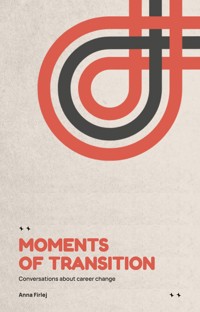
What happens to a person when they no longer fit the job, the role, or the path they once chose? How do you recognize the moment when something stops feeding you? And what do you do when the old professional coat gets too tight, and the new one isn't hanging ready in the closet yet?
Moments of Transition is a reportage about five women who, at different points in their lives, dared to make a professional turn. A psychotherapist who found her way back to herself after years in the corporate world. A serial entrepreneur who traded the stability of a large company for freedom with no safety net. A fintech CEO who changed direction without crisis or drama. A country manager who learned to trust life step by step. And a woman whose taste was decades ahead of the market -until the market stopped rewarding it.
Anna Firlej - a strategic leader, certified coach and mediator, long involved in business and the tech industry — talks with them without lecturing, ready-made recipes, or sugarcoating. There's insomnia here. There's shame. There's the body, which often knows before the mind does. And there's the price you pay even for a change that's good, wanted, and chosen.
This isn't a book about change being easy, beautiful, and profitable from month one. It's about what really happens when an old identity stops working and a new one hasn't been born yet — and about how a career change is rarely only about a career.
Ebooka przeczytasz w aplikacjach Legimi na:
Liczba stron: 88
Rok wydania: 2026
Odsłuch ebooka (TTS) dostepny w abonamencie „ebooki+audiobooki bez limitu” w aplikacjach Legimi na:
Podobne



















Moments of Transition
© Anna Firlej, 2026All rights reserved.
Warsaw, 2026
Wydawnictwo Firlej, Anna FirlejISBN 978-83-964107-3-3
Moments of Transition · Anna Firlej
Change begins when we begin to choose ourselves — not in a romantic sense, but very practically.from the introductionThis is not a book about how change is always light, beautiful and profitable from the first month. It is about what actually happens when the old identity stops working and the new one is only just being born.
Moments of Transition
Contents
A Few Words, or Why I Wrote This BookIn place of a preface01New Profession, Same MechanismsOn returning to your roots, burnout, and change that doesn't erase who we areConversation One · Monika, 3802Home Is Wherever I AmOn freedom, safety, and change that teaches you to build your own frameConversation Two · Agata, 3603Before the Full Picture EmergesOn change that doesn't have to begin with a crisisConversation Three · Emilia, 3804Step by Step, Not All at OnceOn travel, trust, and a life you don't have to keep fightingConversation Four · Sara, 3405How Much More Do I Have to Give?On quality, the market, and the moment the world stops recognizing value the way it used toConversation Five · Gosia, 60AfterwordTo closeAbout the AuthorIn place of a preface
A Few Words, or Why I Wrote This Book
I was sitting in a café, and I was angry.
Three months earlier I had parted ways with my last company. They hadn't paid me for my final month of work or the bonus for the previous year. Almost 200,000 PLN. For several months we had been trading letters, until in the end I filed for a European Order for Payment.
For 17 years I worked in the technology industry. Big companies, an international environment, fast growth, investment funds, results conjugated through every grammatical case. A world where you have to deliver, grow, scale, optimise, improve conversion, accelerate.
The last company wrung me out to the bone. A German firm, travel every week, six and a half hours one way, six and a half hours back. I had the feeling I was spending more time on planes than in the previous five years combined. The company was in transformation, everything was urgent, everything was important, and I was crying more and more often, every other day – from exhaustion, from tension, from my own doubts, and from that quiet voice that kept repeating: I don't think I can do this any longer. And I don't think I want to.
I earned well. That mattered to me at the time, because I had just finished building a house and financially I was running on fumes. So I rebuilt my finances, but I ran my psyche into the ground. At a certain point I got an offer to relocate permanently to a German city that, in my head, had the energy of a small town. And that was when I felt a very firm: no.
We were supposed to part without hard feelings. We agreed on two months of paid notice. I exhaled. For a moment it seemed to me this would be a calm closure. It wasn't. In the final month the company tried to pin on me the responsibility for not terminating a contract with an external supplier, and on that basis refused to pay the last invoice. I was in shock. I was their subcontractor, after all. My contract had a clause stating that I could not represent the company toward third parties. How could anyone suddenly decide that I was accountable for something I formally had no authority over?
I remember the mixture of anger, grief and disbelief. And one more feeling, quieter but far more important: I don't want to live like this anymore.
I don't want the rush. I don't want the pressure. I don't want to cry every other day. I don't want to achieve at my own expense. I don't want a life in which I look good on LinkedIn but inside I'm growing emptier and emptier.
I wanted to live more in agreement with myself. Only, to be honest, I had no idea what that actually meant. I knew only that I was in a serious crisis of my professional identity. For years I had been the person for growth, strategy, product, expansion, management. I had titles, experience, money, an external persona. And suddenly I was running movement classes, teaching yoga and checking whether it was even possible to build a new life out of that. The hardest part turned out not to be the moment of leaving. The hardest part was the in-between state. The old identity no longer fed me, but the new one did not yet give me stability. In the old one I was "someone": C-level in tech companies, 17 years of experience, big projects, good money. In the new one I was only starting. And that was when a voice would appear in my head: "Hey, girl, you're 39. You worked all those years in tech. And now what? You're teaching yoga? You'll become a mediator or a coach. You're trading status, money and position for something uncertain and less prestigious? Have you lost your mind?"
That voice can be cruel.
Career change tends to get romanticised. We talk about courage, freedom, passion, living in agreement with yourself.
Much more rarely do we talk about frustration, fear, loss of status, falling income, uncertainty, and that strange moment when you don't yet know who you are becoming.
And it's precisely that moment that tends to be the hardest. Because you may already know you don't want to go back to the old world, but the new world isn't working yet. Or that you want to rebuild the old world so that it gives you more room. You may feel in your body that your current way of working is destroying you, and at the same time be afraid of what you'll live on. You may want to do something from the heart, and then hear from the market: "let's run a free pilot." You may have great experience, and at the same time discover that people put you in a box: you were in management, so stay in management. And if you want to use other skills, brace yourself for a steep discount.
This is a lesson in humility. Sometimes a very painful one. For me the change turned out to be not only a change of work.
It was a collision with my own ego, with fear of rejection, with a need for stability, with impatience, procrastination, a body that says "enough," and a psyche that asks: "and what if you're not as good as you thought?" I began to see how quickly I get discouraged when I don't see a result. How much I want to be entrepreneurial, and at the same time how much I need predictability. How hard it is for me to bear suspension. How easily I slip into "nothing makes sense" mode when things don't come at once. How much I sometimes wait for something to arrive from outside and rescue me: an offer, a project, a client, someone on a white horse who will say: "come to us, we see your value."
Except that change is not about someone finally choosing us.
I believe more and more that change begins when we begin to choose ourselves – not in a romantic sense, but very practically. In how we earn. How we care for the body. How we set boundaries. How we respond to refusals. How we build a new identity before the world has had time to recognise it.
This book grew out of my own in-between moment.
Out of a place where I did not yet have all the answers, but I already knew I was not the first woman going through such a process. That there are other people who at a certain point decided: it's time for a change. Time to stop living solely for the title, the salary, other people's expectations or an old version of yourself.
In this book you will find the stories of women who dared to step into change – sometimes from a need for meaning, sometimes from burnout, sometimes from a body that was saying "I can't go on like this," sometimes because the world around them had changed.
This will not be a book about how change is always light, beautiful and profitable from the first month.
It will be about what actually happens when the old identity stops working and the new one is only just being born.
Conversation One
01
New Profession, Same Mechanisms
On returning to your roots, burnout, and change that doesn't erase who we are
In conversation withMonika, 38
Some changes look from the outside like an abrupt turn, but from the inside they are more of a return to something that has been in us for a long time.
That's how it was with Monika. Monika is 38 and a Gestalt psychotherapist. She works with teenagers and young adults. When I first heard her story, she was one of the first people who inspired me to look into the subject of career change more deeply. At my birthday party she told me how, after years of working in marketing, CRM and international corporations, she had returned to psychology.
I use the word "returned" deliberately. Because Monika did not start from zero. By training she was a psychologist. Psychology had been in her from the beginning, but for many years her career took a different road. First PR agencies, then corporations, the media industry, digital marketing, project management, CRM. It was a path that for a long time made sense. It was stable. Prestigious. It offered room to grow, business travel, work with interesting people and the feeling of moving upward. That matters, because we often tell stories of change as if the old life were purely bad and the new one purely true.