Uzyskaj dostęp do tej i ponad 240000 książek od 14,99 zł miesięcznie
- Wydawca: epubli
- Kategoria: Biznes, rozwój, prawo•Biznes, rozwój
- Język: angielski
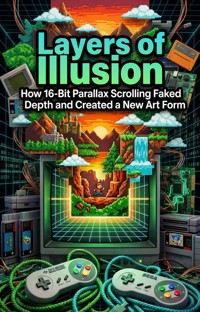
Before the advent of true 3D polygons, video game developers faced a monumental visual challenge: how do you make a completely flat, two-dimensional screen feel like a living, breathing, infinite world? The solution was not a hardware upgrade, but a brilliant hack of human visual perception. By moving different layers of background images at slightly different speeds—a technique known as parallax scrolling—programmers tricked the human eye into perceiving deep spatial depth where none existed. Slower-moving mountains in the back and fast-moving ground in the front created an incredibly immersive illusion of speed and scale. What began as a desperate technical workaround to bypass hardware limitations quickly evolved into the defining aesthetic of the 16-bit golden age. This book unpacks the ingenious mathematics and artistry behind early game rendering. It explores how legendary studios meticulously hand-painted scrolling layers to simulate complex camera movements, and how this specific technical restriction birthed a beloved visual style that modern indie developers are still desperately trying to replicate today. Revisit the visual magic of your childhood through the lens of technical mastery. Understand the exact optical illusions that made classic platformers feel alive, and appreciate the immense engineering required to fake a three-dimensional world on a two-dimensional grid.
Ebooka przeczytasz w aplikacjach Legimi na:
Liczba stron: 156
Rok wydania: 2026
Odsłuch ebooka (TTS) dostepny w abonamencie „ebooki+audiobooki bez limitu” w aplikacjach Legimi na: