Uzyskaj dostęp do tej i ponad 240000 książek od 14,99 zł miesięcznie
- Wydawca: Narodowy Instytut Fryderyka Chopina
- Kategoria: Literatura popularnonaukowa•Nauki humanistyczne
- Język: angielski
[…] książka jest próbą pojednania refleksji literaturoznawczej i muzykologicznej. Pokazania relacji Chopina z literaturą, a szerzej: kulturą jego czasów, gdy ranga słowa poetyckiego była nadzwyczajna i bardzo szczególna i na którą – to teza książki – Chopin nie mógł być obojętny. […] sprawą intrygującą jest to, że w najbliższym otoczeniu muzyka zawsze znajdowali się ludzie pióra, że to właśnie z nimi łączyły go najbardziej osobiste, często intymne relacje. Równie intrygujące wydaje się utarte i rozpowszechnione w wielu biografiach kompozytora przekonanie, że Chopin nie był wrażliwy na słowo poetyckie, […] że etażerka z książkami była w jego paryskim mieszkaniu meblem jedynie ozdobnym i raczej nieużywanym. W książce próbuję zatem przyjrzeć się gustom literackim Chopina, ale też temu, jak on sam pisał. Dziełem szczególnie niedoczytanym są wszak jego listy, którym przez lata odmawiano literackiej wartości, traktując je nade wszystko jako dokument biograficzny, jedynie znak życia i twórczości wielkiego kompozytora. Tymczasem epistolografia […] to świetny literacko autokomentarz Chopina do własnej biografii, ale też czasów, w których żył. Świadectwo istnienia artysty, człowieka bogatego wewnętrznie, przyswajającego burzliwą historię pierwszej połowy XIX wieku, kulturę swojej epoki, zarazem bardzo konkretnego i racjonalnego w postawie wobec świata i problemów współczesnych.
Ebooka przeczytasz w aplikacjach Legimi na:
Liczba stron: 423
Rok wydania: 2026
Odsłuch ebooka (TTS) dostępny w abonamencie „ebooki+audiobooki bez limitu” w aplikacjach Legimi na:
Podobne












Original titleFryderyk Chopin. Przymierze ze słowem (© Narodowy Instytut Fryderyka Chopina, Warszawa 2021)
English translation Łukasz Barciński
Proofreading and index Ian Upchurch
Editorial support John Comber
Project coordinator and technical editing Marcin Wąsowski
Cover design, graphic layout Krzysztof Czajka (Studio Robot)
Typesetting Pracownia DTP Aneta Osipiak-Wypiór
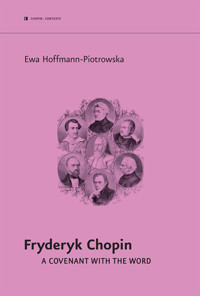
Used in the cover image is Bronisław Puc̕s woodcut Panteon Polski [The Polish pantheon], from 1878.
© Copyright by the Fryderyk Chopin Institute, 2026
Editor The Fryderyk Chopin Institute Tamka 43 Street 00-355 Warsawnifc.pl
Converted to ePub 3 by: eLitera s.c.
The title is also available as an ebook in EPUB and MOBI formats.
ISBN EPUB 978-83-68058-81-9
ISBN MOBI 978-83-68058-82-6
The publication of the book was co-financed by His Magnificence the Rector of the University of Warsaw.
In loving memory of my Dad
Introduction
A masterpiece–be it Chopin’s musical works or his artistic biography–compels the audience to continually reinterpret it, provoking a search for new meanings. The hallmark of an outstanding work–especially a Romantic one–is its semantic openness, a certain indeterminacy that allows for endless hermeneutic exploration. It seems that a work, also understood as creative biography, when encountered by the sensitivity of successive generations, reveals entire realms of “misreadings,” hidden meanings, and previously overlooked interpretations...
This book represents an attempt to look at the composer of the mazurkas through the prism of his connections with literature–and more broadly, with the written word. The choice of this subject requires some justification: in almost every biography of the composer there is some mention of his relationships with the most important “lyricist” of his songs, Stefan Witwicki, and with Adam Mickiewicz–most often invoked in the context of the pressure he is said to have exerted on the “Ariel of the piano” to compose a national opera; and also, of course, the tempestuous relationship with George Sand... There have also been separate studies (I am thinking here mainly of Franciszek German’s articles and book) on Chopin and men of letters. Yet apart from the fact that these works were written quite some time ago, they most often emphasize the composer’s biographical ties with literary figures. Mieczysław Tomaszewski devoted more attention to these relationships, focusing primarily on the poetic texts for which Chopin composed music. The distinguished musicologist, with his acute sensitivity to the word, nevertheless wrote from the perspective of the scholarly field closest to him.
This book, however, will seek to reconcile the literary and musicological perspectives–to illuminate Chopin’s relationship with literature and, more broadly, with the culture of his time, when the status of the poetic word was both exceptional and unique, and to which–this is the book’s central claim–Chopin could not have been indifferent. The essays therefore present the literary milieu with which Chopin came into contact. It is, after all, intriguing that in the composer’s immediate circle there were always literary men, and that it was with them that he often formed his most personal, even intimate, bonds. Equally intriguing is the persistent notion–repeated in many of his biographies–that Chopin was insensitive to the poetic word, an idea reinforced by the opinion of nineteenth-century literary historian Bronisław Chlebowski, who claimed that the bookshelf in Chopin’s Paris apartment was little more than a decorative piece of furniture, seldom, if ever, used. In this book, I attempt to examine Chopin’s literary tastes, as well as his own writing. His letters, for instance, remain a particularly under-read body of work; for years they were denied any literary value and regarded merely as biographical documents–a sign of the life and work of a great composer. Yet his correspondence, to which I devote substantial attention, is in fact a superbly crafted literary self-commentary on both his life and the era in which he lived. It bears witness to an artist with a rich inner life, deeply engaged with the turbulent history of the first half of the nineteenth century and with the culture of his epoch, yet also concrete and rational in his outlook on the world and on contemporary problems. A fascinating hermeneutic venture for me has been to view the composer through the experiences–not only literary but also biographical–of his contemporaries Słowacki, Mickiewicz and Krasiński, seeking bridges between literary and musical sensations. The similarities between the lives and creative destinies of these artists–who at first glance might appear so different–are in fact striking, particularly due to their roots in the Romantic culture to which Chopin belonged. These considerations lead to the need to revise the most fundamental questions: about Chopin’s romanticism, which is, after all, a polyvariant, highly diverse, pluralistic phenomenon, far removed from the simplified schemas to which we have become accustomed through our school education. That is why, at the very beginning, I try to show what romanticism was like–the one that co-constructed Chopin’s personality, but which he himself also helped to shape–without at the same time claiming any pretensions to synthesizing, textbook generalizations.
The covenant in question therefore has multiple meanings, reflecting the dimension of an open work that constantly needs to be supplemented anew.
At this point, I would like to warmly thank those who contributed to the final shape of the book: Prof. Dr hab. Andrzej Fabianowski, for his insightful reading and discussions about the text; Dr Anna Tenczyńska, for her musical and bibliographic suggestions; and especially Dr Kamila Stępień-Kutera, for her consultations and musicological guidance, inspiration, and careful, substantive editing.
Ewa Hoffmann-Piotrowska
1. Aleksander Kokular, Wnętrze salonu w domu artysty [Interior of the living room in the artist’s house], c.1830Full e-book available atThe National Chopin Institute website:https://nifc.pl/pl
What romanticism?
Full e-book is available at The National Chopin Institute website
https://nifc.pl
An étagère with books
Full e-book is available at The National Chopin Institute website
https://nifc.pl
“He expresses himself entirely in letters...”
Full e-book is available at The National Chopin Institute website
https://nifc.pl
The intimate Chopin
Full e-book is available at The National Chopin Institute website
https://nifc.pl
Conclusion
Full e-book is available at The National Chopin Institute website
https://nifc.pl
Bibliography
Full e-book is available at The National Chopin Institute website
https://nifc.pl
List of illustrations
Full e-book is available at The National Chopin Institute website
https://nifc.pl
Footnotes
Full e-book is available at The National Chopin Institute website
https://nifc.pl