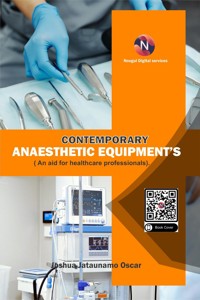
Contemporary Anaesthetic Equipments.An Aid for Healthcare Professionals. (1, #1) ebook
Joshua Jataunamo Oscar
Uzyskaj dostęp do tej i ponad 240000 książek od 14,99 zł miesięcznie
- Wydawca: Noogul Online Digital Services
- Kategoria: Literatura popularnonaukowa•Nauki ścisłe
- Język: angielski
This version has been thoroughly edited and updated to reflect the most recent equipment’s used in Anaesthesia Practice. A must-have for anesthetists, the book is extremely comprehensive, educational and practical with pictorial representations for anesthesia trainees, Contemporary Anaesthetic Equipment’s. An Aid for Healthcare Professionals is a priceless resource for all those who work with anaesthetic equipment, including anaesthetic and intensive care nurses and operating department practitioners. The book should appeal to readers since it is well-organized and simple to read.
Ebooka przeczytasz w aplikacjach Legimi na:
Liczba stron: 50
Rok wydania: 2024
Odsłuch ebooka (TTS) dostepny w abonamencie „ebooki+audiobooki bez limitu” w aplikacjach Legimi na:
Podobne

















CONTEMPORARY
ANAESTHETIC EQUIPMENTS.
AN AID FOR HEALTHCARE PROFESSIONALS.
ALL RIGHTS RESERVED
No part of this publication may be reproduced, stored in a retrieval system, or transmitted in any form or by any means, electronic, mechanical, photocopying, recording, or otherwise, without the prior written permission of the copyright holder.
Copyright © Joshua Jataunamo OSCAR
(RN, RM, RNAS, RNE, BNSc, PDGE, MSc, FWACN PhD)
First Published, 2023
ISBN: 978-1-304-99639-8
Noogul Digital Publishing
Table of Contents
ALL RIGHTS RESERVED
SECTION ONE:
EQUIPMENT’S USED IN ANAESTHESIOLOGY
Introduction
Medical Gas Supply
Cylinders
Pin index system
Pressure in the cylinders
Cylinder valve
Piped gas supply
Liquid oxygen
Oxygen Concentrator
Compressed Air
Pressure Gauge
Pressure regulator (Reducing valve)
Flow restrictor
Flowmeters
Vapourizers
Ideal vapourizers characteristics
Boyle's bottle/glass-ether vapourizers
Trichloroethylene vapourizer bottle
Goldman halothane vapourizer
Back bar
Oxygen supply failure alarm
Plenum vapourizers
Common gas outlet
Bag mount
Rebreathing bag
Corrugated Rubber Tube
Adjustable pressure limiting valve (Expiratory valve)
Face mask and angle piece
Anaesthetic Breathing System
Advantages:
Disadvantages:
Soda Lime
Conical neutralization of CO2
Baralyme
Absorbers
Water's 'to-and-fro' system
Circle breathing system
Vapourizer outside the circle breathing system
Vapourizer inside the circle breathing system
Mapleson Classification
Criteria for an Ideal Breathing System
Mapleson A System
Mapleson B System
Mapleson C System
Mapleson D System
Mapleson E System
Mapleson F System
Bain Circuit
Endotracheal Tubes and Airways
Endotracheal tubes
Length of the tube:
Type of cuff:
Oxford endotracheal tube
Armoured endotracheal tube
RAE (Ring, Adair and Elwyn) endotracheal tube
Laser resistant endotracheal tube
Micro laryngeal endotracheal tube
Tracheostomy tubes
Metal Tracheostomy Tubes
Double Lumen Endobronchial Tubes
Oropharyngeal Airway
Nasopharyngeal Airway
Laryngeal Mask Airway
Advantages:
Disadvantages:
Laryngoscopes
Endotracheal Tube Connections
Catheter Mount
Intubating Forceps (Magill)
Laryngeal Spray
Gum Elastic Bougie
Stylet
Ventilators
Options:
Summary
Bibliography
SECTION TWO:
ANAESTHETIC MACHINE
Components of Anaesthetic Machine:
Safety Devices incorporated in the anaesthetic machine
Explain uses of O2 in the Anaesthetic machine
Temperature Compensated Vaporizer
Temperature uncompensated vapourizer (Not temperature compensated)
Modern – Plenum Vapourizer Temperature compensated.
Signs of Electrolyte Imbalance
Peri Operative Embolism
Management: - Vasopressors, inotopes
Isoflurane
Side effect – Respiratory depression, low blood pressure
Uses:
Adverse Effect
Physical Properties: Molecular weight 184.5glmol
Mechanism of Action:
Premedication
Specific Indications:
Factors that Reduces Sedative Premedication
Summary
References
List of Figures
Figure 1: Cylinder Valve Flush Type
Figure 2: Pressure Gauge
Figure 3: Rotameter Unit
Figure 4: Boyles Ether / Isofluorane Vaporiser
Figure 5: Goldman Vaporizer
Figure 6: Trilene Interlock Unit
Figure 7: A Bag Mount
Figure 8: Rebreathing / Reservoir Bag
Figure 9: Corrugated Rubber Tube
Figure 10: Expiratory Valve
Figure 11: Anaesthesia Face Masks
Figure 12: Face Mask Angle Piece Adaptor
Figure 13: Schimmelbusch Mask
Figure 14: Dr. Ralph Waters To and Fro System Canister
Figure 15: Circle Carbon dioxide Absorber
Figure 16: Mapleson A Circuit
Figure 17: Mapleson B Circuit
Figure 18: Mapleson C Circuit
Figure 19: Mapleson D Circuit
Figure 20: Mapleson E Circuit
Figure 21: Mapleson F Circuit
Figure 22: Bain Circuit
Figure 23: Plain and Curved Endotracheal Tube
Figure 24: Oxford Non-kinking Endotracheal Tube
Figure 25: Latex Armoured Endotracheal Tube
Figure 26: Tracheostomy Tubes Cuffed and Uncuffed
Figure 27: Metal Tracheostomy Tubes
Figure 28: Double Lumen Endobronchial Tube
Figure 29: Phillips Airway
Figure 30: Water's Airway
Figure 31: Guedel Airway
Figure 32: Nasopharyngeal Airway
Figure 33: Laryngeal Mask Airway
Figure 34: Laryngoscope
Figure 35: Straight Bladed Magill Laryngoscope
Figure 36: Macintosh Laryngoscope Blades
Figure 37: Magill Connection Nasal and Oral
Figure 38: Cobb's Suction Union and Nosworthy Endotracheal Connection
Figure 39: Catheter Mount
Figure 40: Magill Forceps
Figure 41: Anaesthesia Gas Machine Ventilator
SECTION ONE:
EQUIPMENT’S USED IN ANAESTHESIOLOGY
Introduction
The anaesthetic machine enables to deliver gas and vapour mixtures to the patient accurately and continuously. The Boyle anaesthetic machine is designed by HEG. Boyle in 1915. Modern machine differs greatly in detail and modified time-to-time, but the basic principles remain the same. It consists of:
i. Oxygen and anaesthetic gas supply
ii. Pressure gauges
iii. Reducing valves
iv. Flow meters
v. Vapourizers
vi. Common gas outlet
vii. Certain other features:
High flow oxygen flush, pressure relief valve, oxygen supply failure alarm, suction apparatus! Monitoring devices.
Medical Gas Supply
Cylinders
Made of molybdenum steel to withstand high pressures
Made of different sizes (A to J). Size E cylinders are used in the anaesthetic machine
Oxygen is stored as gas at about 2000 lb/inch2 and nitrous oxide is stored in a liquid phase with vapour on the top at a pressure of 760 lb/inch2. It is 75% filled with liquid nitrous oxide Note: Filling ratio is the weight of fluid in the cylinder divided by the weight of water need to fill the cylinder.
Cylinders are colour coded.
- Oxygen: Black with white shoulders, green in some countries.
- Nitrous oxide: Blue
- Carbon dioxide: Grey
- Entonox: Blue with white /bluequarters shoulder
- Air: Grey with white/black quarters shoulder.
Some markings engraved on the cylinders: Test pressure, chemical formula, Tare weight, dates of test performed, etc.
Checking and testing by manufacturers at regular intervals:
- Flattening test
- Bending test
- Impact test
- Pressure test
- Tensile test.
Gases and vapour must be free from water vapour as it may freeze and block the exit port at a decreased temperature particularly when opening
Cylinder valve provides pin index- system as a safety feature to make it almost impossible to connect a cylinder to a wrong yoke
Should be stored in a dry, well-ventilated and fire proof room. Avoid dampness, corrosives and fumes nearby. No oil or grease or any other flammable materials or any source of heat ; should be allowed
Full cylinders should be kept separately and should not be mixed with empty ones
Avoid over pressurized full cylinders..
Pin index system
A specific pin configuration