Uzyskaj dostęp do tej i ponad 240000 książek od 14,99 zł miesięcznie
- Wydawca: epubli
- Kategoria: Literatura popularnonaukowa•Nauki humanistyczne
- Język: angielski
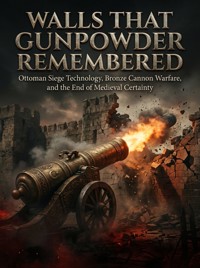
For over a thousand years, the Theodosian Walls had not merely defended Constantinople — they had defined the idea of a city that could not fall. They had repelled Avars, Arabs, Rus, and Crusaders. They had outlasted empires. When Mehmed II arrived before them in April 1453, he brought something those walls had never been designed to meet: a Hungarian cannon-founder named Urban, a bronze siege gun capable of hurling stone balls weighing over half a ton, and an understanding of ballistic physics that rendered eight centuries of military architecture suddenly, irreversibly obsolete. The artillery question at Constantinople was never purely technical. It was ideological. The Theodosian Wall was not just stone — it was the calcified confidence of an empire that had survived by outlasting everything. Mehmed understood that the wall's symbolic weight was as strategically significant as its physical mass. When the great bombard fired, it did not merely crack mortar. It shattered a theory of permanence that had organized Byzantine statecraft for generations. The cannon did not end a city. It ended a way of thinking about defense, time, and the limits of inherited power. But the siege's most extraordinary act was not artillery. It was logistics. When the Byzantine chain blockade denied Ottoman ships access to the Golden Horn, Mehmed ordered his fleet — seventy to eighty warships — transported overland across the Galata ridge on greased wooden cradles.
Ebooka przeczytasz w aplikacjach Legimi na:
Liczba stron: 725
Rok wydania: 2026
Odsłuch ebooka (TTS) dostepny w abonamencie „ebooki+audiobooki bez limitu” w aplikacjach Legimi na: