


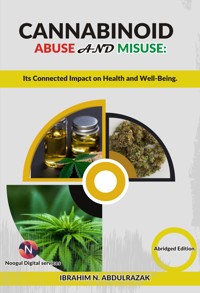
Cannabinoid Abuse And Misuse: Its Connected Impact On Health And Well-Being ebook
Ibrahim Nugwa Abdulrazak
Uzyskaj dostęp do tej i ponad 240000 książek od 14,99 zł miesięcznie
- Wydawca: Noogul Online Digital Services
- Kategoria: Literatura popularnonaukowa•Nauki humanistyczne
- Język: angielski
Cannabinoid Abuse and Misuse: Its Connected Impact on Health and Well-Being is an abridged version of Substance Abuse and Substance Use Disorders: A Global Pandemic among Teenagers and youths: Implications for Counselling. This book made clear how to deal with today's substance-related problems. Abuse of substances and drugs, along with the accompanying physical, social, and mental diseases, has emerged as a global issue. The "Innovative Substances" disclosed in this book have given the issues with drugs, particularly socio-demographic borders, new dimensions. For the benefit of his broad target audience's reading and understanding, the author has imaginatively categorized cannabinoids in this book using the most comprehensible typology. The book dedicates each Section and Unit to a class, offering a brief history of the class, its Chemical Structures, forms, kinds, and pathogenetic sequences, as well as how to identify symptoms and treat misuse and addiction as well as diseases that are associated to them. The book should appeal to readers because of its simple layout. The book will be of great use to professionals in the social sciences, education, health, and other helping professions.. Additionally, every family should read and maintain a copy.
Ebooka przeczytasz w aplikacjach Legimi na:
Liczba stron: 55
Rok wydania: 2025
Odsłuch ebooka (TTS) dostepny w abonamencie „ebooki+audiobooki bez limitu” w aplikacjach Legimi na:
Podobne









CANNABINOID ABUSE AND MISUSE:
ITS CONNECTED IMPACT ON HEALTH AND WELL-BEING. .
ALL RIGHTS RESERVED
No part of this publication may be reproduced, stored in a retrieval system, or transmitted in any form or by any means, electronic, mechanical, photocopying, recording, or otherwise, without the prior written permission of the copyright holder.
Copyright © IBRAHIM N.A
First Published, 2023
ISBN: 978-1-312-44256-6
Noogul Digital Publishing
Edited by:
Ishaku Usman Gadzama PhD
Senior Lecturer,
Department of Sociology, Faculty of Social Sciences,
Ahmadu Bello University, Zaria, Kaduna State
Nigeria
Email: [email protected]
Dr. Okoosi Sunday Adegoke
Human Physiologist
Ahmadu Bello University Teaching Hospital, Zaria.
Kaduna State, Nigeria
Email: [email protected]
Preface
Cannabinoid Abuse and Misuse: Its Connected Impact on Health and Well-Being is an abridged version of Substance Abuse and Substance Use Disorders: A Global Pandemic among Teenagers and youths: Implications for Counselling. This book made clear how to deal with today's substance-related problems. Abuse of substances and drugs, along with the accompanying physical, social, and mental diseases, has emerged as a global issue. The "Innovative Substances" disclosed in this book have given the issues with drugs, particularly socio-demographic borders, new dimensions.
For the benefit of his broad target audience's reading and understanding, the author has imaginatively categorized cannabinoids in this book using the most comprehensible typology. The book dedicates each Section and Unit to a class, offering a brief history of the class, its Chemical Structures, forms, kinds, and pathogenetic sequences, as well as how to identify symptoms and treat misuse and addiction as well as diseases that are associated to them.
The book should appeal to readers because of its simple layout. The book will be of great use to professionals in the social sciences, education, health, and other helping professions..
Additionally, every family should read and maintain a copy.
Emmanuel Ejembi Anyebe PhD, JP.
Associate Professor,
Mental Health Unit, Department of Nursing Sciences,
Faculty of Clinical Sciences,
College of Health Sciences, University of Ilorin
Ilorin 240001,Nigeria.
Mobile: +2348036422771
Email: [email protected]; [email protected]
TABLE OF CONTENTS
ALL RIGHTS RESERVED
Edited by:
Preface
SECTION ONE
DRUG MISUSE, DRUG ABUSE AND ADDICTION
Introduction
Drug Misuse
Drug Abuse
Drug Addiction
Progression In Drug Use
Drug Use Initiation and Progression Phase
Experimentation Phase
Frequent Use Phase
Risky Use Phase
Dependence Phase
Addiction Phase
Crisis / Treatment Phase
Summary
SECTION TWO:
CANNABINOID ABUSE AND MISUSE: ITS CONNECTED IMPACT ON HEALTH AND WELLBEING
Cannabinoids
Classes of Cannabinoids
What do Cannabinoids do?
How are they used?
Effects of Cannabinoids
Cannabinoids and other Drugs
Health and safety
Dependence and tolerance
UNIT ONE:
BUTANE HASH OIL
Chemical Structure of Butane
Other names
How is it used?
Effects of BHO
Long term effects
Withdrawal
UNIT TWO:
CANNABIDOL
Chemical Structure of Cannabidol
What does it look like?
Other Names
How is it used?
Effects of CBD
Long-term effects
Mixing CBD with other drugs
UNIT THREE:
CANNABIS
Chemical Structure of Cannabis
Other Names
Historical Antecedents of Canabis
How is it used?
Effects of Cannabis
Long-term Effects
Using cannabis with other drugs
Withdrawal
UNIT FOUR:
MEDICINAL CANNABIS
Chemical Structure of Medicinal Cannabis
The Endocannabinoid System
Types and forms of medicinal cannabis
Why smoking cannabis for medical purposes is not recommended
Side effects
What can medicinal cannabis be used for?
The Side Effects of Medicinal Cannabis Treatment
General Cautions
UNIT FIVE:
SYNTHETIC CANNABINOIDS?
Chemical Structure of Synthetic Cannabinoid
What do synthetic cannabinoids look like?
Other Names
How are synthetic cannabinoids used?
Effects of synthetic cannabinoids
Set and Setting
Overdose
Long-term Effects
Tolerance and Dependence
Mixing synthetic cannabinoids with other drugs
Withdrawal
Health and Safety
Summary
SECTION ONE
DRUG MISUSE, DRUG ABUSE AND ADDICTION
Introduction
Addiction, drug abuse, and misuse are all major public health issues. Many individuals frequently use these phrases interchangeably since they all relate to the use of illicit drugs as well as the improper use of legal substances (such as cigarettes, alcohol, and prescription medications). But each issue's interventions differ substantially from one another. The importance of accurately diagnosing a person's drug use is due to this. Medication on prescription has a lot of positive impacts. They can make us live longer, healthier lives when used properly under medical care. However, these same drugs have the capacity to have fatal results and serious adverse effects, particularly when overused or abused. Prescription drugs should only be taken by the individual for whom they are designed and exactly as directed due to this risk of damage.
Drug Misuse
Prescription medications are commonly related with drug misuse. Prescription medications are intended to be taken exactly as prescribed by doctors. This is because these medications might have negative side effects if the instructions are not followed.
Drug Misuse occurs when these drugs are used for purposes that are not in accordance with legal or medical norms.
The FDA (2019) defines prescription medication MISUSE as failing to follow medical directions, although the individual using the medicine is not intending to "get high." If a person is unable to fall asleep after taking a single sleeping tablet, they may take another pill an hour later, reasoning, "That will do the job." Alternatively, a person may offer his headache medicine to a buddy in agony. Those are examples of drug abuse because, according to the FDA, the individual is treating oneself but not in accordance with the recommendations of their health care professionals. Prescription medication abuse can include: taking the wrong dose; taking a dose at the wrong time; forgetting to take a dose; and discontinuing medicine too soon, according to the Institute for Safe Medication Practices.
Drug Abuse
Drug abuse occurs when any psychoactive substance, including alcohol, illegal narcotics, and prescription medications, is used improperly to get high or hurt oneself. Since drug user’s exhibit profoundly changed thinking, behavior, and bodily functioning, it is also known as substance use disorder (SUD). According to the National Institute on Drug Abuse (NIDA, 2019), prescription drug abuse is the use of a medicine without a prescription, in a manner other than as directed, or for the experience or sensations it produces. For instance, drug abuse occurs when someone consumes a prescription medication in larger dosages than recommended in order to "get high" or have a pleasant or euphoric feeling.
The primary distinction between someone who misuses drugs and someone who abuses drugs is their purpose. The former consumes a medicine to cure a specific condition, whereas the latter consumes a substance to provoke specific emotions.





