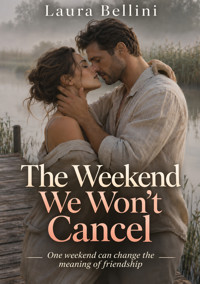
The Weekend We Won't Cancel - One weekend can change the meaning of friendship ebook
Laura Bellini
29,99 zł
19,90 zł
Najniższa cena z 30 dni przed obniżką: 29,99 zł
19,90 zł
Najniższa cena z 30 dni przed obniżką: 29,99 zł
Dowiedz się więcej.
- Wydawca: ALL-IN Rafał Płonkowski
- Kategoria: Romanse i erotyka•Romanse
- Język: angielski
Eleven years of friendship. One weekend alone together. And a love neither of them ever planned for.
Daria Młyn has always believed that life is easier when everything has a plan. At thirty-four, she runs her own garden design studio in Warsaw, manages demanding projects, and knows exactly how to protect her independence. She has worked too hard to let anyone else decide what her future should look like.
Piotr Lisiecki has never been quite so predictable.
A thirty-seven-year-old wildlife photographer with a passion for spontaneous adventures, Piotr has been Daria's best friend for eleven years. He knows how she takes her coffee, when she's hiding her worries behind a professional smile, and exactly how to make her laugh when life becomes overwhelming.
They know each other better than almost anyone.
Or so they believe.
When they escape to a secluded wooden house beside the Biebrza River for their first weekend alone together, neither expects anything more than familiar jokes, peaceful walks, and a few days away from work.
But beneath the morning mist, among the reeds and quiet wetlands, something changes.
A glance lasts a little too long. A familiar touch suddenly feels different. Conversations by the fireplace reveal desires neither has dared to acknowledge.
And when friendship finally gives way to a kiss, they discover that the most dangerous person to fall in love with might be the one they cannot imagine losing.
Their growing attraction brings tenderness, passionate kisses, and the exhilarating possibility of something neither has experienced with the other before. Working together to protect the natural landscape surrounding the riverside house gives them another reason to return, and every shared moment deepens the connection between them.
Yet Daria is keeping a secret.
Before their first weekend together, she accepted a career-changing position in Gdańsk. The contract is already signed. Her relocation is approaching, and the opportunity represents everything she's spent years working toward.
She has no intention of abandoning her ambitions.
But she cannot bring herself to tell Piotr that their future may involve hundreds of kilometers, competing schedules, and sacrifices neither has agreed to make.
Piotr, meanwhile, is beginning to question the loneliness hidden beneath his apparently carefree life. He wants someone to share the ordinary moments with, not another relationship built around departures and occasional reunions.
As their feelings deepen, Daria's silence becomes more than an omission.
It becomes a choice with consequences.
When the truth finally emerges, love alone may not be enough to repair what has been broken.
The Weekend We Won't Cancel by Laura Bellini is an emotionally intimate, sensual contemporary romance about friends becoming lovers, the courage to pursue your dreams, and the fragile trust that makes real love possible.
Set against the atmospheric beauty of Poland's Biebrza wetlands, this standalone love story explores a difficult question: can two independent people build a future together without losing themselves along the way?
This publication was prepared using tools that support the creative process, including artificial intelligence solutions. The final concept, structure and editing are the responsibility of the author.
Ebooka przeczytasz w aplikacjach Legimi lub dowolnej aplikacji obsługującej format:
Liczba stron: 221
Rok wydania: 2026
Podobne









Cover
The Weekend We Won't Cancel
One weekend can change the meaning of friendship
Laura Bellini
ROMANS
ISBN: 9788384900680
ALL-IN Rafał Płonkowski
Table of contents
Title page
INTRO
Chapter 1 - The Rules We Never Agreed On
Chapter 2 - What the Photographs Don't Show
Chapter 3 - Where the Ground Gives Way
Chapter 4 - Between the Words
Chapter 5 - The Right to Pause
Chapter 6 - For the First Time, Truly
Chapter 7 - Everything I Still Hadn't Told Him
Chapter 8 - On the Other Side of the Lens
Chapter 9 - The Risks We Choose
Chapter 10 - Everything We Choose
Chapter 11 - Room for Two
Chapter 12 - The Price of Silence
Chapter 13 - What Cannot Be Rushed
Chapter 14 - The Truth Won't Fit into Half a Sentence
Chapter 15 - The Date I Could No Longer Hide
Chapter 16 - Distance Begins Before You Leave
Chapter 17 - Everything That Remains After Leaving
Chapter 18 - A Trial on Our Own Terms
Chapter 19 - Not Everything Needs to Be Built from Scratch
Chapter 20 - The Weekend We Won't Cancel
Landmarks
Cover
Title page
Table of contents
Start of content
INTRO
The first thing I did when I entered the house by the Biebrza River was check my phone reception. The second was slip my phone into my pocket before I could read, for the fourth time, a message I should have answered three days earlier.
Through the living room's wide windows, I could see the river, a stretch of reeds, and a wooden pier reaching into the morning mist. The water looked so peaceful, as though it had nowhere to hurry. I envied its outrageous confidence that it could stay exactly where it was.
On the table lay a key with a metal moose-shaped charm, a note from the owner, and two small chocolates. Instinctively, I pushed one to the other side of the table. Piotr always chose dark chocolate, while I preferred milk. Only then did I notice they were identical.
"Excellent," I muttered. "First conflict resolved."
I set my bag beside the stairs and opened the terrace doors. The air smelled of damp wood, autumn leaves, and something fresh I couldn't quite identify. As a garden designer, I usually recognized plants faster than the faces of people I'd met at industry conferences. Here, though, the scents mingled, and the wild landscape had no need of my assistance.
That was exactly what I wanted. Three days without clients demanding revisions, contractors calling, or having to prove that a thirty-four-year-old woman running her own studio could make decisions without anyone's blessing.
I had another plan, too.
On Monday, I intended to tell Piotr that I'd accepted a job on a major public-gardens project in Gdańsk. In six weeks, I was due to start work that would require me to move there for at least a year. I'd signed the contract on Wednesday. The document was saved on my laptop in a folder with such an innocent name that even I was beginning to believe it contained another quotation.
Throughout our eleven years of friendship, Piotr had known about most of my important decisions before my family did.
This time, I intended to tell him last.
Not because I thought he didn't matter.
Precisely because he mattered too much.
My phone vibrated.
Piotr: I'm ten minutes away. Tell me the coffee machine works.
I smiled before I could even think of a reply.
Me: Haven't checked. But I've discovered the owner believes in equal chocolate rights.
Piotr: Disturbing. I'm bringing coffee, then.
I leaned against the kitchen counter. Eleven years. Thousands of messages, evenings together, trips with friends, photographs in which we always stood close to each other without ever wondering what that closeness actually meant.
And now we were about to spend a weekend alone.
The idea had been Piotr's. He'd found the house in the spring while photographing birds in the Biebrza Valley. He'd made the reservation in June, after my latest birthday, when I'd complained that I hadn't gone anywhere in ages without planning every last detail.
"One weekend," he'd said. "No clients of yours, no deadlines of mine. Just you, me, and somewhere nobody expects anything sensible from us."
I'd agreed immediately.
Back then, I hadn't known about Gdańsk.
I heard a car pull onto the gravel driveway. Looking through the window, I saw a familiar off-road vehicle, muddy from the drive between the fields. Piotr climbed out wearing a dark jacket, his camera slung over one shoulder. He was thirty-seven, had very little patience for posing, and possessed the infuriating ability to look like a man who always knew where he was going, even when he was completely lost.
He took two paper cups from the car and raised one toward me.
I opened the door.
"I hope that's coffee and not another attempt to convince me to drink an infusion made from some weed."
"Careful, Młyn. You've just insulted half your profession."
He handed me a cup and studied my face. Not intrusively. His gaze simply lingered a second longer than usual.
"You look as though you've already settled in here for life."
"I only checked for mold."
"Such a romantic soul."
"A responsible consumer."
He laughed, then leaned down to hug me. I knew that embrace. He'd always held me firmly, briefly, without awkwardness. This time, though, I noticed the chill of his jacket against my arms and the scent of rain in his hair. When he stepped back, I momentarily had no idea what to do with my hands.
Piotr noticed my hesitation but said nothing.
"Show me this palace," he said.
We walked through the living room. He examined the fireplace, checked the door leading toward the pier, and stopped beside the stairs, where my bag stood.
"Have you picked a bedroom yet?"
"Not yet."
"Good. Because I have a problem."
I gave him a suspicious look.
"How serious?"
"Depends how attached you are to having your own bed."
Upstairs were two bedrooms. One had a large bed overlooking the river; the other had two single beds tucked beneath a sloping roof. The owner had mentioned them in the listing, but I hadn't thought much about it.
Piotr stopped in the doorway of the larger room.
"I want this one."
"On what grounds?"
"On the grounds that I get up before dawn and want to photograph the mist without going downstairs."
"And I want to fall asleep looking at the river."
"So we have a conflict of interests."
I leaned against the doorframe.
"We could toss a coin."
"Or we could agree that one of us gets the room tonight and the other gets it tomorrow."
"That's reasonable."
"You're agreeing suspiciously quickly."
"Because I'm claiming the first night."
His smile widened. A small crease appeared in his cheek, one I'd known for years but had never before considered a problem in its own right.
"I've missed you, Daria."
He said it without a joke or any warning. For the past two months, we'd barely managed to catch each other between his photography trips and my projects. We'd met for quick dinners, usually with friends, always conscious that one of us had to get up early the next morning.
"I've missed you too," I answered.
We fell silent. Outside, a bird gave a sharp cry that seemed out of place in the quiet house. Piotr turned his head, probably recognizing the species from its call alone. I watched him approach the window and, for the first time, allowed myself to wonder whether what I'd been missing was more than a friend.
Downstairs, my phone rang.
I went to get it, leaving Piotr by the window. On the screen was the name of the woman overseeing the Gdańsk project. Her message included an attachment containing my onboarding schedule and a request to confirm the date of our organizational meeting.
Daria, we're delighted you'll be joining us. We need final confirmation of your availability from next month.
I hadn't managed to turn off the screen when Piotr appeared on the stairs.
"Everything all right?"
"Yes. Work stuff."
"That was supposed to stay in Warsaw."
"Some things don't respect administrative boundaries."
He came closer. There was no suspicion in his eyes, only ordinary concern. And somehow that made my lie feel heavier than it should have.
"Daria, if you need to deal with something, deal with it. I'm not going to hold five minutes on your phone against you."
"I know."
"Then come down to the pier with me. I want to show you something."
"What?"
"If I told you, there'd be no point taking you there."
He stepped out onto the terrace, leaving the choice to me.
I looked at the message once more. I could answer it immediately. Or I could call him back and tell him the truth before the silence between us began to resemble something I'd built myself.
Instead, I placed my phone facedown on the counter.
Piotr was waiting at the end of the pier, his hands tucked into his pockets. The mist was beginning to lift, revealing a narrow ribbon of river. When I reached him, he moved aside to make room for me at the railing.
"See them?" he asked softly.
Across the water, among the reeds, stood two cranes. One lowered its head while the other stretched its neck, as though watching us. Piotr didn't reach for his camera. He stayed beside me, allowing the moment to happen without collecting any proof.
"Why aren't you taking a picture?" I whispered.
"Because I brought you here so you could see this too."
I looked at his profile. I'd known this man for eleven years, yet something about his answer made me feel, briefly, as though I were only just getting to know him.
"Piotr?"
"Yes?"
I was going to tell him about Gdańsk. The words were ready, sensible and carefully arranged.
But he turned toward me, and I saw the same unexpected uncertainty on his face that I'd been trying to conceal all morning.
"Nothing," I said at last. "I just wanted to ask if we're really not going to plan anything all weekend."
He studied me.
"Is there something you'd like to plan?"
I stood close enough that all I had to do was reach out to touch his hand. Between us lay eleven years of friendship, three days away together, and a future that only I knew about.
I didn't answer immediately.
Because how was I supposed to tell the man who had always made me feel at home that I'd just chosen to build a life somewhere else?
Chapter 1 - The Rules We Never Agreed On
Piotr didn't repeat his question. He stood by the railing of the pier, watching the place where the cranes had disappeared moments earlier, and allowed me to remain silent. It was one of his most dangerous qualities. He never demanded an answer, which somehow made people want to tell him far more than they'd originally intended.
"I'd like to plan lunch," I announced at last.
He turned his head.
"Exactly what I meant when I talked about spontaneity. Big decisions. Uncharted territory."
"We haven't had a proper meal since this morning."
"It's eleven."
"All the more reason to take the matter seriously."
Piotr rested his elbows on the wooden railing. The morning light caught the silver threads at his temples, threads I hadn't even noticed a year earlier. For years, I'd looked at him as though he were a familiar landscape. I knew where every detail belonged, so I'd stopped noticing them. Now each one seemed unexpectedly distinct.
"Daria, I have a favor to ask," he said.
"That sounds ominous."
"Don't make a schedule for us for the next three days."
"I'm not making one."
"You were just trying to establish a time for lunch."
"That's called a survival instinct."
"Yesterday you sent me a message suggesting four walking routes, complete with sunset times and a list of restaurants."
"Those were options."
"Numbered options."
"To make choosing easier."
He smiled, but he wasn't letting it go.
"I want us to do something we never do."
I studied him more closely.
"Which is?"
"Spend time together without a backup plan."
For a moment, all I could hear was the water lapping against the wooden supports beneath us. I had no idea whether Piotr realized how close he'd accidentally come to the subject I'd been trying to push aside all morning.
"Every sensible person has a backup plan," I replied.
"Which is exactly why it's sometimes worth being a little less sensible."
"Says the man who went off to photograph wolves last year and didn't answer his phone for nine hours."
"I had a spare battery."
"For your phone?"
"For my camera."
I shook my head, although I wanted to laugh.
"You're impossible."
"And yet you came."
The words lingered between us longer than an ordinary remark should have.
I had come. Despite the commissions waiting for me, the documents I hadn't sent, and the decision that could change everything. Piotr had booked the house months earlier, but as recently as Thursday I'd considered canceling. I could have told him I had too much work. He would have accepted that calmly, perhaps with a disappointment he wouldn't have shown outright. Instead, I'd packed a bag and driven more than two hundred kilometers to spend three days pretending the world beyond the Biebrza Valley didn't exist.
"I came because I promised," I said.
"Is that the only reason?"
He looked at me with an expression I couldn't quite name. It wasn't the provocative gaze of a man trying to seduce a woman. It was more like someone waiting patiently for an honest answer.
"Because I wanted to see you," I admitted.
Piotr slowly straightened.
"That's a better reason."
We went back inside when the wind began carrying a damp chill off the river. I decided not to argue about schedules for the next hour. In exchange, Piotr agreed not to suggest any excursions requiring rubber boots that came up to our waists. We were supposed to seal the agreement with a handshake, but when I offered him my hand, he held it in his for a moment longer.
"You realize you even negotiate relaxation?" he asked.
"That's why I'm so good at it."
"Relaxing?"
"Negotiating."
He released my hand, and I was irritated with myself for noticing the precise moment when he stopped touching me.
In the kitchen, we discovered that the provisions left by the owner consisted of bread, butter, eggs, tomatoes, and a jar of preserves. Piotr opened the refrigerator, inspected every shelf, and announced that we could survive until evening.
"Did you bring any food?" I asked.
"Of course."
"What?"
"Nuts, dried fruit, chocolate, and coffee."
"That's what a wildlife photographer packs in his backpack, not groceries for a weekend."
"What about you?"
I unpacked pasta, olive oil, pesto, cheese, vegetables, and a bottle of wine.
Piotr watched as I arranged everything on the counter.
"I knew I could count on you."
"You came here assuming I'd feed you?"
"I came here knowing you're a woman prepared for every eventuality."
"That's an exceptionally convenient philosophy of life."
"Maybe. But I can cook."
I surrendered the stove to him with some satisfaction. Piotr was perfectly capable of preparing simple meals, although his approach to seasoning involved tasting everything endlessly. I watched him roll up his sleeves, chop tomatoes, and move his camera away from the edge of the table so it wouldn't accidentally get dirty.
"Aren't you going to photograph lunch?" I asked.
"I'm not quite that desperate."
"I thought you photographed everything."
"Only things worth paying attention to."
He said it without looking up from the chopping board. I couldn't understand why those particular words made me feel suddenly warm.
I sat at the table with a glass of water. My phone vibrated in my pocket. I took it out automatically and saw a reminder about unfinished correspondence concerning my relocation. I opened the message, but before I could read the details, Piotr placed a plate in front of me.
"You said you'd had a difficult week," he remarked.
"I did."
"Then put work aside for a little while."
He didn't say it like an order. He sounded like someone who'd noticed another person was approaching the limits of exhaustion, even though she was trying to maintain a cheerful expression.
"Not everything can be put aside," I replied more sharply than I'd intended.
Piotr went still.
"I wasn't asking you to give up anything important."
"I know."
"I just wanted to have lunch with you."
I felt ashamed. He hadn't deserved that reaction, and I couldn't even explain why his innocent remark had sounded to me like a demand to choose.
I put my phone down.
"I'm sorry. It wasn't about you."
"I figured."
He sat opposite me. For several minutes, we ate in a silence that wasn't unpleasant but lacked our usual ease. I wanted to explain at least part of the truth. Tell him that something significant was happening professionally, that I was excited and terrified at the same time. But every sentence led to another, and every next sentence led to Gdańsk.
"Tell me something," Piotr said.
"I'm listening."
"When was the last time you did something simply because you felt like doing it?"
I rested my fork against the edge of my plate.
"I came here."
"Exactly. And you almost immediately started turning this weekend into a project."
"Surely a list of attractions wouldn't hurt anyone."
"It bothers me a little."
"Why?"
He considered his answer.
"Because in everyday life, we see each other whenever we happen to have a free hour. We meet for coffee between appointments or talk on the phone while one of us is driving. I wanted to find out what it's like to have time together that we don't have to give away to anyone else."
I had to lower my eyes.
Piotr had never been sentimental. He spoke about friendship plainly, almost sparingly, yet he made gestures I remembered for years. He'd picked me up from the hospital when I broke my ankle while inspecting a garden. He'd walked my neighbor's dog for a week while I helped her recover from surgery. He remembered that I couldn't stand cilantro but forgot his own birthday.
"I thought you liked going away with me," I said.
"I love it. But until now, someone else has always come along."
"And?"
"And I want to find out whether we can spend time alone without hiding behind other people."
I hadn't expected that answer.
"Hiding?"
"There's always someone organizing the evening, someone telling a story, someone needing help. And we're brilliant at working together in those situations. I wanted to see what happens when we don't have a task to complete."
I looked at him over my plate.
"And what if we discover we're terribly boring?"
"Then we'll spend three days disappointing each other."
I laughed, this time without any effort.
After lunch, I carried the plates to the sink and suggested a walk along a nearby nature trail. Piotr agreed on the condition that I wouldn't check its length beforehand. I collected my jacket, comfortable shoes, and a small backpack. When he saw me putting a bottle of water, a first-aid kit, and a power bank inside it, he raised his eyebrows.
"Spare battery?" he asked.
"For my phone," I explained with satisfaction.
The path led between damp meadows and small clusters of trees. Piotr walked beside me with his camera, but he didn't stop for every bird. He told me about his latest trip, when he'd spent three mornings waiting for the right light, only to take his best photograph by accident while walking back to his car.
"So all that effort was unnecessary?" I asked.
"No. If I hadn't gone, I wouldn't have been there at the right moment."
"Clever justification."
"Photography is largely about patience."
"And I thought it was about having the right camera."
"The camera helps. But it can't notice something important for you."
I stopped beside a small stand of birch trees. Beyond them stretched an area covered in tall grasses, wild roses, and willow shrubs. Some stems were broken; others bent beneath the weight of moisture. The landscape looked untidy, yet it possessed an order that even the most meticulous designer could never have created.
"Do you know what's most beautiful about this?" I asked.
Piotr followed my gesture.
"What?"
"That nobody has tried to improve it."
He was silent for a moment.
"You should apply that principle to your own life more often."
I turned toward him.
"Was that supposed to be romantic or insulting?"
"Depends which interpretation you choose."
"I choose to believe you're outrageously cheeky."
"I accept your verdict."
He continued walking, but after a few steps he looked back and waited. He didn't beckon or hurry me. He simply stood there, as though he trusted me to decide for myself.
I caught up with him, wondering when I'd begun paying attention to things I'd previously taken for granted. The way he listened. The fact that he never interrupted when I talked about plants. His composure, which sometimes drove me mad and at other times was the only thing capable of quieting my thoughts.
By the time we returned to the house, the sky had turned the color of diluted lead. Piotr lit the fireplace while I made tea. I sat on the rug in front of the sofa and stretched my legs toward the fire. He settled into the armchair beside me.
"Can I ask you something?" I said.
"Go ahead."
"Why did this particular weekend matter so much to you?"
Piotr turned his mug between his hands for a moment.
"Because lately I've felt as though I hardly ever see you."
"We've both been working."
"I know."
"That happens."
"Which is exactly why I didn't want to postpone seeing you yet again."
An uncomfortable weight settled beneath my ribs. Not because he was accusing me. Quite the opposite. He spoke calmly, like someone who didn't want to burden anyone with how much he'd missed them.
"Our friendship matters to me," I said.
"To me too."
"I wouldn't want to lose it."
He looked up.
"Why would you?"
I could have answered honestly then. I could have sat beside him and told him about the job, the signed contract, and my fear. Instead, I reached for a mug I didn't even need.
"I don't know. I'm just saying."
Piotr watched me for another moment, then nodded.
"Then let's agree on one thing."
"What's that?"
"We don't need to know what Monday will look like to enjoy Saturday."
I gave him a faint smile.
"You sound like the author of a self-help book."
"And you sound like someone who ought to try listening."
A log cracked in the fireplace. Outside, the wind stirred the branches. Piotr leaned forward to adjust the wood, and I watched his profile illuminated by the flames.
I still didn't know how to tell him the truth. But I knew I'd never been so afraid of an ordinary conversation with the person I trusted most.
And for the first time in eleven years, friendship alone was beginning to feel both safe and insufficient.
Chapter 2 - What the Photographs Don't Show
The smell of coffee and the sound of rain striking the roof woke me.
For several seconds, I didn't know where I was. The sloping ceiling, pale bedding, and view of the river through the window didn't belong to my apartment in Warsaw. Only when I heard the familiar creak of the stairs did I remember the house by the Biebrza and Piotr sleeping in the other bedroom.
It was nearly seven. The previous evening, we'd agreed that I would spend the first night in the room overlooking the river and that we'd switch the following night. I hadn't expected that small compromise to be the first thing I thought about upon waking.
Downstairs, I found Piotr standing by the window with a mug of coffee. He wore a dark T-shirt and sweatpants, and his hair was even more disheveled than usual. He turned when I entered the living room.
"Morning, sleepyhead."
"It's seven in the morning."
"I know. I've already lived through half the day."
"Not everyone photographs birds at an hour when normal people are still negotiating with their alarm clocks."
"Which is exactly why we need each other."
He handed me a second mug. The coffee was strong, with a splash of milk, exactly how I liked it. He hadn't asked how I wanted it because he'd known the answer for years. Yet that morning, I felt a gratitude that had very little to do with the drink itself.
"It's raining," I observed.
"Congratulations. Your powers of observation are impressive."
"We were going to take a walk."
"We weren't. You wanted to."
"Is there a fundamental difference?"
"Enormous."
I sat at the table and watched raindrops run down the glass. Mist hovered low over the meadows, and the river looked like a dark ribbon drawn across the wet landscape. Piotr placed his camera on the windowsill, but this time he didn't even attempt to take photographs.
"I have a suggestion," he said.
"I'm afraid it will involve the word spontaneity."
"No. This time it involves the word collaboration."
I looked at him over my mug.
"I'm listening."
"I spoke to the owner yesterday. There's a patch of land beside the side terrace she'd like to tidy up before spring. She asked whether I knew anyone who could help her assess it."
"And naturally, you thought of me."
"Naturally."
"Piotr, I came here to rest."
"I know. That's why I didn't promise her anything."
He leaned against the counter. He didn't look offended. He looked more like someone offering an opportunity and prepared to accept whichever answer he received.
"Then why are you telling me?" I asked.
"Because the land is interesting. From the house, it looks like an ordinary neglected garden, but farther out it merges with the natural vegetation along the wetlands. I thought you might find something worth looking at."
Despite myself, I was intrigued. I disliked working while on holiday, but places on the boundary between private gardens and protected landscapes had always drawn my attention. Too often, I'd seen aesthetic improvements in such places destroy the very things that made them valuable.