Uzyskaj dostęp do tej i ponad 240000 książek od 14,99 zł miesięcznie
- Wydawca: epubli
- Kategoria: Literatura popularnonaukowa•Nauki humanistyczne
- Język: angielski
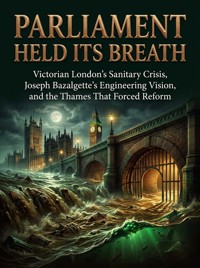
In the summer of 1858, the River Thames became unbearable. London's Victorian parliament suspended debate not over war or revolution, but over the stench rising from millions of tons of human waste — and that moment of institutional paralysis became the catalyst for the most consequential urban engineering project of the 19th century. For decades, London's explosive population growth had overwhelmed a medieval drainage logic built for a city a fraction of its size. Cesspools overflowed into streets; waste ran openly into the Thames, which simultaneously served as the city's primary drinking source. Cholera epidemics had already killed tens of thousands. Yet political inertia, jurisdictional fragmentation, and the Victorian reluctance to spend public capital on the poor kept intervention dormant. The Great Stink of 1858 dissolved that inertia — not through reasoned debate, but through the sheer physical force of civic disgust. Joseph Bazalgette's response was not merely technical. His system of 1,100 miles of street sewers, 82 miles of intercepting mains, and tidal outfall stations at Barking and Crossness represented a new theory of government: that modern states bore responsibility for the invisible infrastructure sustaining urban life. What emerged from the crisis was not only London's sewer network, but a template replicated across European capitals — from Paris to Berlin — redefining the boundary between public health and sovereign duty.
Ebooka przeczytasz w aplikacjach Legimi na:
Liczba stron: 231
Rok wydania: 2026
Odsłuch ebooka (TTS) dostepny w abonamencie „ebooki+audiobooki bez limitu” w aplikacjach Legimi na: