alicja_koziol
Thank you ❤️❤️❤️
Uzyskaj dostęp do tej i ponad 240000 książek od 14,99 zł miesięcznie
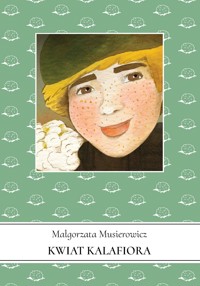
Gabriela Borejko is by no means an ethereal beauty like her younger sister Ida. She doesn’t daydream like her father Ignacy, and she certainly doesn’t see herself as future Mother of the Year. She loves sports, is full of energy, and firmly believes in the power of a smile.
When the Borejko family’s world suddenly falls apart and, due to her mother’s illness, the household responsibilities fall on Gabriela, the carefully ordered and well-planned life of the young girl urgently needs a complete overhaul. Fortunately, she can count on the support of her friends: Danka, Aniela, and Robrojek.
Kwiat kalafiora was included on the IBBY Honour List in 1982.
All volumes of the Jeżycjada series are available exclusively on Legimi. Read and listen with Synchrobooks®!
Ebooka przeczytasz w aplikacjach Legimi na:
Liczba stron: 307
Rok wydania: 2026
Odsłuch ebooka (TTS) dostepny w abonamencie „ebooki+audiobooki bez limitu” w aplikacjach Legimi na:
The dress was pink.
In its folds and seams, the material shimmered delicate and gold. At the bottom of the skirt, an ornament of fake diamonds showered iridescent sparks. It hung on a glaucous mannequin in the display window of the Telimena House of Fashion on Red Army Street in Poznań.
Generally speaking, creations of that kind do not appeal to ladies of refined elegance. But Ida Borejko was not among their number. She was fourteen years old, thin, red-haired and dressed in an overlarge coat inherited from her elder sister, Gabriela.
— I wish, said Ida Borejko with an ardent voice — I wish I was a brunette. She pressed her nose to the display window of the Telimena House of Fashion and devoured the wondrous shiny pink garment with her eyes. — If I were a brunette, she added — I could paint my lips cherry red.
— But as things stand, you’ve got no chance, observed Gabriela, a tall, good-looking seventeen-year-old sportswoman with incredibly long legs. — Ida, child, we’re going. I’m hungry as a jackal.
— But just look, Gabby…
Gabby looked and shrugged her eyebrows superciliously. They were wide, adamant brows, seemingly made to be superciliously shrugged. Beneath those brows shone intelligent brown eyes of resolute gaze, and it all belonged to a florid, thoughtful and quite heavily freckled face. Gabby was dressed in worn Odra jeans and a khaki jacket, with a felt beret of indistinct colour pulled down any old how onto her skew-cut blonde thatch. She looked like a large unkempt boy. She was not a fan of elegance, as anyone could tell at first glance.
— Okay, enough! she said with a strong, despotic voice, before tugging at the handle of the shopping-bag. The other handle was held by the wide-eyed Ida, for whom that tug came as an unpleasant surprise. She barely kept her balance, and at the same time, forced into a trot, was already running after her elder sister, who was marching with large, even steps towards the crossing.
— What?! What?! shouted Ida peevishly. — What are you in such a hurry about?
— I’m hungry, I said. Fiendishly hungry.
— If I were you, I wouldn’t eat so much, the riled Ida nettled her brutal sister. — If I were you, I would try to stop growing.
— Why on earth should I? asked Gabriela, keeping up her regular tempo. — If I was shorter, I wouldn’t be able to play basketball at the AZS.
— Did we buy eggs? Ida remembered.
— Yes, we did. Don’t mention food, or I’ll faint. Okay, come on, let’s get a move on! Gabriela hastened her steps even more and dragged her sister to the crossing of Red Army Street and Tadeusz Kościuszko Street.
At exactly the same moment, a very tall, broad-shouldered, dark-haired young man with steely eyes, a Roman nose and the dangerous smile of a notorious skirt-chaser set off from the opposite side of the road. He was a handsome, self-confident young man, which might have made his behaviour seem all the more odd, when — borne on the wave of crossing pedestrians — he suddenly bumped into Gabriela and stood eye to eye and nose to nose with her.
— Ugh! Was the fearful exclamation that escaped his lips, and his face paled.
The startled Gabriela stood for a moment immobile. The eyes of her younger sister, who was hanging onto the shopping bag, suddenly ignited with that curiosity which is characteristic of younger sisters.
— You, you… Gab… Gabby? the dark-haired young man dully enquired.
Gabriela was as far from any romantic abashment as Siberia is from the Riviera. — Are you blind, or what? She asked to the point.
— Listen…
— No way, retorted Gabriela emphatically. — Oh, no. And if you try anything else, this time you’ll kop it, you have my word.
— Gabby… started the dark-haired young man, regaining some of his composure. — Let me explain.
— Listen, old boy, she exclaimed, with a voice like a razor. — I don’t need anything explained to me. I’m intelligent and I understand at once. Forgive and farewell. The green light is flashing.
— Gabriela!
— So long, old boy. See you at some training session. And leave me alone, once and for all, said Gabriela mercilessly, and, tugging at her handle as if it were a harness, she pulled Ida so hard that the poor thing’s red fringe fell over her eyes.
They crossed onto the other side of the road and walked on in the direction of the dark stone hulk of the Palace of Culture.
— Gabby, who was that? Please, tell me, who was it? wailed Ida. Unable to squeeze a reply out of her obstinately silent sister, she continued her enquiries: — Someone you know? From the AZS? Are you angry at each other? Please, say!!!
— Someone I know, grunted Gabriela, to lay the matter to rest. She was vexed. — Some guy. Called Pyziak.
‘Julian Pyziak’, she thought, and the anger she’d felt a moment before shook her again. Pyziak (aged eighteen, six feet tall) was a star of the junior men’s team. He was famed for his reliable throws. A basketball match without him usually ended in crushing defeat. Well, one September evening, this basketball star had turned his gaze to Gabriela. It was a beautiful evening, and Julian Pyziak walked Gabby home after training, taking a somewhat circuitous route. Despite the gloom, he looked unstintingly into her eyes and said that she reminded him of apple blossom trembling in a light spring breeze. This metaphor made a remarkably strong impression on Gabriela until the next training session, when, having confided in a team-mate, she heard that she too, about a month ago, had been compared by Pyziak to apple blossom. When arraigned before the entire junior women’s team, Pyziak’s metaphor turned out to be a well-worn platitude: four different girls had been apple blossom for the valiant basketball player, whilst two had been compared to violin music. That evening, the female team’s changing-room resounded to thunderous outbursts of laughter, and the ignorant Pyziak, on suggesting to Gabriela a walk around the park, was berated, shown up, scolded like a child and categorically shunned for good. Subsequently ridiculed by the whole junior women’s team without exception, he skipped training for three weeks on those days when the boys’ and girls’ teams trained together in the gym. After three weeks, he regained his sang-froid and returned to training, but he avoided Gabriela like the devil shuns holy water.
And then today he just happened to bump into her at a crossing!
The poor little thing…
Gabby smiled with concealed satisfaction, recalling the discomfiture of that mendacious brute, and she slowly reached the conclusion that there was no reason to be upset, and that today’s encounter had even been quite amusing.
2
It was the last afternoon of 1977.
Gabriela and Ida were wandering with their shopping through the streets of Poznań, and around them, in the grey air, the heady fluids of New Year’s Eve were rising. The restaurants and cafés, the after-school and student clubs, the conference halls and the canteens of schools, companies, the Polish Army, the Health Service, the Civil Militia and its Voluntary Reserve, numerous classrooms and all other suitable venues were decorated with pale streamers of rather dubious provenance, polystyrene clocks showing the obligatory time of five to twelve, humorous paintings with a sentimental or frivolous subtext, frightful chimney-sweeps with their brushes, and also gigantic cardboard masks, smeared with black poster paint and sprinkled with glitter. The shops had sold huge quantities of alcoholic drinks and Pepsi Cola, fish in aspic, meat loaf and ready-made salads. Everything was agog in anticipation of an exhilarating night. Thousands of preoccupied citizens of the People’s Republic of Poland tramped along the pavements and roads of the city, choking in clouds of bluey, black and brown exhaust fumes, lugging packages, shopping bags and bottles in their cold stiff hands. Bubbling streams of cash flowed into the shop tills, increasing the general ado. Dantesque scenes were played out inside and outside hairdressers’ salons. Elsewhere, a new consignment of champagne was delivered, causing an eddy with several epicentres to form at once on the pavement. Passers-by had a feverish gleam in their eyes — a mixture of predatory arousal and hope at reversing the current of everyday mediocrity, with the assistance of New Year’s Eve madness.
Yes, there was certainly something in the air that afternoon.
Even Gabby remembered she had been invited to a party. The invitation had come from Joanna, a cousin who always called Gabby a few days before a planned soirée. Unfortunately, those soirées and parties were usually so exclusive that Gabby seldom attended, as she simply had nothing to wear. For instance, if she had decided to go to Joanna’s this evening, her choice would have been between her wholly unpretentious Odra jeans and her navy blue school skirt, already a little too short.
A person’s attitude towards material goods and consumer products is not always a matter of whim. When, for example, one is part of a ‘social cell’ with multiple children but a modest income and an extremely reckless attitude towards it, one is wise to adopt a dismissive, even haughty, attitude towards such goods. And that is just what Gabriela did. In addition, such an approach was very much suited to her nature, which was devoid of coquetry and marked by a certain nonchalance. Gabby was wholly content both with her family and with her situation in life. And besides, she never had any intention of going to the party. She meant to stay at home and revel in Aristotle’s Physiognomy, borrowed from her father.
3
— ‘Small eyes mean a small soul, by congruity and on the evidence of the ape’, Gabby read with relish. She knew of no more pleasant way of reading than lying prostrate, though a rolled-up pillow should be placed beneath the chin to prevent one’s neck from going numb.
Ida was looking for something in the wardrobe and reacted at once.
— You watch out! Or I’ll tell you what I conclude from your example! Mum, Gabby’s taunting me!
— Gabby, don’t taunt Ida, mum Borejko uttered mechanically, passing through the room with the vacuum cleaner. The mother of four daughters, each of whom had a highly distinctive personality, Mrs Millicent Borejko only maintained relative mental equilibrium thanks to a special system elaborated over long years of training. She registered all conflicts between her daughters on a superficial level only. Otherwise, she would have been simply unable to survive in such a scrum.
— Well I never, she can’t tell Aristotle from a taunt, laughed Gabby, and her words passed through the upper climes of her mother’s awareness, going in one ear and out the other.
Ida snarled with anger, slamming her fists into the wardrobe. When she was angry, her eyes were like green electric lamps, and her hair, resembling disorderly coils of copper wire, seemed to spark spontaneously. Two of the Borejkos’ daughters were redheads: Ida and Natalia. The other two, Patricia and Gabriela, were blonde, like their mother. As for their redheaded dad (whom the years had turned greyish), he considered that four daughters were quite enough for one father to cope with, and it was just as well that they were not four ginger daughters. Fate — averred dad Borejko with characteristically philosophical urbanity — had mercifully refrained from adding a monotony of colouring to a monotony of sex. In actual fact, each of the daughters had a different coloured head. Gabriela was distinguished by a luxuriant skew-cut, light ashen head of hair. Ida was as red as a squirrel, whilst little Natalia termed herself an ‘orange blonde’, which was an accurate description: her hair was precisely the colour of carrots. The youngest, Patricia, was just like a Baroque cherub, hewn from pink alabaster, and accordingly she had twisting gold locks around her chubby little face.
— Ha!!! Ida suddenly yelled shrilly. — Excuse me for disturbing the peace, but someone’s been at my tights again!
— ‘A soft, languid voice means gentleness, as in sheep; a shrill, shrieking voice, lewdness, as in goats’, read Gabby with genuine pleasure.
— Listen, you miserable goats, where’s your father?
— Our miserable father is in town, together with our miserable sisters, replied Gabby, browsing Aristotle. — They’re trying to buy sausage.
— The man’s gone mad, stated mum tersely. — The children will get trampled in the queue.
— Our miserable father will not stand in the queue, explained Ida. — Pulpy is the only one who can conquer the crowds. She had in mind the five-year-old Patricia, a sweet little infant with a steely character — a typical product of the seventies. That product could burst into tears at will when a queue, pressing in serried ranks towards the counter, demanded that no senior citizens, pregnant women or invalids with children be allowed to join it. At such moments, the battle-hardened sweetie would sob so convincingly that the disconcerted queue would fall silent and issue no more cries about a big girl who certainly had no need of being held by the hand, but on the contrary could queue by herself for brawn and liver sausage.
— The vacuum cleaner’s broken, stated mum with irritation.
Gabby raised her eyes above her book, as a note of curious vexation had resounded in her mother’s voice. There was also something disturbing about her appearance. Mum had always been short and very slim, but today she seemed even more haggard. And out of sorts as well. Mum was a little over forty, but looked older, as her face bore traces of all the troubles and cares that she barred from the depths of her consciousness. In her face, only the eyes were young: they shone with a kind, good, bluey gaze; indeed, mum was a kind and good person, though just incredibly overbearing. She was a little domestic tyrant, full of concentrated energy, forever busy with something and unswervingly devoted to her large family.
All the more unusual was her apathy today, since an attitude that in someone else might have been interpreted as a normal state, with mum signified apathy and torpor. Sighing and rubbing herself around the stomach area, mum Borejko stood idly in the middle of the room and gazed at the hoover. Eventually, she gave herself a shake, took a book from the table, checked its title and turned over a few pages.
— Who bought this? She asked.
— What’s that?
— The Second and Third Youth of a Woman.
For a moment, there was silence.
— Me… admitted Ida at last, hemming and hawing with embarrassment.
Gabby giggled, then set her chin on the pillow.
— ‘Buttocks pointed and bony’, she started out loud.
— Mum, now you’ve heard it for yourself — that shrew keeps belittling me.
— Gabby, don’t belittle.
— Aristotle! Tell her, mum, that she’d be better off reading physics, or she’ll never get a pass.
— Gabby, you’d be better off reading physics, said mum. — Or you’ll never get a pass. She sighed and grimaced in pain. — What the devil? Somehow I’m feeling lousy today. Listen, why doesn’t either of you know anything about electricity? Why do I have to stand in the middle of the room with a broken vacuum cleaner?
— Because you’ve not plugged it in, guessed Gabby like lightning, though she had fail marks in physics and a loathing of electrical currents.
Mum glumly realised that Gabby was right, before going into the next room to turn the vacuum cleaner on at last. But having got there, she immediately forgot about it and sat down in an armchair, clutching her belly.
Silence fell on the Borejkos’ abode.
It was also growing quiet outside — slowly, but surely. The darkness on the streets became more opaque, taking on navy blue tones. Not even the pale street lights could illuminate it, as around the turn of 78 the whole country was economising on electrical energy. The room occupied by Ida and Gabby, by contrast, was fair flooded with light. That room had green walls, although one could hardly tell through the patina of the years. It was a narrow, high-ceilinged room, furnished without conviction. It contained two divans, a three-door wardrobe, a big desk, a table and two upholstered chairs — all in the characteristic style of the 1950s, esteemed by connoisseurs. The Borejkos’ old four-room flat had been almost entirely crammed full with these furnishings. Here, in one of their three rooms in a respectable bourgeois tenement house from 1914, that furniture flaunted its paltry charms quite shamelessly.
The Borejkos had moved here not two months before, succumbing to the urgings of their old acquaintance Mrs Trak, who, after her husband’s death, had decided to move to a smaller and more comfortable flat. Light-headed as usual, the Borejkos agreed to a swap, excited at the thought that the rent in that old council-controlled flat was much smaller than what they had to pay in a housing association flat. In that respect, they won. But in all other respects, they were hoodwinked, though that was a relative deception insomuch as the Borejkos simply did not consider themselves to be victims. The flat had tile stoves, for which coal had to be acquired by ruse and by blackmail, then tipped into the cellar and brought up to the flat every day by the bucket-load. Yet for the Borejkos this drawback was merely a source of consolement and delight. Could there be anything more delectable than a warm stove made from beautiful old tiles, to which one could press one’s back so blissfully on a frosty winter’s eve? These irremediably impractical tenants evinced a similarly warped view of reality with regard to the bedraggled heater in the bathroom, which threatened to explode (but which, in their opinion, was an exquisite brass relic of the German Secession), the rotting floorboards, which required continual waxing (but how nicely they creaked underfoot!), the ceilings with their dust that settled spitefully on the plaster stucco and garlands (but how delightful to wake up in the morning and see above one’s head something so different to a reinforced concrete ceiling with sewage pipes!) and so on, and so forth. A further shortcoming to the flat was the fact that it was probably last renovated in the twenties.
No immediate change to the renovation situation was foreseen. Mr Borejko, a classics scholar and library specialist, was the last person who might make a fortune. Mum had given up her office work after giving birth to Natalia and devoted herself solely to their home and to bringing up their daughters, sewing together sweaters and hats on a knitting machine, as she was commissioned to do by the ‘Dawn’ Workers’ Cooperative — a form of employment that, although it did not overly inconvenience her, was by no means lucrative. Happily, the Borejko family was so tired of cooperative housing estate concrete that everybody liked the new flat, even in its present condition. Moreover, even people more practical than these fantasists liked it. Everyone who spent even just half an hour in it left fully appreciative of its cosiness, beauty and indeterminate charm, as if every nook was alive. What people did not realise was that any flat inhabited by this family would have possessed similar characteristics, and that the sense of cosiness was by no means engendered by the furniture or the carpets. One felt cosy quite simply with these people — not wealthy, not practical and utterly devoid of pushiness. That was why guests would always sit longer at the Borejkos’ than they ought, and some of them would sit until late in the night, although often the only victuals offered up for consumption were tea with bread and jam.
Indeed, the fact that there was more room in the new flat, and that at last they could invite all the guests they wanted to see, was for the Borejkos a source of constant delight. And that could be felt.
4
Gabby made herself a snug little nest on the divan out of a blanket, pillows and a large woollen shawl. Lying there blissfully, she switched between reading and looking at her sister, who was standing in front of the mirror on the wardrobe door and wriggling as if a cockroach was crawling around her waist. She bent this way and that, made turns and bows, pulled faces and fluttered her eyebrows. Gabriela smiled indulgently. Staring into a mirror — a strictly practical activity, which a rational person limits to the few most essential moments — clearly seemed fascinating to the loopy young Ida. If only she were beautiful at least! But no. Gabby was very fond of her sister’s flat, thin face, round as a plate, with its upturned nose and its ruddy brows. But she couldn’t claim it to be a pretty face, although the freckled teenager did everything she could to achieve that effect. Now, for example, she was smearing her freckles with lotion, and covering the skin around her eyes with a generous amount of sparkling green ointment.
— Treasure, said Gabriela, concealing a smile. — What’s this sudden eruption of elegance? Are you off out somewhere?
— Certainly, muttered the treasure. — To a party at Joanna’s.
— Aha… to Joanna’s… for a party… Gabriela’s remark seeped out. — Hey, listen to this: ‘Hair on the nape of the neck indicates liberality, as in lions’ …wait a minute, she suddenly realised. — What do you mean: to Joanna’s for a party? It was me who was invited!
— Yes, but you’re not going, sighed the vexed Ida, and she hissed, because the green ointment had suddenly run into her eye. Poking under her eyelids and blinking heavily, with her eyes watering, she zipped up the velvet dress handed down to her from Gabby.
— How do you know I’m not going, you cherry brunette? How do you know, I’d like to ask?
Ida turned away from the mirror and sniffed with contempt. Her worldly woman’s pocket arsenal contained a plentiful store of such scornful grimaces. She practised them every day in front of the mirror, in case some enchanting, but importunate, brute chose to bother her on that particular day. Now she was practising that haughtiness on her sister — without difficulty. Although she regarded Gabriela as an imposing creature in every respect, Ida secretly suspected that her elder sister had not a single female hormone in her body. To neglect oneself to such an extent! To never wear make-up! Never a manicure! To bawl in the street at such a handsome boy as Pyziak! Ida already had not just a discreet manicure, but also a discreet admirer, by the name of Will, who, paying no heed to her fickleness and cruelty, willingly subjected himself to her delectable tyranny. This subjection was expressed in numerous acts of self-sacrifice, such as lugging coal from the cellar, taking out all the Borejko family’s rubbish when it was Ida’s turn to do it, doing all the harder homework for her, and standing in various queues for everything.
— My poor Gabby, said Ida, seeing that her carefully elaborated facial expression was making not the slightest impression on her sister. — You don’t have to be Aristotle to see when a woman is getting dressed for New Year’s Eve. You’re not getting dressed. Firstly, you’ve got no one to go with. And secondly, you’ve got nothing to go in.
— My poor Ida. You’re mature beyond your years. I wonder what that’s got to do with hairy legs.
— Clearly nothing. Look at yours. Ida, content with her witty and lightning riposte, felt in sufficiently good spirits to give Gabby some good advice. She smacked her lips reprovingly and said: — You’re silly not going. Today on the stairs I met that blond from the first floor who’s in your class.
— Ah, Paul, mumbled Gabby.
— He told me that he’d be at Joanna’s. They know each other. I think he’s lovely.
— Yes, said Gabby. — Lovely. Lovely like rice pudding and jam.
— Shame you don’t like him. Luckily, I’m just his type.
— If you ask me, every girl is his type. Whereas he is the type of a certain Dana.
— From your class? asked Ida forlornly.
— Yes. You’ve got no chance there, Ida, my child. You’re better off loving Will.
— Be that as it may, I’m going, said Ida Borejko resolutely. — Paul told me that he drove his Fiat to Joanna’s today; he’s got a Fiat Mirafiori… and he helped her to do the shopping. Apparently, she’s already baked a yeast cake with crumble — two big tins. There’ll be loads of other sna…
— What’s the time? asked Gabriela abruptly, leaping to her feet with one deft movement.
— Um, late already, late. Nearly seven.
— Well then wash off that make-up. You’re staying at home.
— Who, me? Mum!
Mum rushed in.
— Who’s beating whom and for what?
It was explained to her what had happened, and without a moment’s reflection mum issued her verdict:
— Gabby’s going. Ida’s staying. No protests, please.
— Mum!!
— I said no protests. Under-aged schoolgirls don’t go around private parties. Gabby, come to think of it… why don’t you go to them either?
— Well, because I’ve got no togs, explained Gabby indulgently. — But that doesn’t matter, today I’m not bothered about it, as I’m going just for the cake.
— Gabby, what do you mean? What do you mean you’re not bothered? That’s abnormal. My dear girl, you must, simply must turn yourself into a romantic butterfly this evening. And I’ll tell you just how.
— Not fair! muttered Ida. — I’ve already arranged with Will!
— Oh, darling, how nice. I like William, though he gets the hiccoughs too often. Poor child, why is he so afraid of me?
— Because you’re a fearful despot!
— Invite him anyway. We’ll all sit by the television, and at ten past twelve William will go home.
— I don’t like that proposition. And Will won’t like it either.
— But that’s the only one there is, said Mum, with a steely voice, and Ida, mumbling angrily, refrained from resistance.
5
At precisely seven o’clock, a breathless dad Borejko returned from town with his breathless daughters, Natalia and Patricia. The television in the green room was turned on. The bedtime story was just beginning. The two florid girls — the seven-year-old Natalia, thin as a lath and known as Nutria in the family on account of her impressive upper incisors and her passion for getting wet, and the five-year-old Patricia-Pulpy — sat down in front of the screen without even taking their coats off. They needed complete and exclusive attention to follow the adventures of a certain friendly mole.
— He’ll go into that hole, fluttered Nutria, quivering with excitement, biting her nails and dilating her luminous grey eyes.
— He won’t, he won’t, Pulpy asserted with Olympian calm. Her sky-blue eyes, hidden amidst folds of puppy-fat, shiny round dimpled cheeks and extra dimple in her chin all exuded healthiness, strength and unalloyed good cheer.
— Look, look, they’re torturing him! cried Nutria, holding tight to her little sister’s hand.
— What are you worried about? Look, he’s not worried.
— But…
— You worry, and he always copes, soothed Pulpy, sitting plumply on the divan like a little pink Buddha.
Nutria was nervous. She cried for unknown reasons, and her mood swings were familiar to the near and distant family, since feigning good cheer in moments of depression was a ruse entirely foreign to her candid nature. The pyknic Patricia was the embodiment of calm. As for her, the TV mole could have been quartered and marinated in vinegar and she would doubtless have taken it with a little chagrin before immediately turning her attention to the lighter sides of life.
Luckily, that evening the mole somehow pulled through, the story came to an end, and the whole family cried ‘Off, off!’, and induced Nutria and Pulpy to leave the green room. They doffed their coats, boots and hats, put everything in order in the corridor and went to wash their hands — an activity that was always prompted by Natalia.
It was high time, as the kettle in the kitchen began to whistle. Father turned off the gas flame beneath it and continued his chat with mum, who was preparing supper. While they talked, he looked at her small worn hands, every movement of which was deliberate and precise. Mum sliced large quantities of bread, spread them with vegetable butter and cottage cheese, put slices of sausage on top and garnished the whole thing with a generous sprinkling of spring onion and cumin. And while doing so, she looked tenderly at her husband, who was leaning against the wall by the kitchen table and telling her about his day at work, at the same time as nibbling on bits of this and that. Father Borejko was a hunched and greying redhead with warm brown eyes and a subtle smile. His innate melancholy, honed over the years, was shrouded in a veil of cogitation, enabling him to isolate himself within a protective envelope from the ocean of femininity that surged through the home. He had long preferred to keep a sage silence, and if he spoke at all, it was as if to himself, without paying particular attention to whether anyone was listening. He weathered stormy arguments with the calm of a true philosopher, and if needs be he would simply leave the path of the blizzard. But whenever none of his daughters happened to be fizzing with life in the vicinity, dad would become more loquacious. And this was just such a moment, as the little ones were in the bathroom and the big ones in the green room, where Ida was sulking and Gabby was looking through her wardrobe, only to state a minute later that she manifestly had nothing to put on, unless she went to the party in a white blouse and navy blue skirt. ‘And that’s just what I’ll do’, she thought. ‘What difference does it make what I’m wearing while I’m eating all those tasty titbits?’
6
There was always a dearth of tasty titbits in that home. With the budget stretched to the very limits, and given the unconstrained mania for purchasing books, to which all the literate members of the family succumbed, the situation was inevitably drastic. Admittedly, at times of crisis, the library was purged, and parcels of unwanted books were taken to the second-hand bookshop on the Old Market, but the sums obtained from those sales were never too high. Mum displayed miracles of ingenuity to render their qualitatively modest nourishment high-calorie and high-protein, filled with vitamins, but she did have bouts of rebellion and demonstrated to the father the senselessness of buying, for example, a Polish translation of Plutarch when the original stood on the shelf. She suggested that instead of making such rash purchases, he buy some chocolate for their daughters. Father replied that for one thing there was no chocolate to be had and for another, by its very nature, it served solely rapid digestion, whereas the translation of Plutarch would mature on the shelf, waiting for the girls to grow into reading it. Mum fell silent, as in her heart of hearts she admitted father was right. As a result of this policy, the Borejko girls were intelligent, full of an erudition that was startling for their age, and apt to cast quotations and aphorisms at one another quite freely; but in terms of consummate urbanity they were lacking self-control at the sight of anything edible, particularly anything containing chocolate. Some frightful scenes would occur.
Today’s supper was also devoured at a staggering rate. In this home, no one pulled faces while eating, since one of the sisters might well have taken care of the grimacer’s portion. And no one talked while eating, so as not to lose valuable meal-time. Conversation broke out at the moment the last sandwich disappeared from the plate, and today it was mum who was the first to say something, declaring that she would instantly knock up a dazzling New Year’s Eve creation for Gabby.
Mum’s concept was based on the use of a delightful yellow cotton curtain, adorned with bobbin-lace. Once they had moved home, this curtain had shared the fate of all the others brought by mum from the previous flat. They lay at the back of a wardrobe, as they were too narrow, too short and generally too small for the large, tall windows of Mrs Trak’s apartment. But now the gratifying moment had come when one of the curtains awaiting a better fate met its destiny.
Gabby was amused and somewhat irritated. At first, she protested that there was no way she was going to make a fool of herself and commit Scarlett-O’Hara-style plagiarisms, but later, at the sight of the soft thick yellow-coloured velvet, she piped down and allowed the material to be pinned up on her freckled shoulders.
Her mum was purring with satisfaction.
— Look, it’ll only take sewing up, just on one side… and on the shoulders draping up and fastening with something wooden.
— Nappy-pins, mumbled father from within his mental cocoon, before tittering to himself.
— Struth, I’m making a lunatic of myself, reacted Gabriela to the jibe.
— Nothing of the sort. Stand still. Besides, butterflies don’t say ‘struth’. Gabby, dear child, you have to awaken your femininity and charm. We’ll sew it up here and fasten it here.
— But fasten it well, so it doesn’t fall down, advised Nutria in a bass voice. — ‘Cause if it falls down, everyone will see that Gabby’s wearing a dirty vest underneath.
Nutria had plenty of pet notions, among which a craze for hygiene was to the fore, comparable only to her remarkable obsession with gender. In her early childhood, Nutria had got two crazy notions into her head: firstly, that dirt gives you holes in your skin; secondly, that she was a boy. Now aged seven years and five months, she may perhaps have had different opinions on the subject, but there was nothing to suggest that she had. She still spoke of herself only in the male form, and always in a contrived bass voice, and she manifested a fondness for cars, soldiers and football. In addition, she could bathe five times a day and never had enough of that pleasure.
— But didn’t I say? she asked now in her thick bass. — I’ve been telling you since the morning to put a clean vest on.
— What do you mean? What do you mean? This one’s not dirty at all, countered Pulpy. — Gabby looks lovely. Lovely.
Suddenly, Ida piped up.
— I always wear clean linen, ever since I met Will, she explained dreamily, much to her parents’ consternation.
Gabriela declared proudly that for one thing her vest was by no means dirty, merely a little worn. Secondly, that wear and tear was characteristic of everything. Thirdly, there weren’t any clean vests, since Will’s goddess allowed herself a variety of dirty fiddles.
Mum turned her eyes to the ceiling and issued a briefing about a refined woman’s vests.
Gabby stressed firmly that she had no intention of being such a woman, but at the same time she promised to think over the question of vests.
Father said that nihil semper suo statu manet and phlegmatically lit a cigarette.
As for Patricia, immersed in admiration for Gabriela, she spilt a whole mug of tea over her father’s knees.
And at the door, the bell rang.
7
Father opened.
On the threshold stood a stiff-looking lady aged around sixty. She was grey, meticulously permed, and dressed in a white blouse with cuffs and a tweed suit in refined shades of beige. First she looked at Mr Borejko’s wet trousers; she had round, black eyes, with an immobile, somewhat wild gaze.
— I am your neighbour, she stated coldly. Her admission was confirmed by the door to the neighbouring flat, which stood ajar. Situated at right angles to the Borejkos’ flat, it had once been part of it, and probably served as servants’ quarters. Since the war, two families had lived there: the Gadomskis and the Łuczaks. The third abode was occupied by this grey-haired lady. All the flats were entered through a shared little vestibule with a cracked linoleum floor. A huge, heavy yellowish door with a brass handle and iron bolts led from the vestibule to the stairwell. Now the door was wide open.
— Yes, madam? asked dad with polite interest. His legs were cold and he had no intention of standing in the draught for very long.
— We don’t know each other yet, said the neighbour. — Szczepańska.
— Borejko.
— I have a request.
— Please, of course.
— That door.
— This door?
— No, this one. With a delicate motion of her thumb, Mrs Szczepańska indicated the yellow door with the brass handle.
— Ah, that one, murmured Mr Borejko. — Well?
— Please close it. That’s all. Keep it closed.
— Oh, said father. — I understand.
— It blows a lot from below, sir. Since that janitor knocked an extra passage through to the cellar.
— Not impossible, agreed father distractedly.
— Ah! the neighbour perked up. — So you’ve noticed it as well?
— Ah! said dad. — No, I hadn’t.
Mrs Szczepańska’s animation crumbled at once. The fleeting expression of comprehension also vanished from her eyes.
— Pity, she said drily. — Interesting that nobody sees it. In this house, strange things are happening, sir. Very strange. I would even say — mysterious. She broke off, waiting for a sign of interest on the part of her new neighbour.
Father sighed involuntarily.
— Of course. Mrs Szczepańska had waited in vain. — So please remember. That door.
— Naturally. That door. Dad bowed awkwardly, not knowing whether the conversation should be considered closed, but assuming that perhaps it should, he made a movement as if he wanted to retreat back into the flat.
— Oh, just a moment, the neighbour detained him in an aggressive tone. That’s not all.
— No? said Mr Borejko resignedly.
— Mrs Trak was a quiet, well-mannered neighbour. Why aren’t you like that?
Father was dumbstruck. Mum, her mouth full of pins, poked her head out of the living room, not believing her own ears.